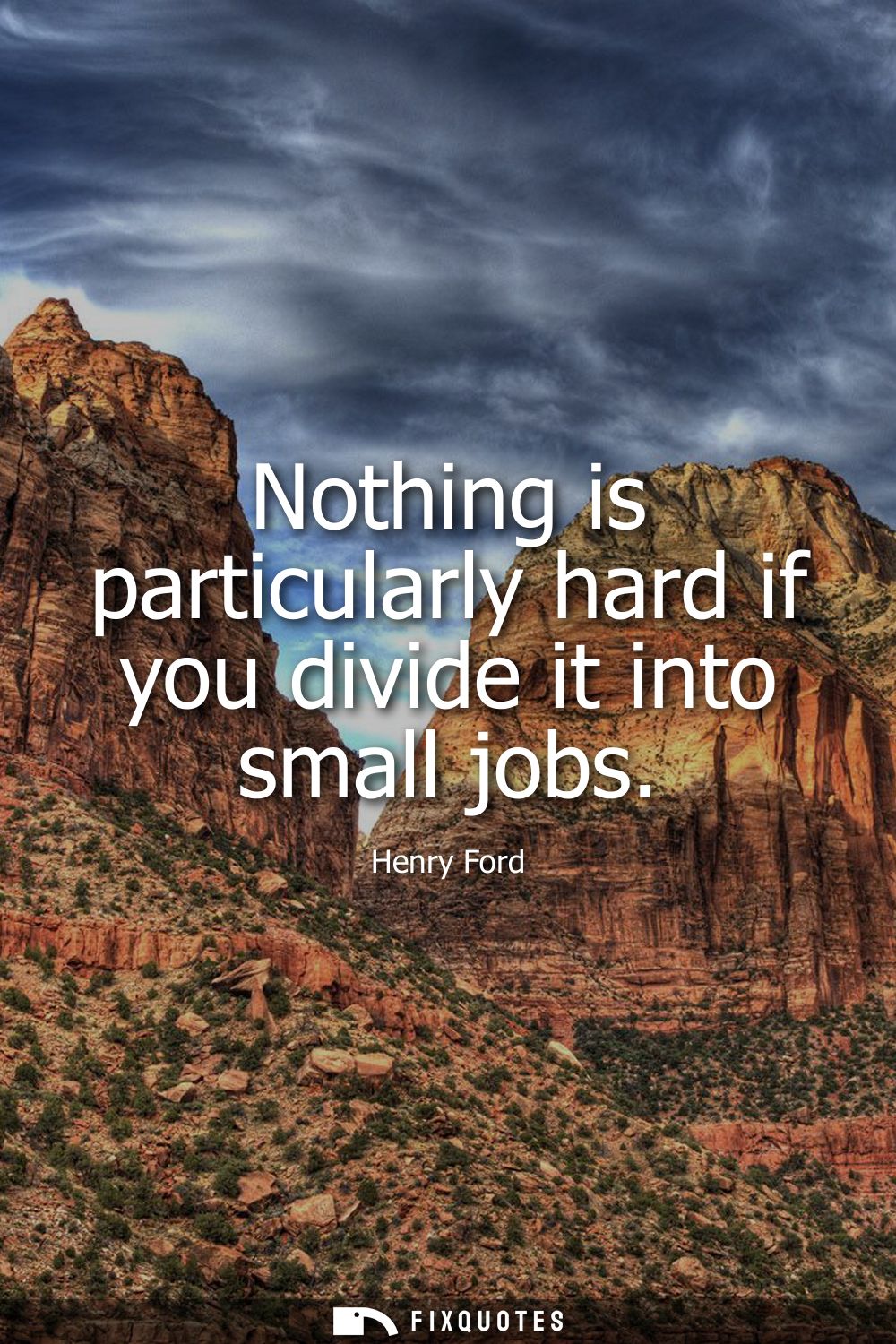
"Nothing is particularly hard if you divide it into small jobs"
About this Quote
Ford’s neat little reassurance doubles as a management doctrine: break the world down until it fits inside a factory shift. “Nothing is particularly hard” is a bold claim from a man who made industrial complexity look deceptively simple, not by eliminating difficulty but by slicing it thin enough to be scheduled, timed, and supervised. The line sells competence as an engineering problem rather than a moral one. It’s optimism with a stopwatch.
The intent is practical, almost paternal: don’t panic, partition. Yet the subtext is more pointed. Division isn’t just a coping strategy for the overwhelmed worker; it’s the operating system of modern capitalism. Ford’s assembly line worked precisely because it took a daunting whole - building an automobile - and converted it into repeatable micro-actions that could be taught fast, monitored easily, and swapped out when labor got restless. “Small jobs” are manageable, but they’re also controllable.
Context matters. Coming out of the late 19th and early 20th century, American industry was intoxicated by “scientific management,” the belief that any task could be optimized into efficiency. Ford’s quote flatters the listener with agency while quietly endorsing a worldview where complexity yields to process. It’s motivational on the surface, ideological underneath: the promise that the modern system can domesticate any challenge, provided you accept its method of fragmentation.
It works because it turns intimidation into logistics - and because it smuggles in a philosophy of work that still shapes how we organize everything from startups to self-help.
The intent is practical, almost paternal: don’t panic, partition. Yet the subtext is more pointed. Division isn’t just a coping strategy for the overwhelmed worker; it’s the operating system of modern capitalism. Ford’s assembly line worked precisely because it took a daunting whole - building an automobile - and converted it into repeatable micro-actions that could be taught fast, monitored easily, and swapped out when labor got restless. “Small jobs” are manageable, but they’re also controllable.
Context matters. Coming out of the late 19th and early 20th century, American industry was intoxicated by “scientific management,” the belief that any task could be optimized into efficiency. Ford’s quote flatters the listener with agency while quietly endorsing a worldview where complexity yields to process. It’s motivational on the surface, ideological underneath: the promise that the modern system can domesticate any challenge, provided you accept its method of fragmentation.
It works because it turns intimidation into logistics - and because it smuggles in a philosophy of work that still shapes how we organize everything from startups to self-help.
Quote Details
| Topic | Work Ethic |
|---|---|
| Source | Later attribution: Stupid, Ugly, Unlucky and RICH (Richard St John, 2005) modern compilationISBN: 9780973900903 · ID: Z6pcKczlylQC
Evidence:
... Nothing is particularly hard if you divide it into small jobs . Henry Ford automobile pioneer If you get overwhelmed by the largeness of some- thing , break it down into manageable components and start doing those . Eve Shalley VP ... |
| Cite |
Citation Formats
APA Style (7th ed.)
Ford, Henry. (2026, February 10). Nothing is particularly hard if you divide it into small jobs. FixQuotes. https://fixquotes.com/quotes/nothing-is-particularly-hard-if-you-divide-it-137514/
Chicago Style
Ford, Henry. "Nothing is particularly hard if you divide it into small jobs." FixQuotes. February 10, 2026. https://fixquotes.com/quotes/nothing-is-particularly-hard-if-you-divide-it-137514/.
MLA Style (9th ed.)
"Nothing is particularly hard if you divide it into small jobs." FixQuotes, 10 Feb. 2026, https://fixquotes.com/quotes/nothing-is-particularly-hard-if-you-divide-it-137514/. Accessed 12 Feb. 2026.
More Quotes by Henry
Add to List