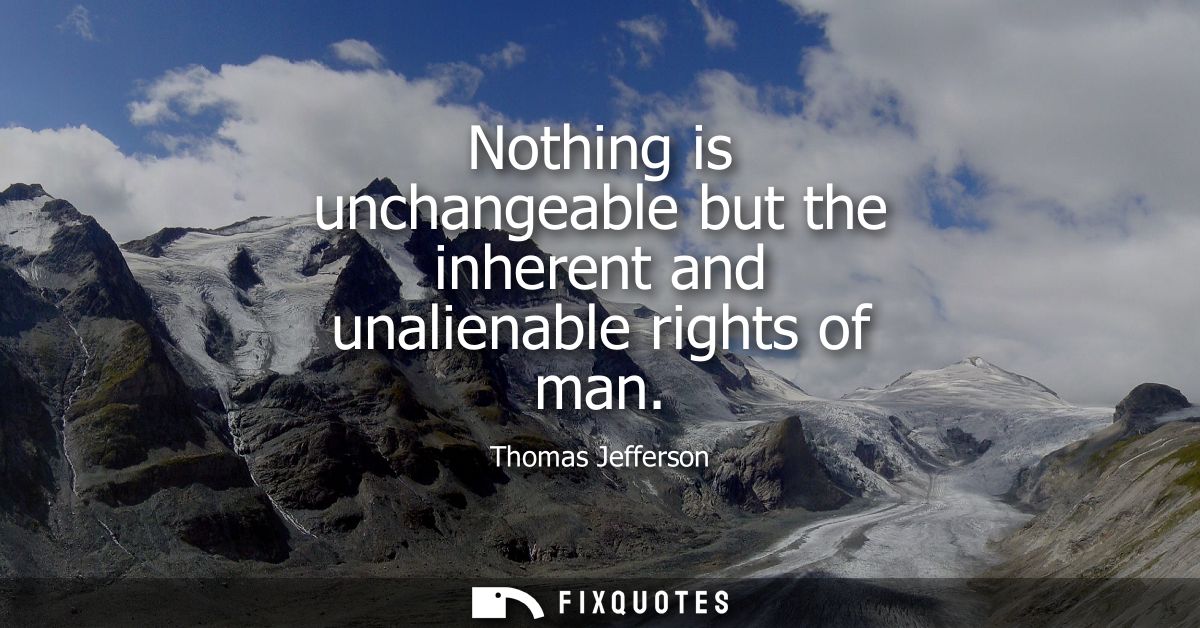
"Nothing is unchangeable but the inherent and unalienable rights of man"
About this Quote
The rhetorical move is also strategic. By declaring nearly everything “changeable,” Jefferson makes revolution sound less like chaos and more like maintenance. Governments are tools; tools get replaced. Rights are the standard; standards don’t. That inversion is the quiet logic behind the Declaration’s more famous charge that governments derive “their just powers from the consent of the governed.” If rights are pre-political, then politics is on probation, permanently.
The subtext, of course, is messier. Jefferson’s own life sits in tension with this claim, given slavery and the restricted circle of who counted as “man” in practice. That contradiction doesn’t nullify the sentence; it explains its afterlife. The line is designed to be weaponized against any regime that mistakes authority for legitimacy, including the one that authored it.
Quote Details
| Topic | Human Rights |
|---|---|
| Source | Help us find the source |
| Cite |
Citation Formats
APA Style (7th ed.)
Jefferson, Thomas. (2026, January 15). Nothing is unchangeable but the inherent and unalienable rights of man. FixQuotes. https://fixquotes.com/quotes/nothing-is-unchangeable-but-the-inherent-and-22045/
Chicago Style
Jefferson, Thomas. "Nothing is unchangeable but the inherent and unalienable rights of man." FixQuotes. January 15, 2026. https://fixquotes.com/quotes/nothing-is-unchangeable-but-the-inherent-and-22045/.
MLA Style (9th ed.)
"Nothing is unchangeable but the inherent and unalienable rights of man." FixQuotes, 15 Jan. 2026, https://fixquotes.com/quotes/nothing-is-unchangeable-but-the-inherent-and-22045/. Accessed 12 Feb. 2026.