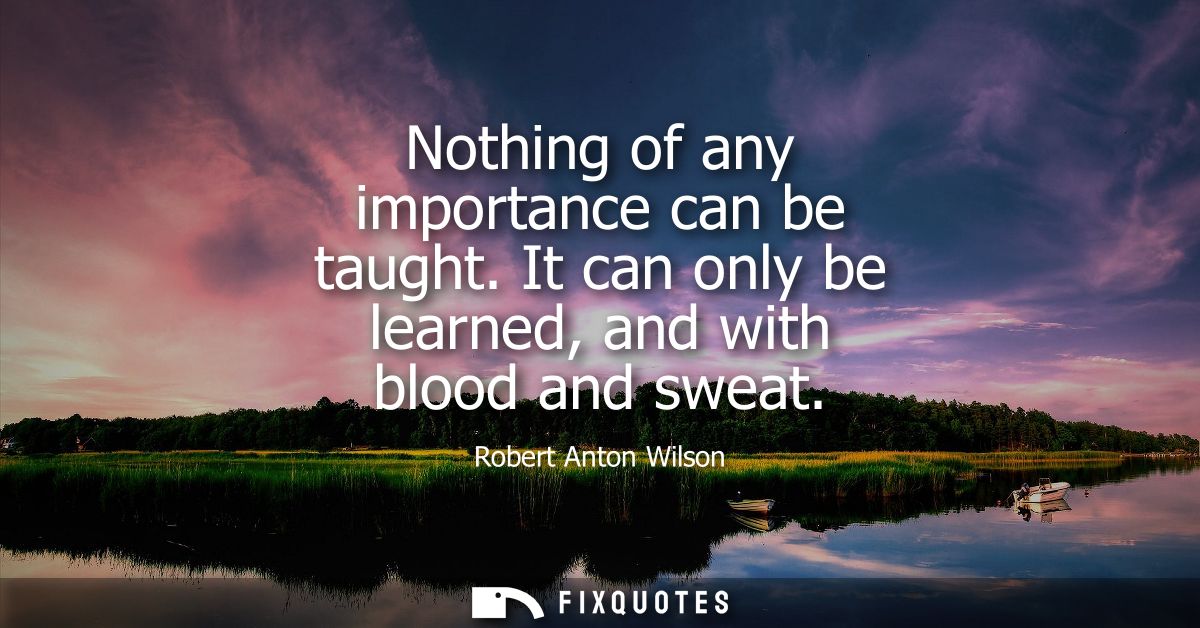
"Nothing of any importance can be taught. It can only be learned, and with blood and sweat"
About this Quote
Wilson is torching the comforting fantasy that wisdom arrives neatly packaged in a lecture hall. “Nothing of any importance can be taught” isn’t anti-education so much as anti-credential: a jab at institutional certainty and the way authority sells secondhand enlightenment. The line lands because it reverses the usual hierarchy. Teachers, gurus, and systems don’t deliver meaning; they can at best stage conditions where you collide with reality and do the metabolizing yourself.
The pivot to “learned” tightens the screw. Learning here isn’t passive intake; it’s adaptation under pressure. “Blood and sweat” is deliberately physical, even grotesque, refusing the clean, antiseptic language of self-improvement. Wilson suggests that the knowledge that counts is paid for: with failure, embarrassment, grief, risk, exhaustion. It’s the kind of education you can’t outsource, the kind that changes behavior rather than vocabulary.
Context matters. Wilson came out of mid-century America’s factories of conformity and into the counterculture’s suspicion of official narratives, then spent a career needling dogma in politics, religion, and science. His work treats belief as a kind of software, dangerously easy to install from authority and painfully hard to debug through experience. That’s the subtext: the “important” truths are precisely the ones power would prefer you absorb as doctrine. Wilson insists you earn them the hard way, because only lived knowledge resists propaganda.
The pivot to “learned” tightens the screw. Learning here isn’t passive intake; it’s adaptation under pressure. “Blood and sweat” is deliberately physical, even grotesque, refusing the clean, antiseptic language of self-improvement. Wilson suggests that the knowledge that counts is paid for: with failure, embarrassment, grief, risk, exhaustion. It’s the kind of education you can’t outsource, the kind that changes behavior rather than vocabulary.
Context matters. Wilson came out of mid-century America’s factories of conformity and into the counterculture’s suspicion of official narratives, then spent a career needling dogma in politics, religion, and science. His work treats belief as a kind of software, dangerously easy to install from authority and painfully hard to debug through experience. That’s the subtext: the “important” truths are precisely the ones power would prefer you absorb as doctrine. Wilson insists you earn them the hard way, because only lived knowledge resists propaganda.
Quote Details
| Topic | Learning |
|---|---|
| Source | Help us find the source |
More Quotes by Robert
Add to List