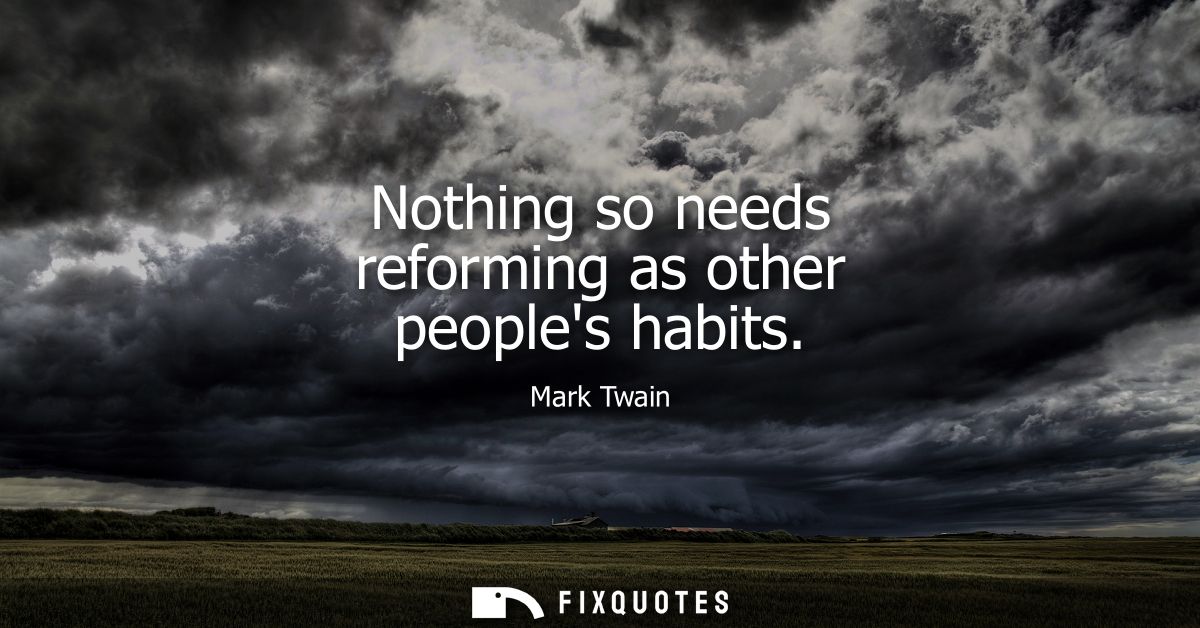
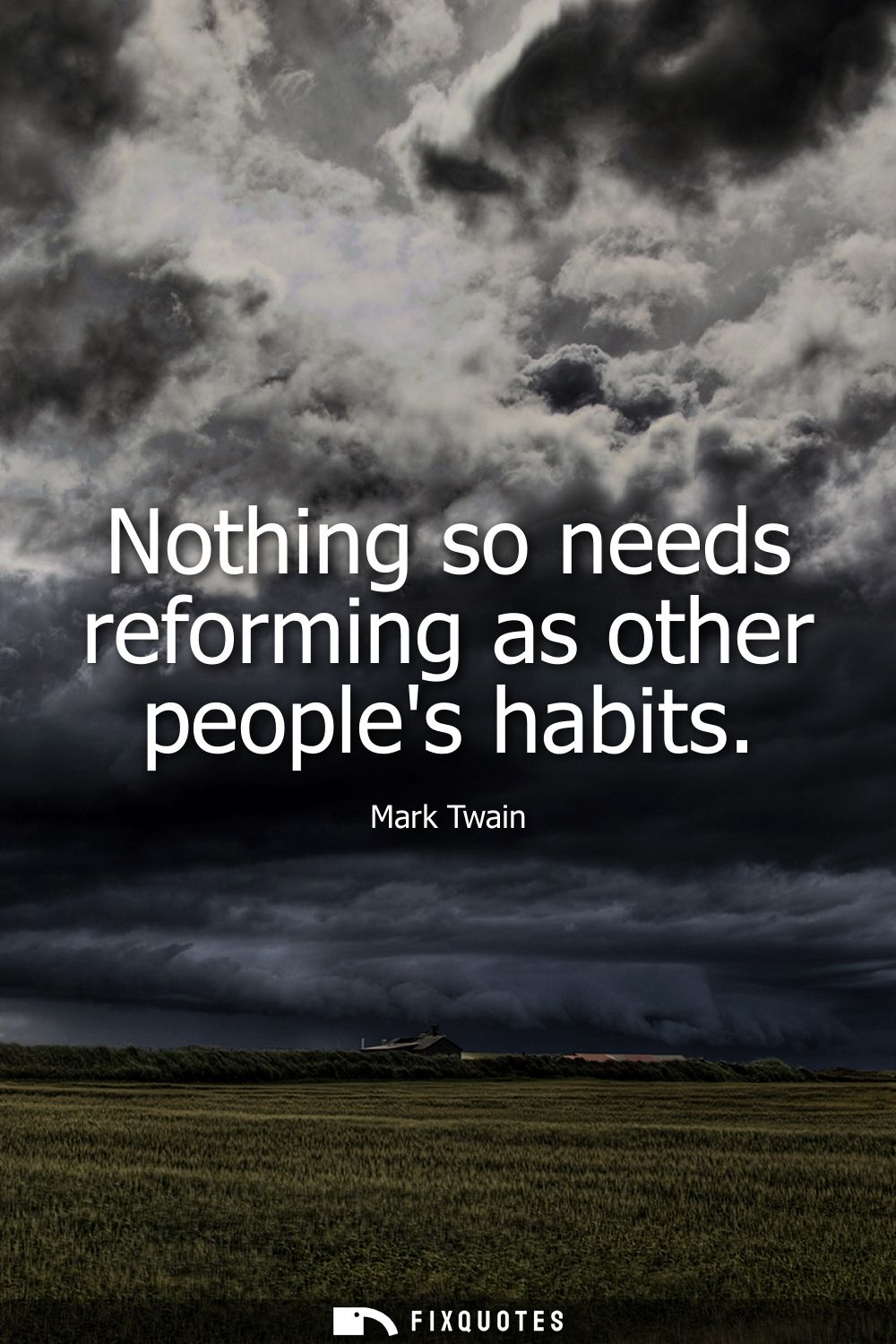
"Nothing so needs reforming as other people's habits"
About this Quote
Mark Twain lances a familiar moral vanity: the itch to renovate the world starting anywhere but the mirror. The line works because it’s built like a confession that refuses to confess. “Nothing so needs reforming” sounds like the opening of a civic sermon, the kind delivered by self-appointed guardians of decency. Then Twain swivels the knife: “other people’s habits.” The punch lands in the last two words, exposing reform as a euphemism for control, and conscience as a mask for irritation.
The intent isn’t to celebrate bad behavior; it’s to mock the reflex that treats personal preference as public good. Twain understood how quickly “habits” become evidence in the case for superiority. Habits are small, intimate, often harmless - which is why they’re perfect targets. You can’t police someone’s character easily, but you can nag their table manners, their speech, their leisure, their vices, their prayers. Reform becomes a social sport: low stakes, high righteousness.
The subtext is democratic and suspicious at once. In a country obsessed with self-improvement, Twain notices the convenient loophole: improving yourself is hard; improving others is pleasurable, performative, and endlessly renewable. It’s also a warning about reform movements that slide from moral argument into cultural bullying. Twain wrote in the Gilded Age, amid temperance crusades, Victorian propriety, and booming social institutions devoted to “uplift.” He keeps the joke compact because the target is ubiquitous: the busybody in all of us, speaking in the noble accent of progress.
The intent isn’t to celebrate bad behavior; it’s to mock the reflex that treats personal preference as public good. Twain understood how quickly “habits” become evidence in the case for superiority. Habits are small, intimate, often harmless - which is why they’re perfect targets. You can’t police someone’s character easily, but you can nag their table manners, their speech, their leisure, their vices, their prayers. Reform becomes a social sport: low stakes, high righteousness.
The subtext is democratic and suspicious at once. In a country obsessed with self-improvement, Twain notices the convenient loophole: improving yourself is hard; improving others is pleasurable, performative, and endlessly renewable. It’s also a warning about reform movements that slide from moral argument into cultural bullying. Twain wrote in the Gilded Age, amid temperance crusades, Victorian propriety, and booming social institutions devoted to “uplift.” He keeps the joke compact because the target is ubiquitous: the busybody in all of us, speaking in the noble accent of progress.
Quote Details
| Topic | Habits |
|---|---|
| Source | Evidence: Mark Twain. CHAPTER XV . Nothing so needs reforming as other people's habits . - Pudd'nhead Wilson's Calendar . Behold , the fool saith , " Put not all thine eggs in the one basket " -which is but a manner of saying , " Scatter your ... Other candidates (1) Pudd'nhead Wilson (Mark Twain, 1894)100.0% Nothing so needs reforming as other people's habits. (Chapter XV (“The Robber Robbed”)). This line appears as a chapt... |
| Cite |
Citation Formats
APA Style (7th ed.)
Twain, Mark. (2026, February 9). Nothing so needs reforming as other people's habits. FixQuotes. https://fixquotes.com/quotes/nothing-so-needs-reforming-as-other-peoples-habits-22236/
Chicago Style
Twain, Mark. "Nothing so needs reforming as other people's habits." FixQuotes. February 9, 2026. https://fixquotes.com/quotes/nothing-so-needs-reforming-as-other-peoples-habits-22236/.
MLA Style (9th ed.)
"Nothing so needs reforming as other people's habits." FixQuotes, 9 Feb. 2026, https://fixquotes.com/quotes/nothing-so-needs-reforming-as-other-peoples-habits-22236/. Accessed 22 Mar. 2026.
More Quotes by Mark
Add to List