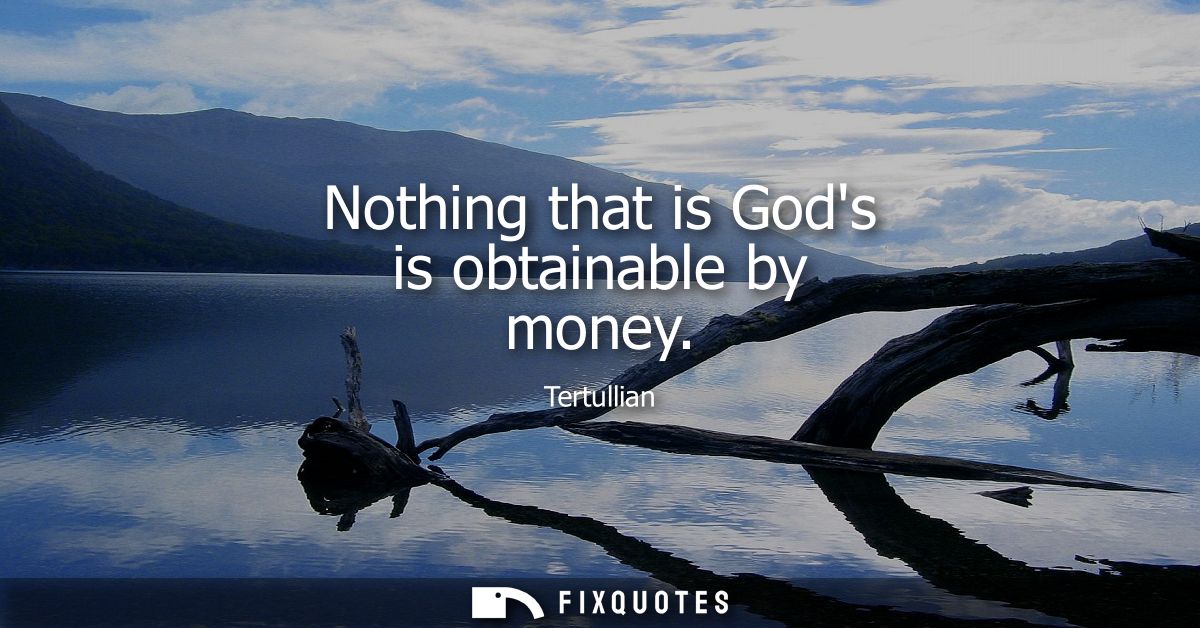
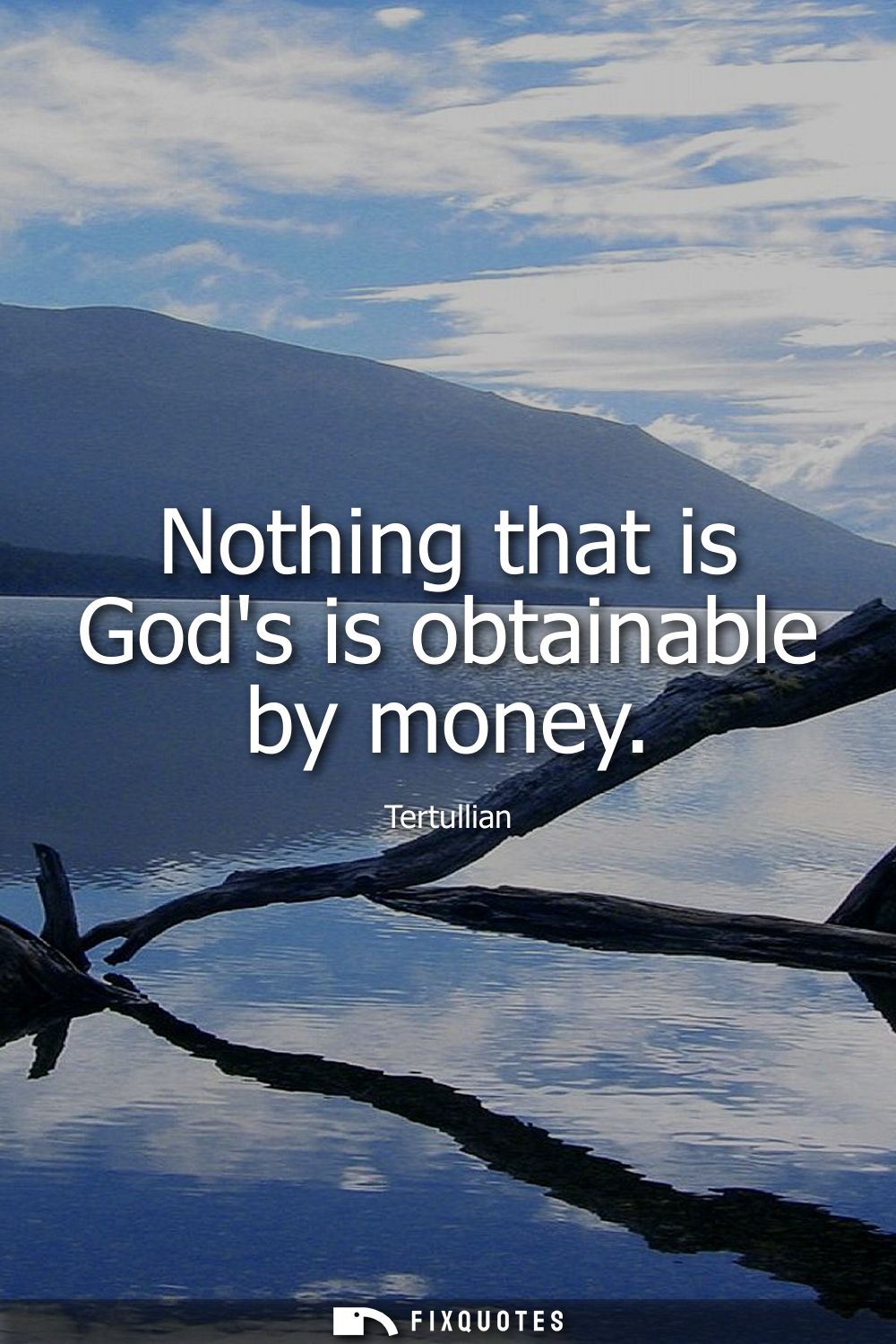
"Nothing that is God's is obtainable by money"
About this Quote
Austere, almost prosecutorial, Tertullian draws a hard border between the divine and the marketplace: if it belongs to God, it cannot be purchased. The line works because it refuses compromise. It is not a gentle reminder to be less materialistic; it is a theological veto aimed at a specific, familiar temptation in late Roman life: treating religion like another civic service you can fund, sponsor, or game.
Tertullian writes as an early Christian polemicist in a world where status, patronage, and payment lubricated everything from legal outcomes to public office. In that atmosphere, even piety could be monetized - donations that buy prestige, rites that feel like transactions, officials who can be "handled". His sentence is engineered to short-circuit that logic. By phrasing it as an ontological claim ("God's" things are categorically unobtainable by money), he turns what might sound like a moral preference into a metaphysical rule.
The subtext is an attack on spiritual bribery: the idea that salvation, forgiveness, or ecclesial standing can be secured through wealth. It also doubles as a defense of Christian identity against Roman norms of exchange. If the empire runs on quid pro quo, the church must run on grace - not because grace is sentimental, but because it is unbuyable by definition. There's an implicit democratization here: the poor are not priced out of God. At the same time, it’s a warning shot to the rich: you can’t tip your way into transcendence.
Tertullian writes as an early Christian polemicist in a world where status, patronage, and payment lubricated everything from legal outcomes to public office. In that atmosphere, even piety could be monetized - donations that buy prestige, rites that feel like transactions, officials who can be "handled". His sentence is engineered to short-circuit that logic. By phrasing it as an ontological claim ("God's" things are categorically unobtainable by money), he turns what might sound like a moral preference into a metaphysical rule.
The subtext is an attack on spiritual bribery: the idea that salvation, forgiveness, or ecclesial standing can be secured through wealth. It also doubles as a defense of Christian identity against Roman norms of exchange. If the empire runs on quid pro quo, the church must run on grace - not because grace is sentimental, but because it is unbuyable by definition. There's an implicit democratization here: the poor are not priced out of God. At the same time, it’s a warning shot to the rich: you can’t tip your way into transcendence.
Quote Details
| Topic | God |
|---|---|
| Source | Help us find the source |
| Cite |
Citation Formats
APA Style (7th ed.)
Tertullian. (2026, January 15). Nothing that is God's is obtainable by money. FixQuotes. https://fixquotes.com/quotes/nothing-that-is-gods-is-obtainable-by-money-150128/
Chicago Style
Tertullian. "Nothing that is God's is obtainable by money." FixQuotes. January 15, 2026. https://fixquotes.com/quotes/nothing-that-is-gods-is-obtainable-by-money-150128/.
MLA Style (9th ed.)
"Nothing that is God's is obtainable by money." FixQuotes, 15 Jan. 2026, https://fixquotes.com/quotes/nothing-that-is-gods-is-obtainable-by-money-150128/. Accessed 21 Mar. 2026.
More Quotes by Tertullian
Add to List