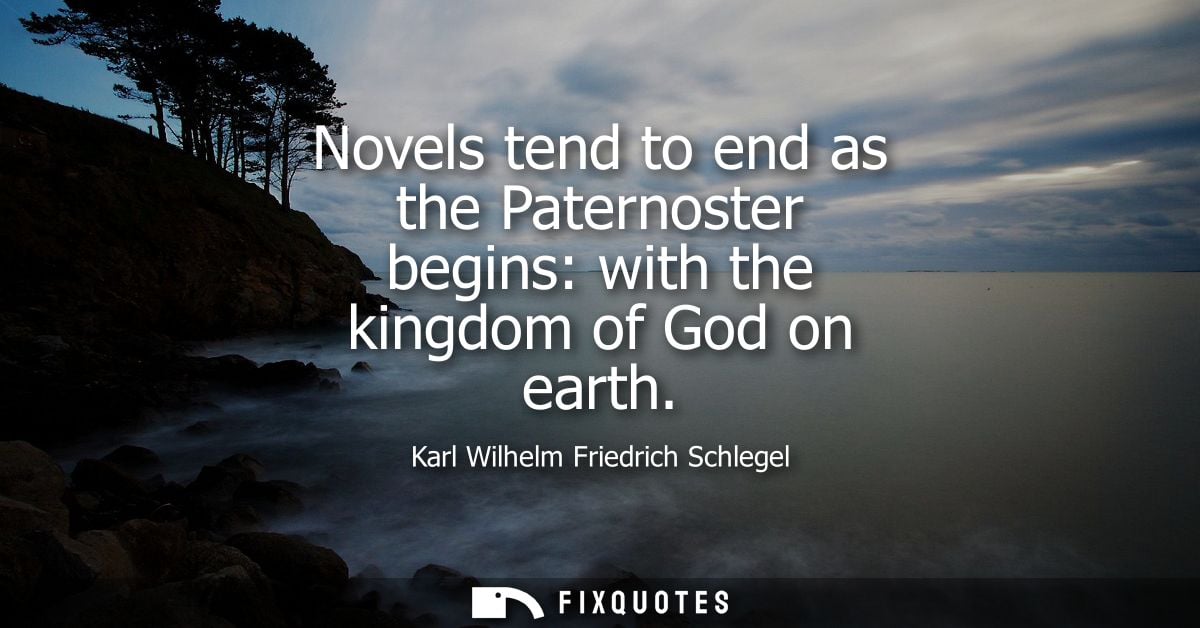
"Novels tend to end as the Paternoster begins: with the kingdom of God on earth"
About this Quote
The intent is polemical. Early 19th-century German Romanticism was busy arguing that art could do what institutions were failing to do: re-enchant a rationalized, post-Revolutionary Europe. Schlegel is writing in the aftermath of Enlightenment confidence and amid political turbulence; the old guarantees of order look shaky. So he frames the novel's ending as a secularized apocalypse: the moment when scattered episodes snap into a felt totality, when characters and readers experience a sudden coherence that life rarely supplies.
The subtext is both flattering and accusatory. Flattering, because it crowns the novelist as a kind of lay theologian, capable of staging moral worlds and smuggling metaphysics into plot. Accusatory, because it implies most novels don't earn their endings; they paste on a "kingdom" - closure, justice, harmony - the way piety can paste hope onto history. It's a sly reminder that narrative can counterfeit redemption as easily as it can imagine it.
Schlegel's line works because it exposes the real appetite behind storytelling: not just to know what happens, but to believe the world can be made legible, even briefly, on human terms.
Quote Details
| Topic | God |
|---|---|
| Source | Help us find the source |
| Cite |
Citation Formats
APA Style (7th ed.)
Schlegel, Karl Wilhelm Friedrich. (2026, January 18). Novels tend to end as the Paternoster begins: with the kingdom of God on earth. FixQuotes. https://fixquotes.com/quotes/novels-tend-to-end-as-the-paternoster-begins-with-12957/
Chicago Style
Schlegel, Karl Wilhelm Friedrich. "Novels tend to end as the Paternoster begins: with the kingdom of God on earth." FixQuotes. January 18, 2026. https://fixquotes.com/quotes/novels-tend-to-end-as-the-paternoster-begins-with-12957/.
MLA Style (9th ed.)
"Novels tend to end as the Paternoster begins: with the kingdom of God on earth." FixQuotes, 18 Jan. 2026, https://fixquotes.com/quotes/novels-tend-to-end-as-the-paternoster-begins-with-12957/. Accessed 18 Mar. 2026.