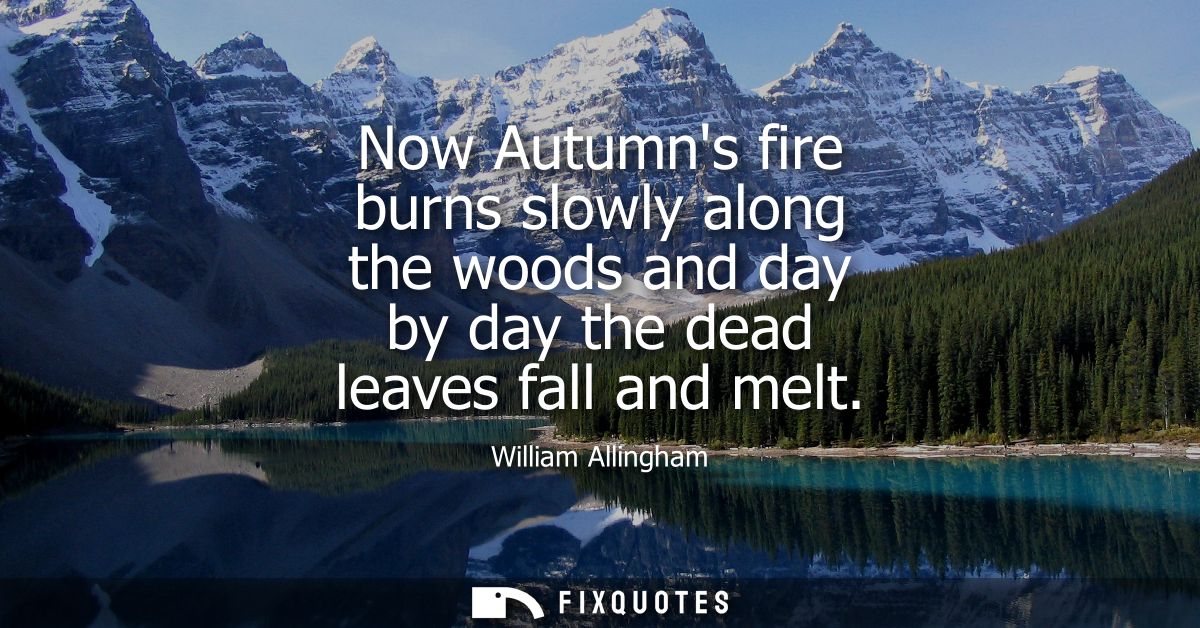
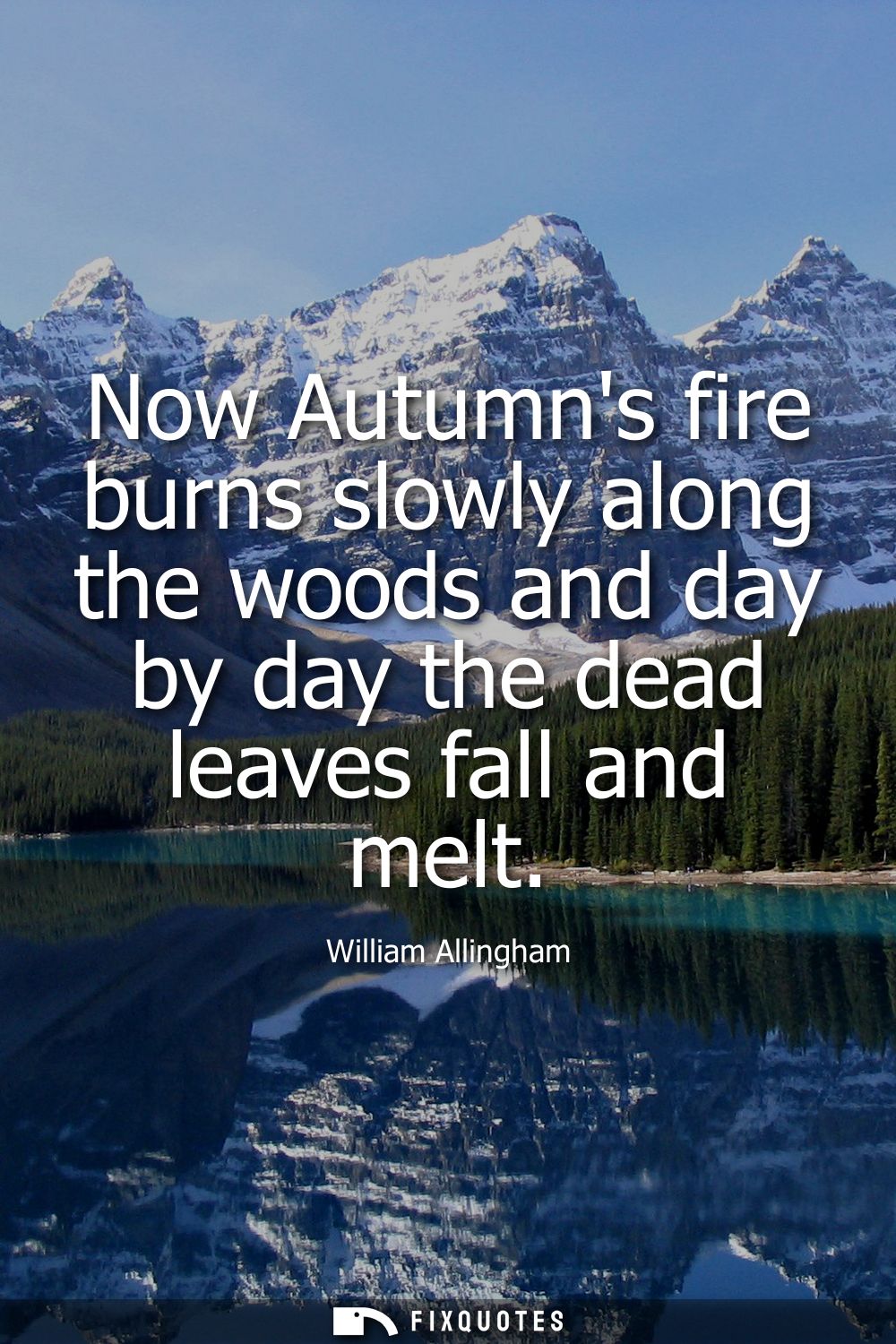
"Now Autumn's fire burns slowly along the woods and day by day the dead leaves fall and melt"
About this Quote
Autumn arrives here not as a postcard but as a slow burn, a controlled decay. Allingham’s first move is kinetic: “fire” that “burns slowly.” It’s an image that flatters the eye while refusing the usual autumnal cheer. Fire suggests brightness and warmth, but “along the woods” and “slowly” turns it into a creeping process, less bonfire than smolder. The season isn’t a scene; it’s a mechanism, working its way through the landscape with patient inevitability.
The line’s quiet power is in its accounting of time. “Day by day” is deliberately plain, almost diary-like, pulling the reader out of lyric rapture and into repetition. Autumn isn’t one dramatic moment of change; it’s accumulation. Then comes the blunt noun phrase “dead leaves,” unsentimental and bodily. These aren’t “gold” or “crimson” leaves performing for a painter; they’re dead matter. And yet Allingham doesn’t stop at falling. They “fall and melt,” a verb choice that dissolves the boundary between death and disappearance. “Melt” implies surrender, a soft exit rather than a crisp snap, as if the world is quietly composting itself.
Context matters: Allingham, an Irish poet writing in the Victorian period, often threaded folk sensibility and natural detail into a gentler counterpoint to industrial modernity. This line leans into that pastoral tradition while slipping in a darker subtext: the beauty of decline, the everydayness of endings. It’s seasonal description that doubles as a human itinerary - not tragic, not triumphant, just steadily, vividly true.
The line’s quiet power is in its accounting of time. “Day by day” is deliberately plain, almost diary-like, pulling the reader out of lyric rapture and into repetition. Autumn isn’t one dramatic moment of change; it’s accumulation. Then comes the blunt noun phrase “dead leaves,” unsentimental and bodily. These aren’t “gold” or “crimson” leaves performing for a painter; they’re dead matter. And yet Allingham doesn’t stop at falling. They “fall and melt,” a verb choice that dissolves the boundary between death and disappearance. “Melt” implies surrender, a soft exit rather than a crisp snap, as if the world is quietly composting itself.
Context matters: Allingham, an Irish poet writing in the Victorian period, often threaded folk sensibility and natural detail into a gentler counterpoint to industrial modernity. This line leans into that pastoral tradition while slipping in a darker subtext: the beauty of decline, the everydayness of endings. It’s seasonal description that doubles as a human itinerary - not tragic, not triumphant, just steadily, vividly true.
Quote Details
| Topic | Autumn |
|---|---|
| Source | Help us find the source |
More Quotes by William
Add to List