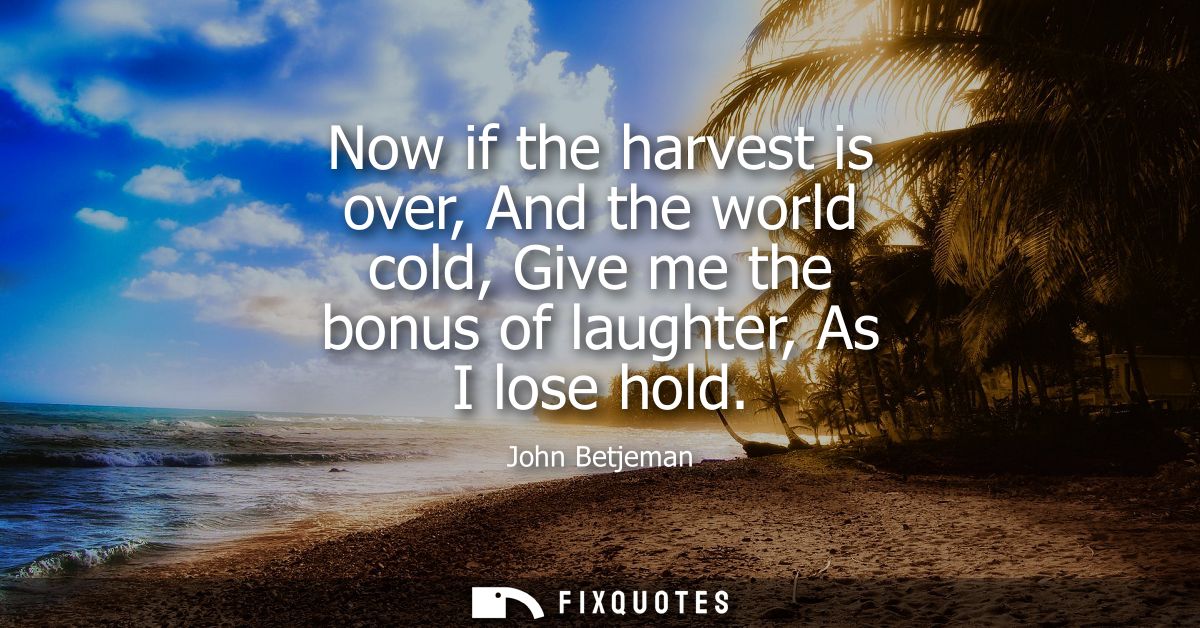
"Now if the harvest is over, And the world cold, Give me the bonus of laughter, As I lose hold"
About this Quote
The subtext is mortality without the sermon. "As I lose hold" is deliberately unspecific - losing hold of what? Youth, faith, love, sanity, the handrail of ordinary life - which makes the line feel honest rather than staged. It’s the language of someone noticing their own loosening, the way a body or a mind stops obeying with total reliability. Laughter becomes both defiance and anesthesia, a way to keep dignity when dignity is no longer guaranteed.
Context matters because Betjeman’s public persona was often genial, nostalgic, even cozy; he loved the texture of everyday England. Here that coziness is put under pressure. The pastoral image of harvest, usually a symbol of completion and reward, is flipped into an admission that completion can look like emptiness. The wit isn’t decorative; it’s a coping mechanism, a final claim on agency when everything else is being repossessed.
Quote Details
| Topic | Mortality |
|---|---|
| Source | Help us find the source |
| Cite |
Citation Formats
APA Style (7th ed.)
Betjeman, John. (2026, January 17). Now if the harvest is over, And the world cold, Give me the bonus of laughter, As I lose hold. FixQuotes. https://fixquotes.com/quotes/now-if-the-harvest-is-over-and-the-world-cold-63274/
Chicago Style
Betjeman, John. "Now if the harvest is over, And the world cold, Give me the bonus of laughter, As I lose hold." FixQuotes. January 17, 2026. https://fixquotes.com/quotes/now-if-the-harvest-is-over-and-the-world-cold-63274/.
MLA Style (9th ed.)
"Now if the harvest is over, And the world cold, Give me the bonus of laughter, As I lose hold." FixQuotes, 17 Jan. 2026, https://fixquotes.com/quotes/now-if-the-harvest-is-over-and-the-world-cold-63274/. Accessed 3 Apr. 2026.