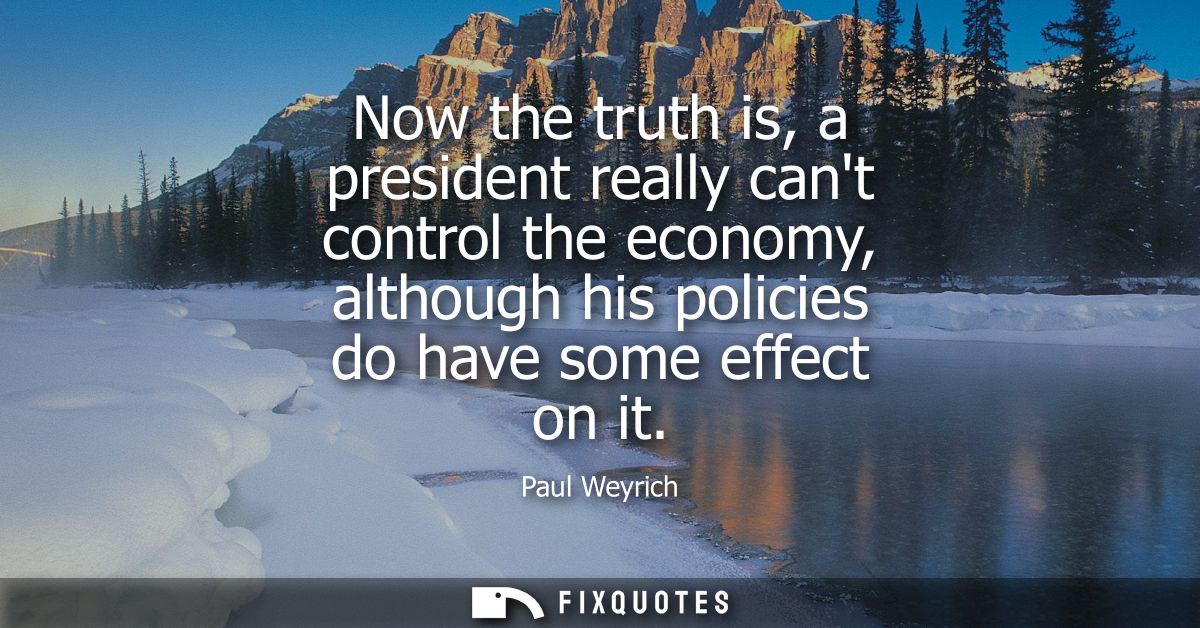
"Now the truth is, a president really can't control the economy, although his policies do have some effect on it"
About this Quote
The sentence is carefully hedged. “Really can’t control” denies the fantasy of a presidential dial labeled GDP, inflation, jobs. The follow-up clause, “although his policies do have some effect,” keeps him from sounding naïve about governance. That balance is the subtext: economic outcomes are shaped by sprawling systems (markets, global shocks, central banks, business cycles), but politicians still benefit from pretending those systems are fully steerable. Weyrich, a conservative critic and strategist, is implicitly indicting both parties’ habit of taking credit in booms and outsourcing blame in busts.
Context matters: late-20th-century American politics increasingly sold the presidency as a CEO role, as if the White House were a corporate headquarters. Weyrich pushes back against that managerial fantasy while preserving the moral of political responsibility. The intent is pragmatic and slightly deflationary: temper expectations, complicate blame, and expose how economic rhetoric functions as a tool of persuasion. It works because it refuses the comforting binary of omnipotence versus irrelevance, leaving us with the messier truth that democracy runs on accountability even when causality is diffuse.
Quote Details
| Topic | Money |
|---|---|
| Source | Help us find the source |
| Cite |
Citation Formats
APA Style (7th ed.)
Weyrich, Paul. (2026, January 16). Now the truth is, a president really can't control the economy, although his policies do have some effect on it. FixQuotes. https://fixquotes.com/quotes/now-the-truth-is-a-president-really-cant-control-94245/
Chicago Style
Weyrich, Paul. "Now the truth is, a president really can't control the economy, although his policies do have some effect on it." FixQuotes. January 16, 2026. https://fixquotes.com/quotes/now-the-truth-is-a-president-really-cant-control-94245/.
MLA Style (9th ed.)
"Now the truth is, a president really can't control the economy, although his policies do have some effect on it." FixQuotes, 16 Jan. 2026, https://fixquotes.com/quotes/now-the-truth-is-a-president-really-cant-control-94245/. Accessed 29 Mar. 2026.