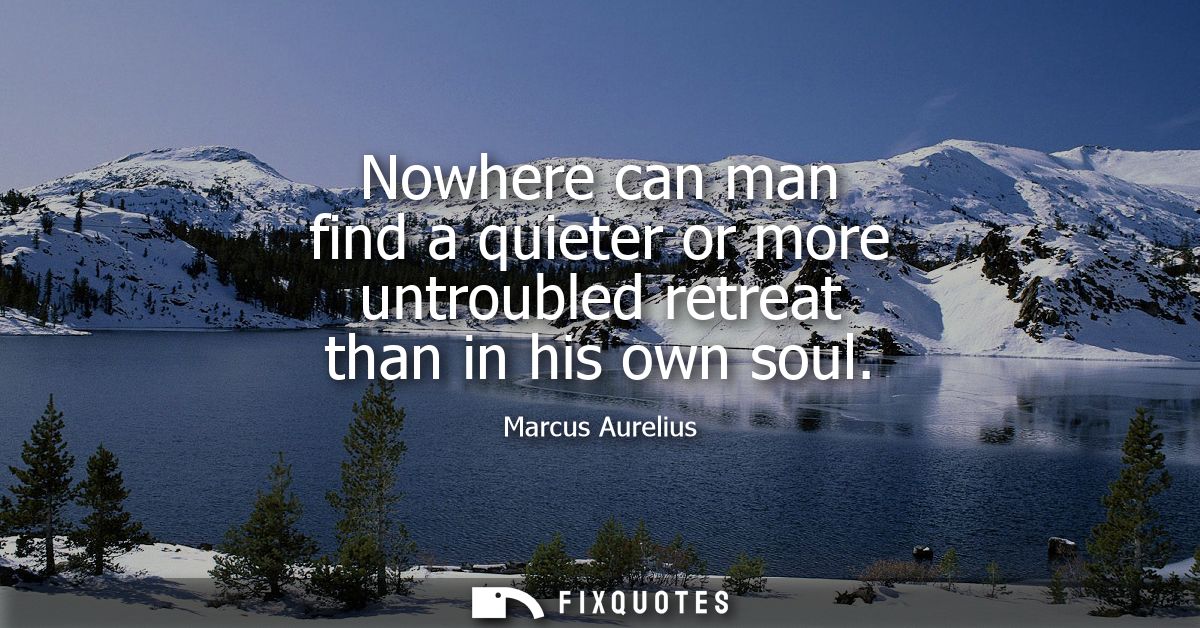
"Nowhere can man find a quieter or more untroubled retreat than in his own soul"
About this Quote
The intent is pragmatic, almost military. “Retreat” is the telling word: not escape, not surrender, but a tactical withdrawal to regroup. The soul, in Stoic terms, isn’t a mysterious inner flame; it’s the command center where judgments get made. That’s the subtext: peace isn’t a change in circumstances, it’s a change in verdicts. If you can control the story you tell yourself about pain, insult, or loss, you can move through chaos without being colonized by it.
There’s also a quiet rebuke to status and spectacle. An emperor could purchase silence; Marcus insists you can’t buy untroubled. The world will always have something to demand, and it will always be a little unreasonable. The only lasting sanctuary is the practice of returning to your own mind, inspecting it, and refusing to let it become a rumor mill. Stoicism here isn’t numbness; it’s sovereignty.
Quote Details
| Topic | Wisdom |
|---|---|
| Source | Verified source: Meditations (Marcus Aurelius, 180)
Evidence: For nowhere either with more quiet or more freedom from trouble does a man retire than into his own soul, particularly when he has within him such thoughts that by looking into them he is immediately in perfect tranquillity; and I affirm that tranquillity is nothing else than the good ordering of the mind. (Book IV, section 3). This line is from Marcus Aurelius’ own work commonly titled “Meditations” (Greek: Ta eis heauton / ‘To Himself’), specifically Book 4, section 3, in the English translation by George Long. The popular wording you provided (“Nowhere can man find a quieter or more untroubled retreat than in his own soul”) is a modern paraphrase/variant of this passage rather than the exact wording of this translation. The original composition date of Meditations is typically placed in the late 2nd century CE (often c. 170–180 CE); it was not ‘spoken’ as a speech but written as private notes. Pinning down the ‘first published’ date in antiquity is not really applicable in the modern sense; the earliest recoverable source is the text tradition of Meditations itself. A different public-domain English rendering (Farquharson) also preserves the same location (Book IV.3) with different wording: https://en.wikisource.org/wiki/The_Meditations_of_the_Emperor_Marcus_Antoninus/Book_4 (see section 3). Other candidates (1) A Year of Daily Meditation: 365 Lessons on Life, Love, an... compilation95.0% ... Nowhere can man find a quieter or more untroubled retreat than in his own soul.” MARCUS AURELIUS Marcus Aurelius'... |
| Cite |
Citation Formats
APA Style (7th ed.)
Aurelius, Marcus. (2026, February 17). Nowhere can man find a quieter or more untroubled retreat than in his own soul. FixQuotes. https://fixquotes.com/quotes/nowhere-can-man-find-a-quieter-or-more-untroubled-8844/
Chicago Style
Aurelius, Marcus. "Nowhere can man find a quieter or more untroubled retreat than in his own soul." FixQuotes. February 17, 2026. https://fixquotes.com/quotes/nowhere-can-man-find-a-quieter-or-more-untroubled-8844/.
MLA Style (9th ed.)
"Nowhere can man find a quieter or more untroubled retreat than in his own soul." FixQuotes, 17 Feb. 2026, https://fixquotes.com/quotes/nowhere-can-man-find-a-quieter-or-more-untroubled-8844/. Accessed 2 Apr. 2026.