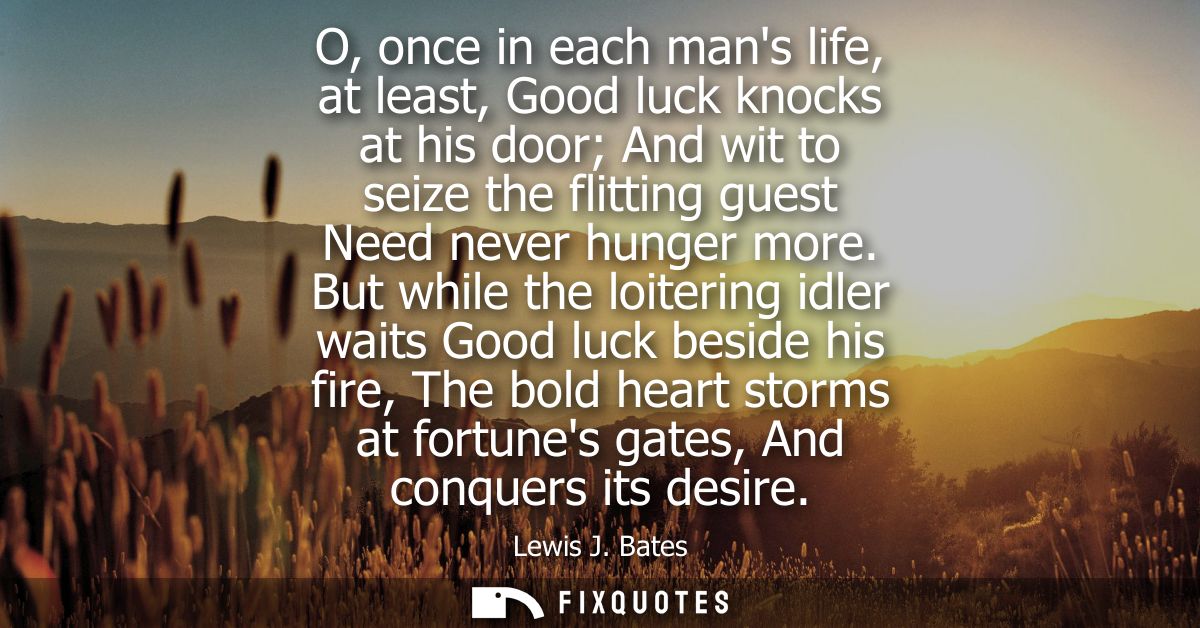
"O, once in each man's life, at least, Good luck knocks at his door; And wit to seize the flitting guest Need never hunger more. But while the loitering idler waits Good luck beside his fire, The bold heart storms at fortune's gates, And conquers its desire"
About this Quote
The real target is the “loitering idler,” warmed by the fantasy that fortune will sit “beside his fire” like a domestic companion. Bates treats that posture as not merely lazy but delusional: waiting turns luck from an opportunity into a bedtime story. The moral pivot lands in the martial imagery - “storms at fortune’s gates” - which reframes success as siegecraft. Fortune has “gates” because it resists; desire must be “conquered,” not granted. Even “bold heart” is a kind of technology: courage as a practical tool for converting a moment into a life.
Contextually, it fits the 19th-century Anglo-American self-help worldview: providence exists, but it favors the alert and the audacious. Subtext: the myth of equal “one knock” flatters the reader while absolving society. If you missed your chance, Bates implies, it wasn’t the world; it was your reflexes. That’s the poem’s persuasive trick - it sells hustle as virtue and consolation as vice.
Quote Details
| Topic | Motivational |
|---|---|
| Source | Help us find the source |
| Cite |
Citation Formats
APA Style (7th ed.)
Bates, Lewis J. (2026, January 15). O, once in each man's life, at least, Good luck knocks at his door; And wit to seize the flitting guest Need never hunger more. But while the loitering idler waits Good luck beside his fire, The bold heart storms at fortune's gates, And conquers its desire. FixQuotes. https://fixquotes.com/quotes/o-once-in-each-mans-life-at-least-good-luck-112219/
Chicago Style
Bates, Lewis J. "O, once in each man's life, at least, Good luck knocks at his door; And wit to seize the flitting guest Need never hunger more. But while the loitering idler waits Good luck beside his fire, The bold heart storms at fortune's gates, And conquers its desire." FixQuotes. January 15, 2026. https://fixquotes.com/quotes/o-once-in-each-mans-life-at-least-good-luck-112219/.
MLA Style (9th ed.)
"O, once in each man's life, at least, Good luck knocks at his door; And wit to seize the flitting guest Need never hunger more. But while the loitering idler waits Good luck beside his fire, The bold heart storms at fortune's gates, And conquers its desire." FixQuotes, 15 Jan. 2026, https://fixquotes.com/quotes/o-once-in-each-mans-life-at-least-good-luck-112219/. Accessed 9 Mar. 2026.