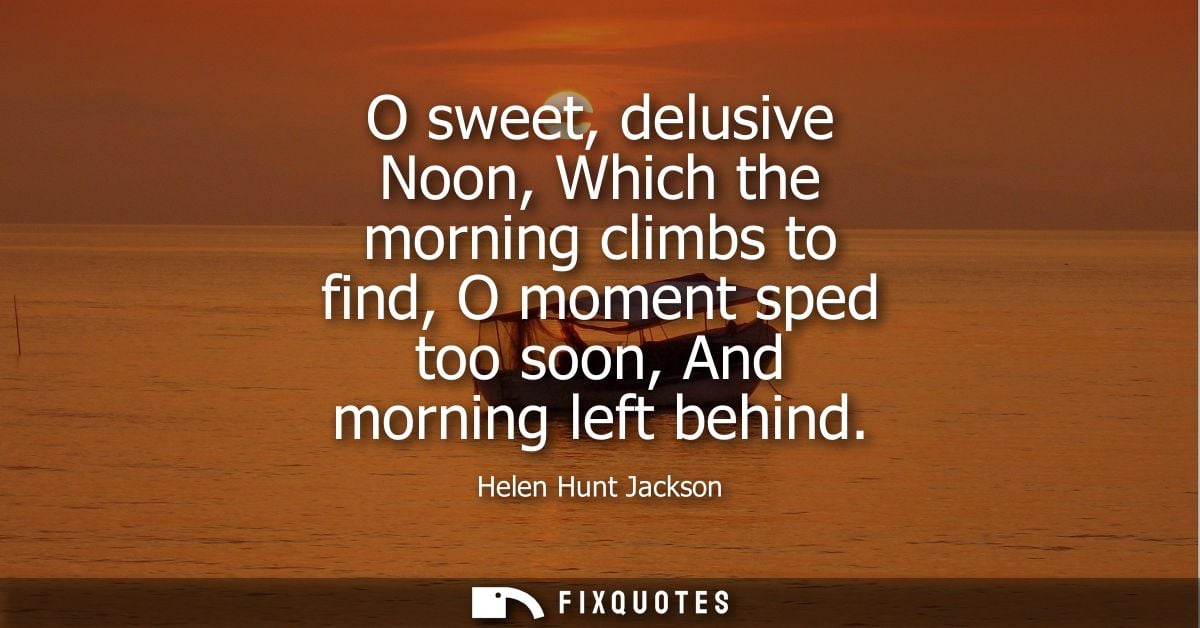
"O sweet, delusive Noon, Which the morning climbs to find, O moment sped too soon, And morning left behind"
About this Quote
What makes the passage work is its quiet cruelty. The speaker mourns not nightfall, but the loss of morning itself - “And morning left behind.” That last phrase is the twist of the knife: the real grief isn’t that time moves forward, it’s that it forces a betrayal of what we were a few hours ago. Jackson gives us nostalgia in real time. The midday sun, normally a symbol of clarity and fullness, becomes the point at which you realize you’ve already begun to lose.
In context, Jackson writes in a 19th-century lyric tradition that often uses the day as a stand-in for a life: dawn as youth, noon as prime, evening as age. But she refuses the comfort of a tidy allegory. The voice here is intimate, almost startled, as if catching oneself mid-happiness and recognizing its built-in expiry date. It’s less a sermon about mortality than a sudden, modern-feeling realization: the thing you’re chasing is already slipping past you as you reach it.
Quote Details
| Topic | Poetry |
|---|---|
| Source | Help us find the source |
| Cite |
Citation Formats
APA Style (7th ed.)
Jackson, Helen Hunt. (2026, January 17). O sweet, delusive Noon, Which the morning climbs to find, O moment sped too soon, And morning left behind. FixQuotes. https://fixquotes.com/quotes/o-sweet-delusive-noon-which-the-morning-climbs-to-54010/
Chicago Style
Jackson, Helen Hunt. "O sweet, delusive Noon, Which the morning climbs to find, O moment sped too soon, And morning left behind." FixQuotes. January 17, 2026. https://fixquotes.com/quotes/o-sweet-delusive-noon-which-the-morning-climbs-to-54010/.
MLA Style (9th ed.)
"O sweet, delusive Noon, Which the morning climbs to find, O moment sped too soon, And morning left behind." FixQuotes, 17 Jan. 2026, https://fixquotes.com/quotes/o-sweet-delusive-noon-which-the-morning-climbs-to-54010/. Accessed 25 Mar. 2026.