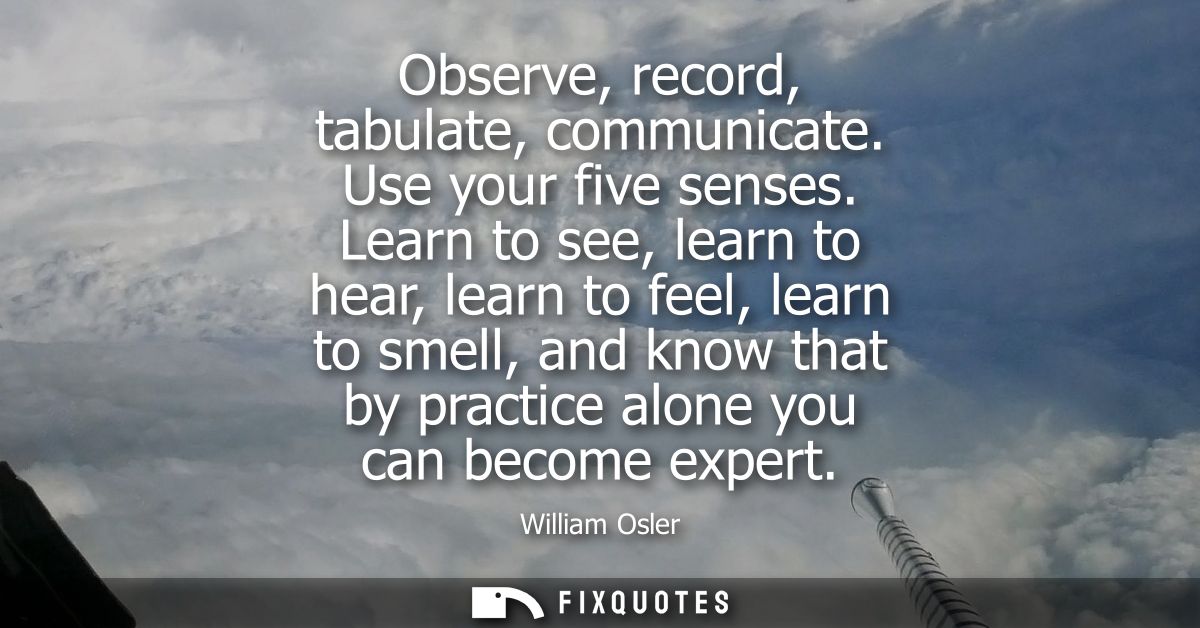
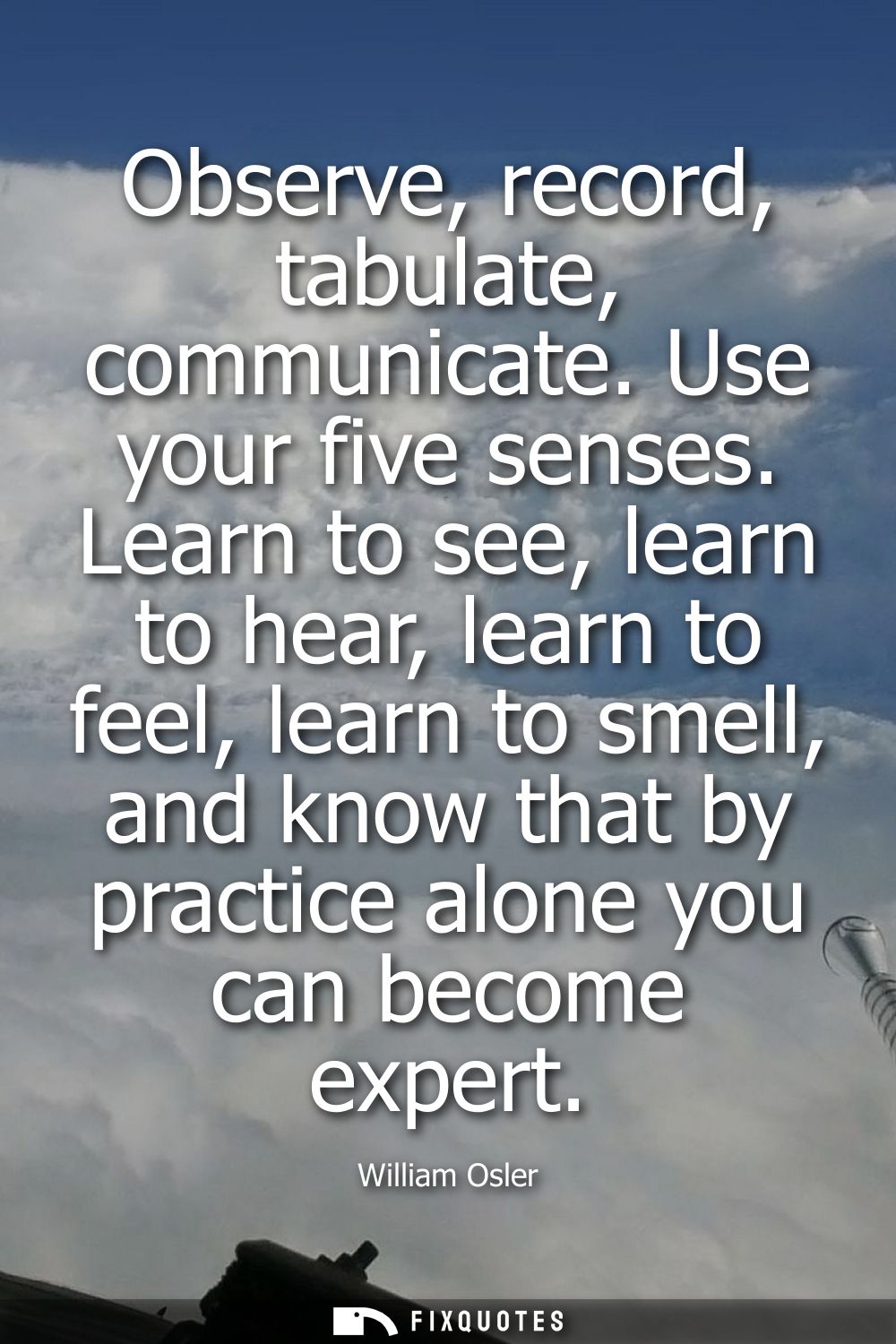
"Observe, record, tabulate, communicate. Use your five senses. Learn to see, learn to hear, learn to feel, learn to smell, and know that by practice alone you can become expert"
About this Quote
Osler is selling a rigor that sounds almost monkish: a daily discipline of attention. The clipped imperatives - observe, record, tabulate, communicate - read like a lab manual but land like a moral code. Science, in his framing, is not a flash of genius; it is a chain of habits that makes truth harder to dodge. Each verb implies an ethic: observe without rushing to certainty, record without flattering your hypothesis, tabulate because memory lies, communicate because private knowledge is just vanity.
The pivot to the five senses is more radical than it looks. In the late 19th-century medical world Osler helped shape, diagnosis still depended heavily on bedside perception. He is insisting that the body is readable if the clinician trains their instrument: not a stethoscope, but the self. "Learn to see" is a quiet rebuke to the educated amateur who mistakes familiarity for competence; seeing is not looking, hearing is not listening. The senses are presented as skills, not gifts.
Then comes the subtext with teeth: expertise is earned, not bestowed. "By practice alone" pushes against the romantic myth of the naturally brilliant physician-scientist. It also hints at humility: if mastery is practice, then error is inevitable, and improvement is always possible. Osler's intent is to professionalize attention - to make careful perception and clear reporting the real prestige, in an era when medicine was trying to become modern without losing its human immediacy.
The pivot to the five senses is more radical than it looks. In the late 19th-century medical world Osler helped shape, diagnosis still depended heavily on bedside perception. He is insisting that the body is readable if the clinician trains their instrument: not a stethoscope, but the self. "Learn to see" is a quiet rebuke to the educated amateur who mistakes familiarity for competence; seeing is not looking, hearing is not listening. The senses are presented as skills, not gifts.
Then comes the subtext with teeth: expertise is earned, not bestowed. "By practice alone" pushes against the romantic myth of the naturally brilliant physician-scientist. It also hints at humility: if mastery is practice, then error is inevitable, and improvement is always possible. Osler's intent is to professionalize attention - to make careful perception and clear reporting the real prestige, in an era when medicine was trying to become modern without losing its human immediacy.
Quote Details
| Topic | Learning |
|---|
More Quotes by William
Add to List