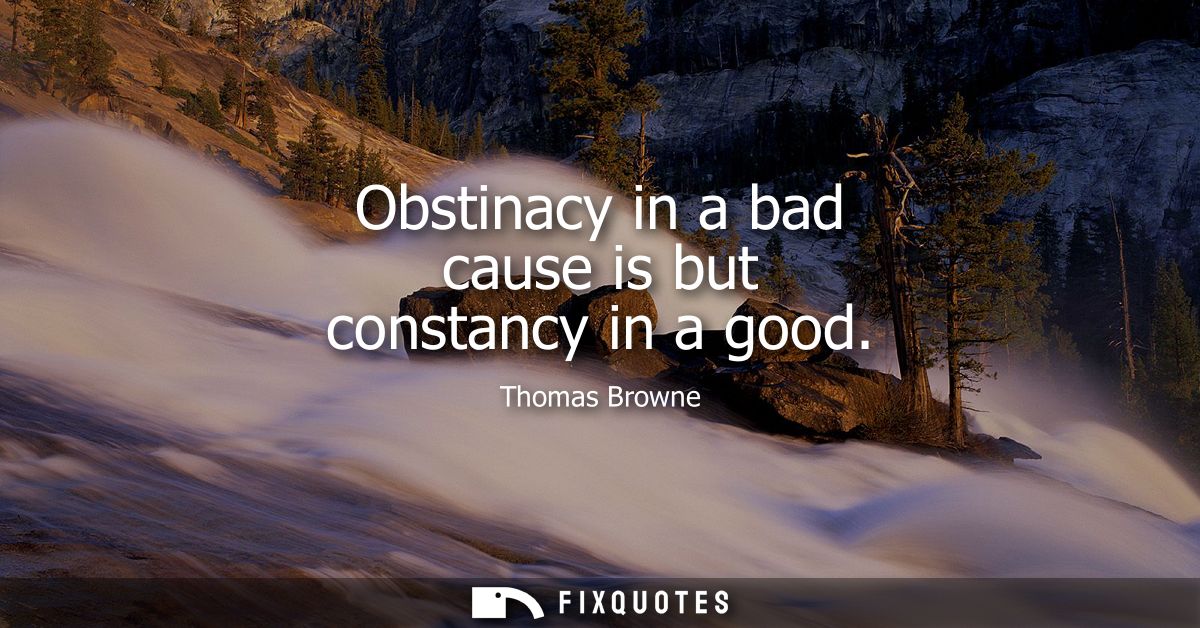
"Obstinacy in a bad cause is but constancy in a good"
About this Quote
Browne’s line is a scalpel aimed at moral self-flattery: the same behavior gets rebranded as virtue the moment we approve of the goal. “Obstinacy” and “constancy” are near-twins in practice, but Browne forces you to hear how quickly language launders stubbornness into principle. The sentence works because it’s almost a reversible equation. Swap “bad cause” for “good” and the vice becomes a virtue without the person changing at all. That’s the punch: character is often less a stable core than a set of labels assigned after the fact.
The subtext is pointedly political and theological, even if Browne dresses it as a cool observation. In 17th-century England, a “cause” wasn’t an abstract debate topic; it was Civil War, sectarian conflict, oaths, and loyalties that could cost property or life. Browne, a physician and natural philosopher, lived amid a culture that prized “constancy” as a hallmark of the faithful while also watching people weaponize steadfastness in service of cruelty, zealotry, or faction. His wording refuses to grant moral credit to endurance alone.
There’s also a proto-scientific sensibility here: skepticism about human testimony, especially self-testimony. Browne implies that we’re not just biased; we’re rhetorically biased, reaching for noble nouns to dignify our refusals to reconsider. It’s a warning about how virtue-signals can be retrofitted to justify being wrong for a long time, loudly.
The subtext is pointedly political and theological, even if Browne dresses it as a cool observation. In 17th-century England, a “cause” wasn’t an abstract debate topic; it was Civil War, sectarian conflict, oaths, and loyalties that could cost property or life. Browne, a physician and natural philosopher, lived amid a culture that prized “constancy” as a hallmark of the faithful while also watching people weaponize steadfastness in service of cruelty, zealotry, or faction. His wording refuses to grant moral credit to endurance alone.
There’s also a proto-scientific sensibility here: skepticism about human testimony, especially self-testimony. Browne implies that we’re not just biased; we’re rhetorically biased, reaching for noble nouns to dignify our refusals to reconsider. It’s a warning about how virtue-signals can be retrofitted to justify being wrong for a long time, loudly.
Quote Details
| Topic | Wisdom |
|---|---|
| Source | Help us find the source |
| Cite |
Citation Formats
APA Style (7th ed.)
Browne, Thomas. (2026, January 16). Obstinacy in a bad cause is but constancy in a good. FixQuotes. https://fixquotes.com/quotes/obstinacy-in-a-bad-cause-is-but-constancy-in-a-99396/
Chicago Style
Browne, Thomas. "Obstinacy in a bad cause is but constancy in a good." FixQuotes. January 16, 2026. https://fixquotes.com/quotes/obstinacy-in-a-bad-cause-is-but-constancy-in-a-99396/.
MLA Style (9th ed.)
"Obstinacy in a bad cause is but constancy in a good." FixQuotes, 16 Jan. 2026, https://fixquotes.com/quotes/obstinacy-in-a-bad-cause-is-but-constancy-in-a-99396/. Accessed 18 Feb. 2026.
More Quotes by Thomas
Add to List