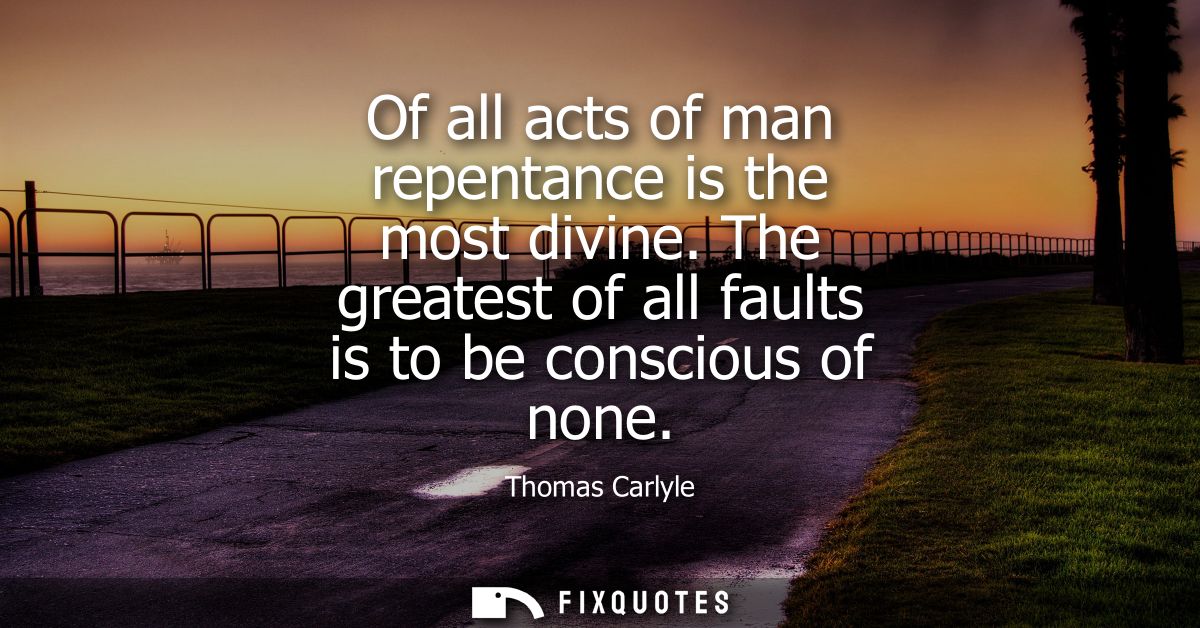
"Of all acts of man repentance is the most divine. The greatest of all faults is to be conscious of none"
About this Quote
The second sentence sharpens into a jab at complacency. “The greatest of all faults is to be conscious of none” targets the smug innocence of people who treat their own character as a settled fact. Carlyle is allergic to that kind of self-satisfaction; it’s not merely an error, it’s a moral anesthesia. If you can’t detect your own failures, you can’t correct them, and you can’t be trusted with power, love, or leadership. Unexamined virtue becomes its own vice.
Context matters: Carlyle wrote in a 19th-century Britain rattled by industrialization, political reform, and mass society - a world where traditional religious authority was fraying, but the need for moral seriousness felt urgent. He’s trying to relocate the sacred from institutions to the individual conscience. Repentance becomes a substitute for certainty: not “I am pure,” but “I can see my impurity and change.” The subtext is bracingly anti-comfort: the holy life begins not in confidence, but in self-interrogation.
Quote Details
| Topic | Humility |
|---|---|
| Source | Help us find the source |
| Cite |
Citation Formats
APA Style (7th ed.)
Carlyle, Thomas. (2026, January 17). Of all acts of man repentance is the most divine. The greatest of all faults is to be conscious of none. FixQuotes. https://fixquotes.com/quotes/of-all-acts-of-man-repentance-is-the-most-divine-34569/
Chicago Style
Carlyle, Thomas. "Of all acts of man repentance is the most divine. The greatest of all faults is to be conscious of none." FixQuotes. January 17, 2026. https://fixquotes.com/quotes/of-all-acts-of-man-repentance-is-the-most-divine-34569/.
MLA Style (9th ed.)
"Of all acts of man repentance is the most divine. The greatest of all faults is to be conscious of none." FixQuotes, 17 Jan. 2026, https://fixquotes.com/quotes/of-all-acts-of-man-repentance-is-the-most-divine-34569/. Accessed 12 Feb. 2026.