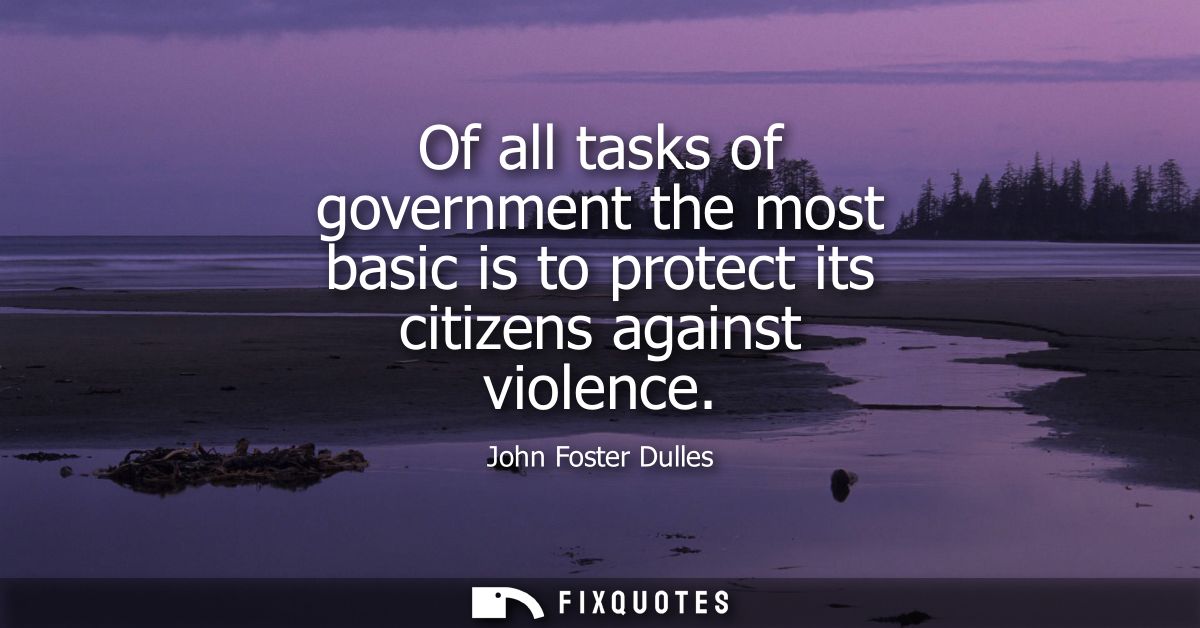
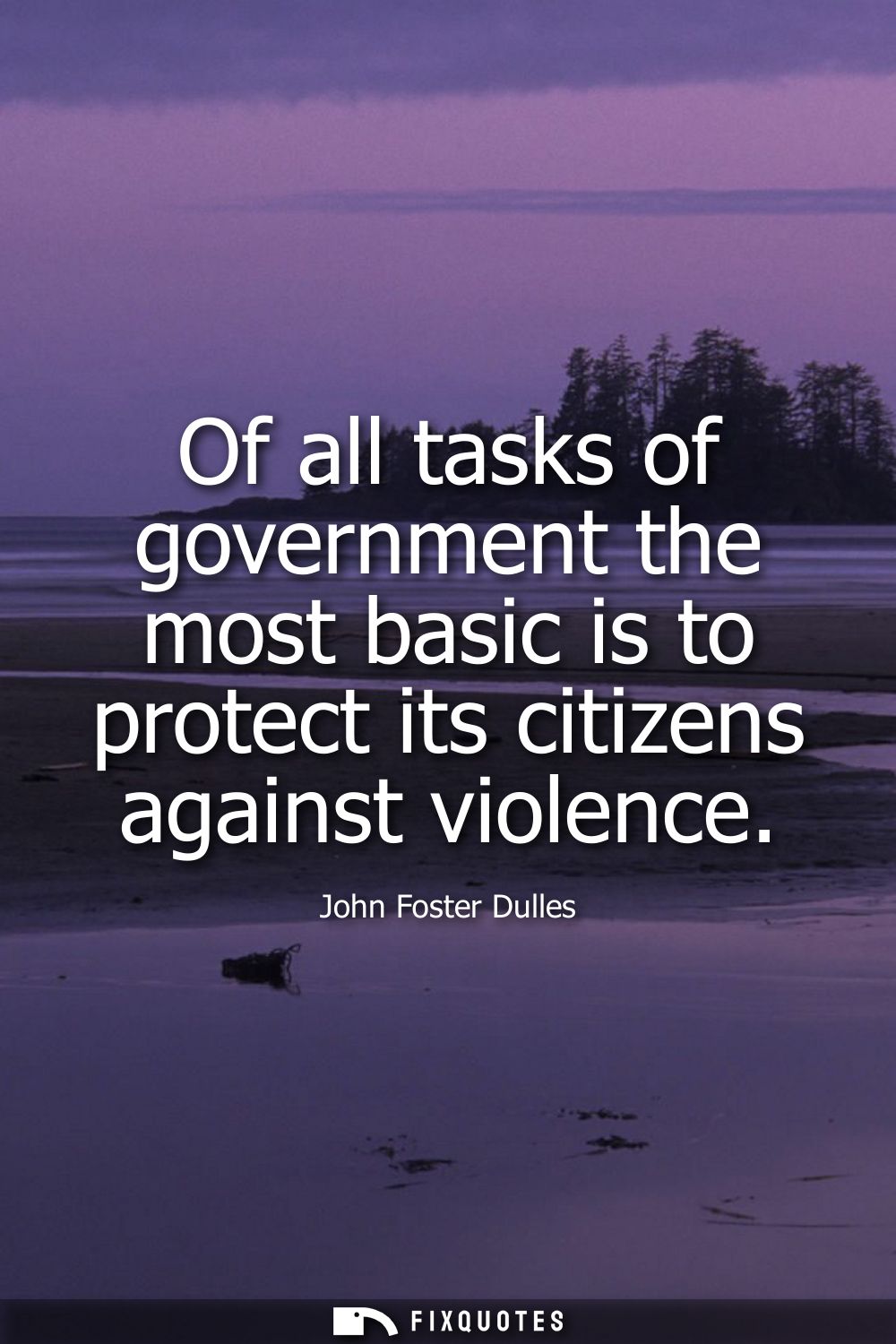
"Of all tasks of government, the most basic is to protect its citizens against violence"
About this Quote
The subtext is Cold War realism in a suit. Dulles helped architect a foreign policy built around containment, alliances, and credible threat. In that world, “violence” isn’t only street crime; it’s invasion, insurgency, sabotage, coups, nuclear blackmail. By using a broad word, he creates a single category that can hold Soviet tanks, domestic unrest, and colonial upheaval alike. That elasticity is strategic: it makes extraordinary measures feel like maintenance of the basics.
The quote also smuggles in a quiet tradeoff. If protection is the most basic duty, dissent can be recoded as risk, and civil liberties as luxuries that must yield when danger rises. Mid-century America knew that logic well, from McCarthy-era suspicion at home to intervention abroad justified as preventing worse violence later.
What makes the sentence work is its moral asymmetry: no one wants to argue against safety. Dulles turns that impulse into a hierarchy of governance, a rhetorical bridge from “security” to “whatever security requires.”
Quote Details
| Topic | Peace |
|---|---|
| Source | Help us find the source |
| Cite |
Citation Formats
APA Style (7th ed.)
Dulles, John Foster. (2026, February 16). Of all tasks of government, the most basic is to protect its citizens against violence. FixQuotes. https://fixquotes.com/quotes/of-all-tasks-of-government-the-most-basic-is-to-149660/
Chicago Style
Dulles, John Foster. "Of all tasks of government, the most basic is to protect its citizens against violence." FixQuotes. February 16, 2026. https://fixquotes.com/quotes/of-all-tasks-of-government-the-most-basic-is-to-149660/.
MLA Style (9th ed.)
"Of all tasks of government, the most basic is to protect its citizens against violence." FixQuotes, 16 Feb. 2026, https://fixquotes.com/quotes/of-all-tasks-of-government-the-most-basic-is-to-149660/. Accessed 30 Mar. 2026.