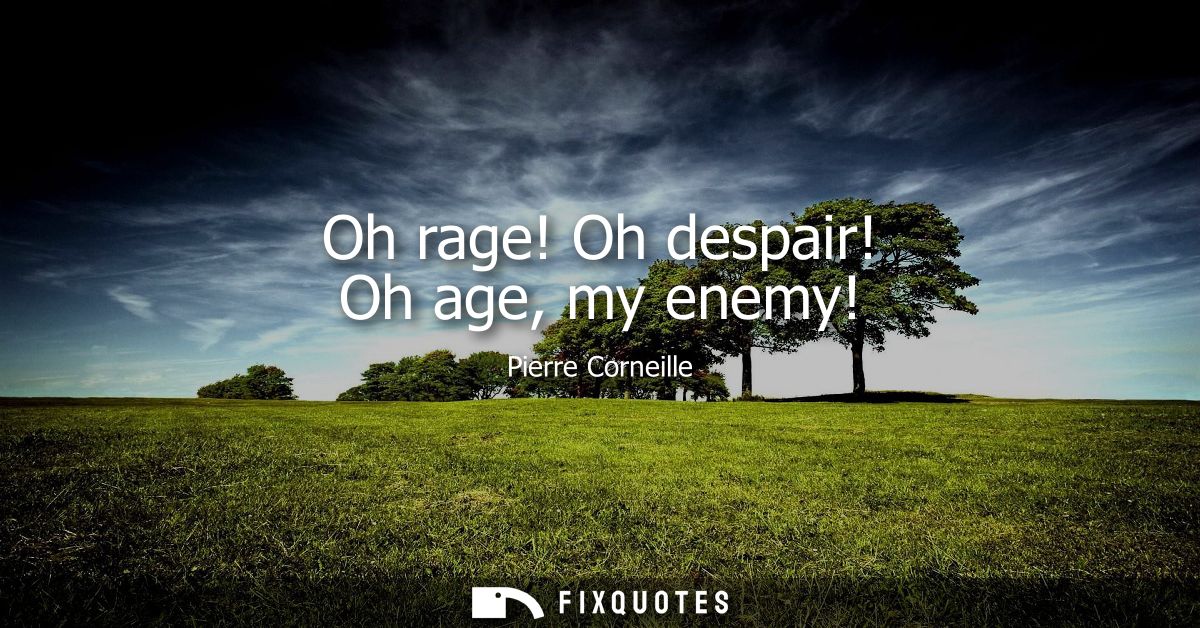
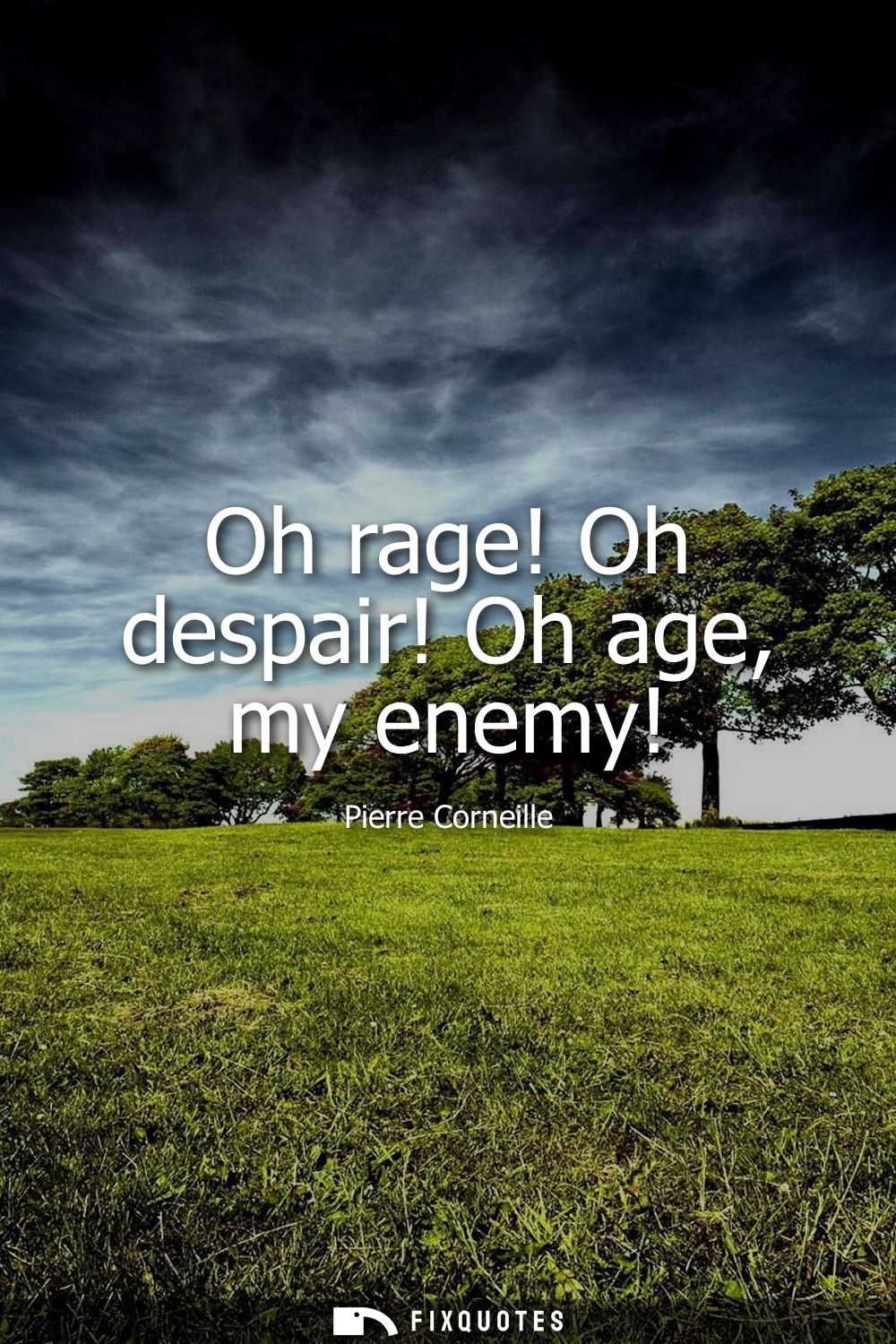
"Oh rage! Oh despair! Oh age, my enemy!"
About this Quote
A triple cry that turns time into a villain: Corneille’s line detonates like a stage-direction for the soul. The exclamations (“Oh rage! Oh despair!”) are less spontaneous feeling than rhetorical architecture, a deliberate piling-on that escalates from emotion (rage) to horizonless collapse (despair) and then lands on the real culprit: age. In classic French tragedy, passion is never just private; it’s a public event, something that must be spoken with ceremony because honor itself is at stake.
The subtext is brutal: the speaker isn’t merely sad about getting older; he’s humiliated by the body’s betrayal. “My enemy” frames aging as an external force, a rival combatant, which lets the character preserve his self-image. If weakness is an attacker rather than an internal decline, pride can stay intact. That’s the psychological trick of the line: it deflects responsibility for fragility while admitting it in the most theatrical way possible.
Context matters because Corneille’s heroes live in a moral economy where worth is measured by action, courage, and visible mastery. Age threatens the currency that buys dignity. The outburst is also a kind of meta-commentary on tragic form: tragedy needs limits, and nothing limits a hero more inexorably than time. The wit is that the enemy can’t be stabbed, negotiated with, or out-argued. It just keeps arriving, cue by cue, until rhetoric is all that remains.
The subtext is brutal: the speaker isn’t merely sad about getting older; he’s humiliated by the body’s betrayal. “My enemy” frames aging as an external force, a rival combatant, which lets the character preserve his self-image. If weakness is an attacker rather than an internal decline, pride can stay intact. That’s the psychological trick of the line: it deflects responsibility for fragility while admitting it in the most theatrical way possible.
Context matters because Corneille’s heroes live in a moral economy where worth is measured by action, courage, and visible mastery. Age threatens the currency that buys dignity. The outburst is also a kind of meta-commentary on tragic form: tragedy needs limits, and nothing limits a hero more inexorably than time. The wit is that the enemy can’t be stabbed, negotiated with, or out-argued. It just keeps arriving, cue by cue, until rhetoric is all that remains.
Quote Details
| Topic | Aging |
|---|---|
| Source | Le Cid (1636), Pierre Corneille — famous line in French: "O rage! O désespoir! O vieillesse ennemie!" commonly translated as "O rage! O despair! O age, my enemy!" |
| Cite |
Citation Formats
APA Style (7th ed.)
Corneille, Pierre. (2026, January 16). Oh rage! Oh despair! Oh age, my enemy! FixQuotes. https://fixquotes.com/quotes/oh-rage-oh-despair-oh-age-my-enemy-115896/
Chicago Style
Corneille, Pierre. "Oh rage! Oh despair! Oh age, my enemy!" FixQuotes. January 16, 2026. https://fixquotes.com/quotes/oh-rage-oh-despair-oh-age-my-enemy-115896/.
MLA Style (9th ed.)
"Oh rage! Oh despair! Oh age, my enemy!" FixQuotes, 16 Jan. 2026, https://fixquotes.com/quotes/oh-rage-oh-despair-oh-age-my-enemy-115896/. Accessed 20 Mar. 2026.
More Quotes by Pierre
Add to List