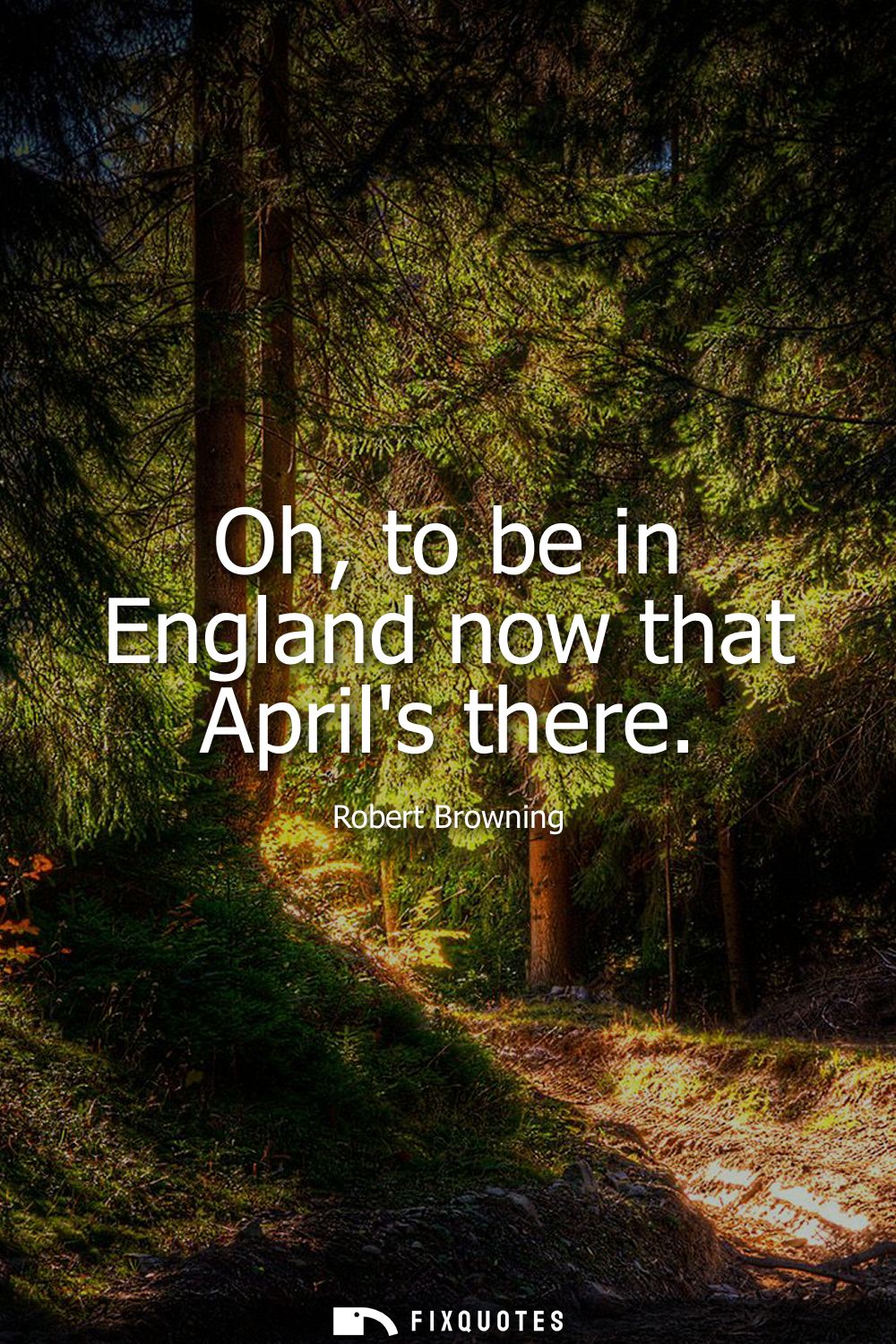
"Oh, to be in England now that April's there"
About this Quote
Homesickness, dressed up as weather. Browning’s line opens with a theatrical sigh - “Oh” - then pivots into a wish so immediate it feels bodily: not “in England in April,” but “in England now that April’s there.” The phrasing makes April an arriving presence, like a beloved person who’s shown up without you. England becomes less a nation than a season you can miss.
The context sharpens the ache. Browning wrote it while living in Italy, long expatriated and increasingly aware of the distance between his private loyalties and his chosen life abroad. The poem “Home-Thoughts, from Abroad” is basically a postcard to himself: a deliberately idealized England of thrushes, chaffinches, and “wise thrushes” singing in orchards. It’s pastoral nationalism, but intimate rather than martial - the kind that sneaks up on you through smell and birdsong instead of flags.
The subtext is selective memory as self-soothing. Browning doesn’t summon industrial England, class conflict, soot, or empire; he reaches for a curated, sensory England that can be carried in the mind. That’s why the line works: it’s not an argument about patriotism, it’s a micro-drama of longing. April isn’t just pleasant weather; it’s a symbol of renewal, of being back inside the rhythms that formed you.
There’s also a sly rhetorical tactic: by anchoring desire to a particular moment (“now”), Browning makes absence feel urgent, not abstract. The reader doesn’t just picture England; they feel the sting of being one season too far away.
The context sharpens the ache. Browning wrote it while living in Italy, long expatriated and increasingly aware of the distance between his private loyalties and his chosen life abroad. The poem “Home-Thoughts, from Abroad” is basically a postcard to himself: a deliberately idealized England of thrushes, chaffinches, and “wise thrushes” singing in orchards. It’s pastoral nationalism, but intimate rather than martial - the kind that sneaks up on you through smell and birdsong instead of flags.
The subtext is selective memory as self-soothing. Browning doesn’t summon industrial England, class conflict, soot, or empire; he reaches for a curated, sensory England that can be carried in the mind. That’s why the line works: it’s not an argument about patriotism, it’s a micro-drama of longing. April isn’t just pleasant weather; it’s a symbol of renewal, of being back inside the rhythms that formed you.
There’s also a sly rhetorical tactic: by anchoring desire to a particular moment (“now”), Browning makes absence feel urgent, not abstract. The reader doesn’t just picture England; they feel the sting of being one season too far away.
Quote Details
| Topic | Spring |
|---|---|
| Source | "Home-Thoughts, from Abroad" (poem) by Robert Browning — opening line: "Oh, to be in England now that April's there." |
| Cite |
Citation Formats
APA Style (7th ed.)
Browning, Robert. (2026, January 18). Oh, to be in England now that April's there. FixQuotes. https://fixquotes.com/quotes/oh-to-be-in-england-now-that-aprils-there-15197/
Chicago Style
Browning, Robert. "Oh, to be in England now that April's there." FixQuotes. January 18, 2026. https://fixquotes.com/quotes/oh-to-be-in-england-now-that-aprils-there-15197/.
MLA Style (9th ed.)
"Oh, to be in England now that April's there." FixQuotes, 18 Jan. 2026, https://fixquotes.com/quotes/oh-to-be-in-england-now-that-aprils-there-15197/. Accessed 31 Mar. 2026.
More Quotes by Robert
Add to List