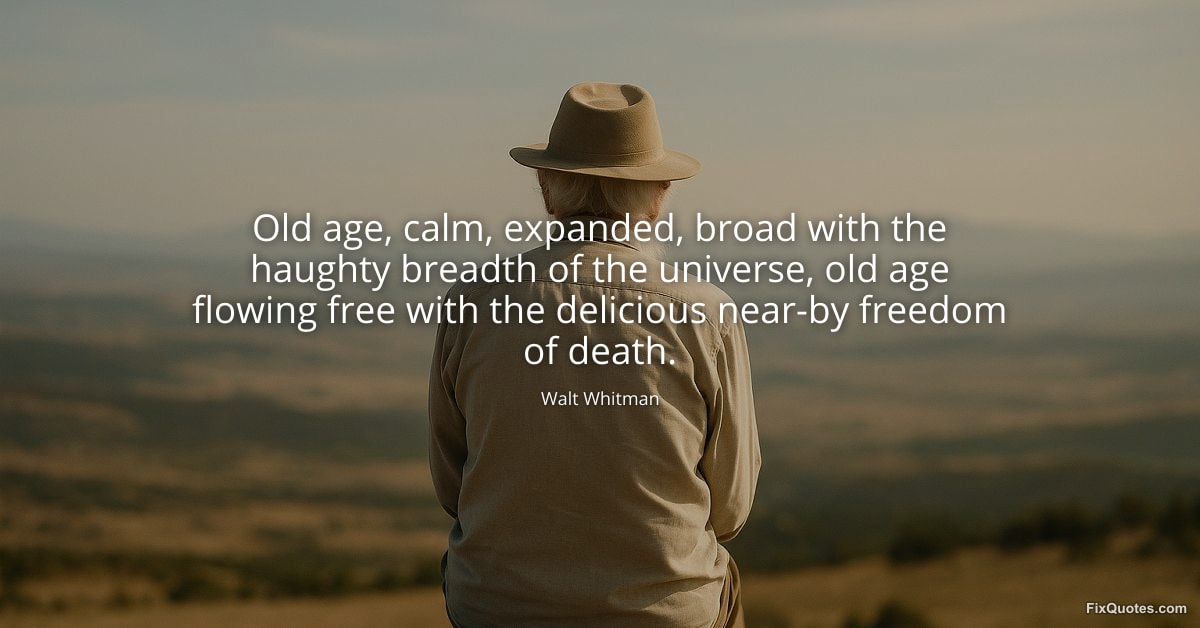
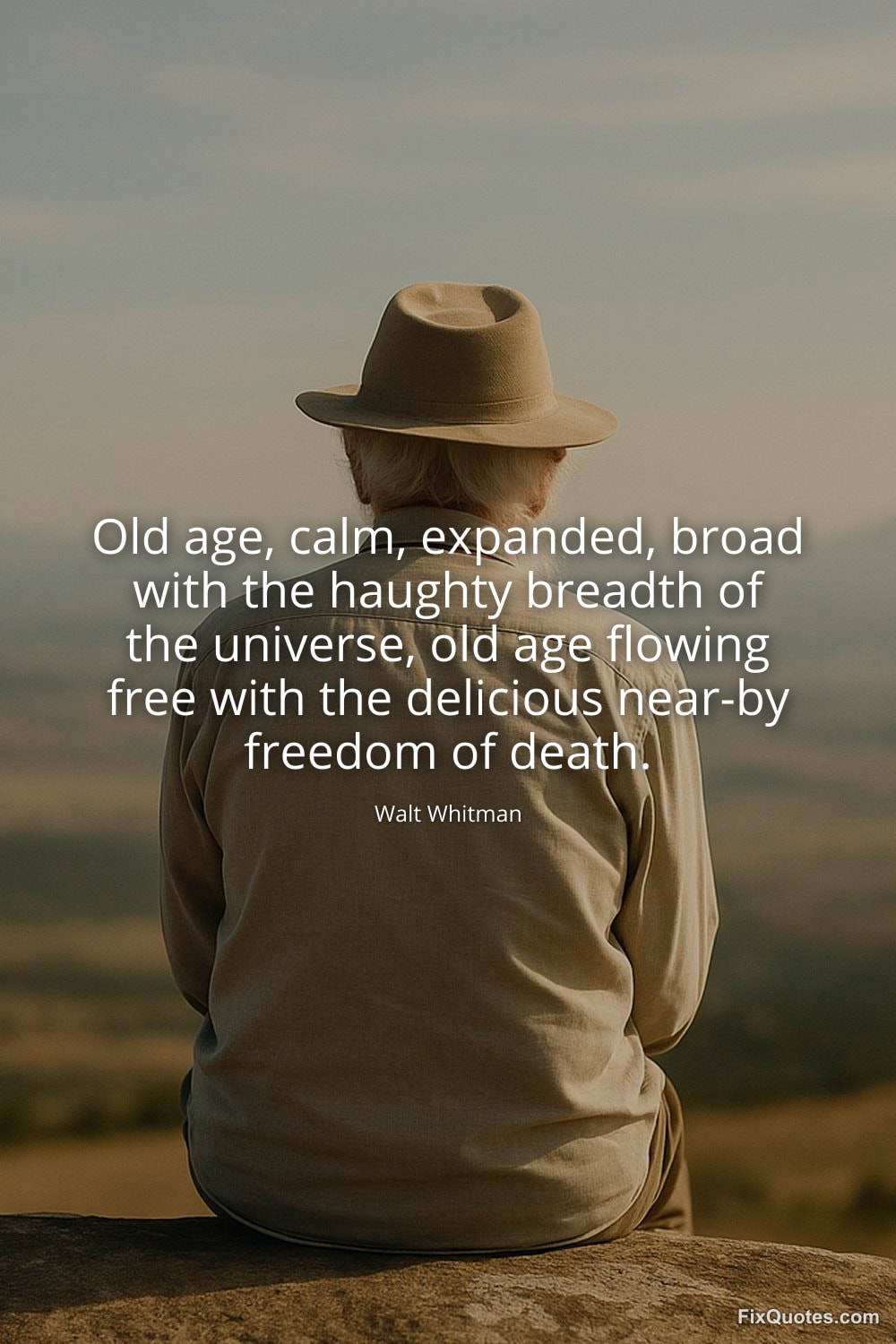
"Old age, calm, expanded, broad with the haughty breadth of the universe, old age flowing free with the delicious near-by freedom of death"
About this Quote
Then he drops the line that would have scandalized more prudish readers: "the delicious near-by freedom of death". "Delicious" refuses piety. Death isn’t a moral lesson or a shadowy threat; it’s proximity, a loosening of obligations, a release from the frantic self-management of youth and middle age. Whitman treats mortality as an intimate neighbor, not an executioner. That intimacy is the point: by bringing death close, he drains it of melodrama and turns it into a kind of permission.
Context matters. Whitman wrote out of a 19th-century America obsessed with progress and productivity, and he personally carried the Civil War’s mass death in his memory. This passage reads like a counter-program to that era’s nervous striving: a mature voice claiming that the final phase of life can be spacious, even ecstatic, because it no longer begs for time.
Quote Details
| Topic | Aging |
|---|---|
| Source | Song of the Open Road, section 12 |
| Cite |
Citation Formats
APA Style (7th ed.)
Whitman, Walt. (2026, January 15). Old age, calm, expanded, broad with the haughty breadth of the universe, old age flowing free with the delicious near-by freedom of death. FixQuotes. https://fixquotes.com/quotes/old-age-calm-expanded-broad-with-the-haughty-53242/
Chicago Style
Whitman, Walt. "Old age, calm, expanded, broad with the haughty breadth of the universe, old age flowing free with the delicious near-by freedom of death." FixQuotes. January 15, 2026. https://fixquotes.com/quotes/old-age-calm-expanded-broad-with-the-haughty-53242/.
MLA Style (9th ed.)
"Old age, calm, expanded, broad with the haughty breadth of the universe, old age flowing free with the delicious near-by freedom of death." FixQuotes, 15 Jan. 2026, https://fixquotes.com/quotes/old-age-calm-expanded-broad-with-the-haughty-53242/. Accessed 7 Apr. 2026.