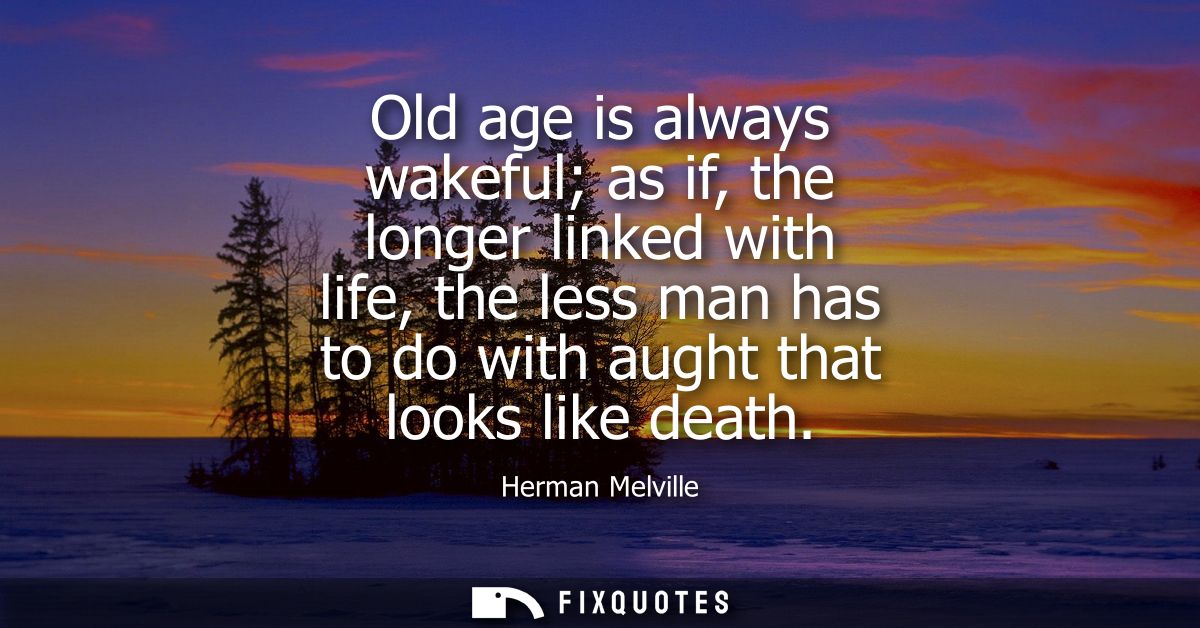
"Old age is always wakeful; as if, the longer linked with life, the less man has to do with aught that looks like death"
About this Quote
The sentence turns on a sly paradox: "the longer linked with life, the less man has to do with aught that looks like death". Time should make you intimate with dying; Melville argues it makes you alienated from it. The subtext is refusal - not denial in a naive sense, but a stubborn biological and psychological clinging. The body is weaker, the future smaller, yet the mind becomes more alert to the stakes. Wakefulness reads as vigilance: old age as a late-stage watchman, guarding the last scraps of agency.
It also hints at Melville’s broader preoccupation with the abyss. In Moby-Dick and later work, death isn’t a tidy endpoint; it’s an oceanic unknown that resists domestication. Here, the elderly aren’t sages serenely prepared for the dark. They’re people who have accumulated so much lived detail that death looks less familiar, not more - too blunt, too total, too unlike the complicated, stubborn continuities of being alive.
The syntax itself, with its looping clause and hesitant "as if", performs the idea: the mind circling, unable to settle. That’s the intent: old age as a state of heightened, uneasy attachment, where proximity to the end doesn’t breed acceptance, it breeds attention.
Quote Details
| Topic | Aging |
|---|---|
| Source | Verified source: Moby-Dick; or, The Whale (Herman Melville, 1851)
Evidence: Old age is always wakeful; as if, the longer linked with life, the less man has to do with aught that looks like death. (Chapter 29, "Enter Ahab; to Him, Stubb"). This quote is verifiably from Herman Melville's novel Moby-Dick; or, The Whale, first published in 1851. The line appears in Chapter 29, "Enter Ahab; to Him, Stubb." Search results from Project Gutenberg and Lit2Go both show the passage in that chapter. I could verify the chapter placement directly, but not a definitive page number from the 1851 first American edition from the sources I accessed, since page numbers vary by edition. The earliest primary-source publication is the 1851 book itself. Other candidates (1) The Ageing Brain (Lawrence Whalley, 2012) compilation96.0% ... Herman Melville observed in his novel Moby Dick that 'old age is always wakeful; as if, the longer linked with li... |
| Cite |
Citation Formats
APA Style (7th ed.)
Melville, Herman. (2026, March 8). Old age is always wakeful; as if, the longer linked with life, the less man has to do with aught that looks like death. FixQuotes. https://fixquotes.com/quotes/old-age-is-always-wakeful-as-if-the-longer-linked-21451/
Chicago Style
Melville, Herman. "Old age is always wakeful; as if, the longer linked with life, the less man has to do with aught that looks like death." FixQuotes. March 8, 2026. https://fixquotes.com/quotes/old-age-is-always-wakeful-as-if-the-longer-linked-21451/.
MLA Style (9th ed.)
"Old age is always wakeful; as if, the longer linked with life, the less man has to do with aught that looks like death." FixQuotes, 8 Mar. 2026, https://fixquotes.com/quotes/old-age-is-always-wakeful-as-if-the-longer-linked-21451/. Accessed 31 Mar. 2026.