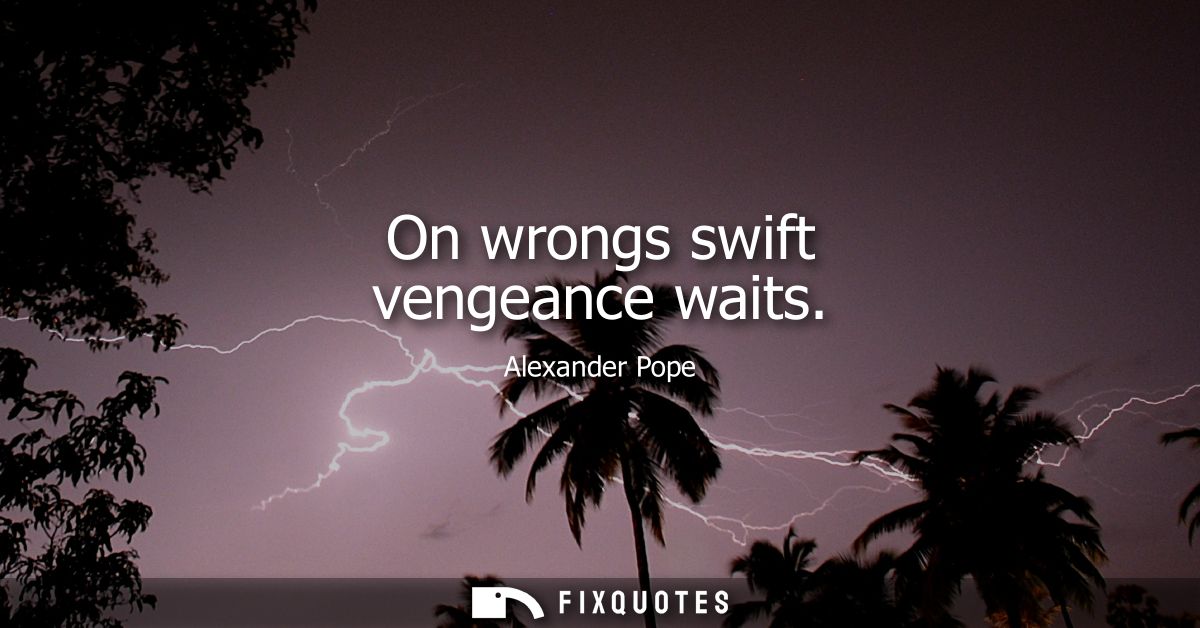
"On wrongs swift vengeance waits"
About this Quote
Pope compresses an entire moral universe into five clipped words, and the compression is the point. “On wrongs swift vengeance waits” isn’t advice so much as a mechanism: wrong-doing triggers a near-automatic response, as predictable as gravity. The sentence reads like a legal maxim, but its real power is psychological. It flatters the listener’s craving for order. You may not be able to stop the wrong, but you can trust that the universe keeps receipts.
The syntax does sly work. “Wrongs” comes first, as if the injury itself is the active ingredient, while “vengeance” arrives like an appointed official, already standing by. “Waits” is the twist: vengeance is both imminent and patient, a predator holding still. That patience smuggles in a warning to the wrongdoer and a sedative for the wronged. Don’t act; the system (whether God, fate, society, or your own conscience) will.
Context matters. Pope, a Catholic outsider in Protestant England and a poet steeped in Augustan ideals of balance and proportion, was obsessed with a world that should make sense even when it doesn’t. In his writing, retribution often functions as cosmic bookkeeping, a way to stabilize a culture anxious about corruption, class churn, and political rot. Yet the line also carries a dark edge: “vengeance” is not “justice.” Pope knows how easily moral certainty slides into punitive appetite. The phrase sells inevitability, but it also exposes our desire to outsource revenge to destiny, so we can feel righteous without getting our hands dirty.
The syntax does sly work. “Wrongs” comes first, as if the injury itself is the active ingredient, while “vengeance” arrives like an appointed official, already standing by. “Waits” is the twist: vengeance is both imminent and patient, a predator holding still. That patience smuggles in a warning to the wrongdoer and a sedative for the wronged. Don’t act; the system (whether God, fate, society, or your own conscience) will.
Context matters. Pope, a Catholic outsider in Protestant England and a poet steeped in Augustan ideals of balance and proportion, was obsessed with a world that should make sense even when it doesn’t. In his writing, retribution often functions as cosmic bookkeeping, a way to stabilize a culture anxious about corruption, class churn, and political rot. Yet the line also carries a dark edge: “vengeance” is not “justice.” Pope knows how easily moral certainty slides into punitive appetite. The phrase sells inevitability, but it also exposes our desire to outsource revenge to destiny, so we can feel righteous without getting our hands dirty.
Quote Details
| Topic | Justice |
|---|---|
| Source | Later attribution: Quote Unquote (A Handbook of Quotations) (M.P. Singh, 2005) modern compilationISBN: 9788183820080 · ID: WYIA-pEQTCAC
Evidence: ... On wrongs swift vengeance waits . " Alexander Pope " Vengeance taken will often tear the heart and torment the con- science . " - QUOTE UNQUOTE 281. Other candidates (1) The Odyssey of Homer (Alexander Pope, 1725)50.0% Behold on wrong Swift vengeance waits; and art subdues the strong! (Book VIII, line 367 (in Pope's translation number... |
| Cite |
Citation Formats
APA Style (7th ed.)
Pope, Alexander. (2026, March 10). On wrongs swift vengeance waits. FixQuotes. https://fixquotes.com/quotes/on-wrongs-swift-vengeance-waits-3341/
Chicago Style
Pope, Alexander. "On wrongs swift vengeance waits." FixQuotes. March 10, 2026. https://fixquotes.com/quotes/on-wrongs-swift-vengeance-waits-3341/.
MLA Style (9th ed.)
"On wrongs swift vengeance waits." FixQuotes, 10 Mar. 2026, https://fixquotes.com/quotes/on-wrongs-swift-vengeance-waits-3341/. Accessed 31 Mar. 2026.
More Quotes by Alexander
Add to List