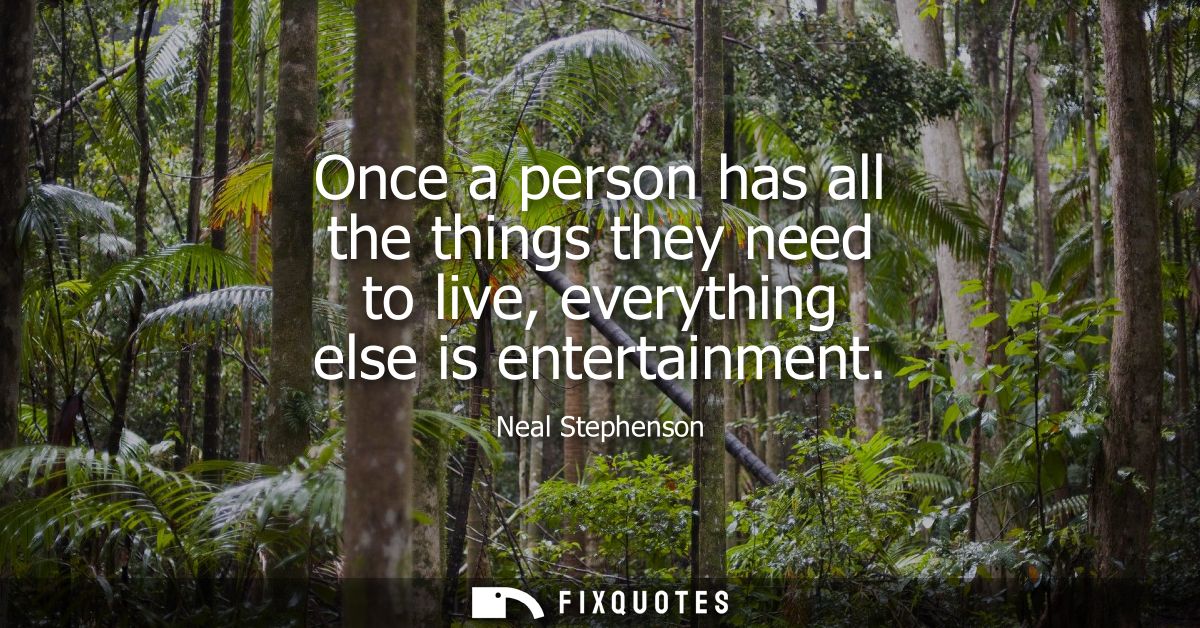
"Once a person has all the things they need to live, everything else is entertainment"
About this Quote
The subtext is that late-capitalist abundance doesn’t liberate us from wanting; it professionalizes wanting. Entertainment becomes the default wrapper for everything discretionary: shopping as sport, politics as fandom, tech as magic show. Stephenson, a novelist who’s spent decades dissecting how systems and stories co-produce reality, is quietly pointing out that “needs” are finite but “wants” can be engineered into infinity. The line works because it’s both true and baiting: readers instinctively object (“healthcare isn’t entertainment,” “education isn’t entertainment”), then realize how often those domains are sold, packaged, and experienced like content.
Context matters. Coming from a science-fiction writer steeped in cyberculture and consumer tech, it reads less like moral scolding and more like a field note: a civilization that has solved calories and shelter still has to do something with its surplus attention. And attention, Stephenson implies, is the real scarce resource being mined.
Quote Details
| Topic | Contentment |
|---|---|
| Source | Help us find the source |
| Cite |
Citation Formats
APA Style (7th ed.)
Stephenson, Neal. (2026, January 16). Once a person has all the things they need to live, everything else is entertainment. FixQuotes. https://fixquotes.com/quotes/once-a-person-has-all-the-things-they-need-to-104901/
Chicago Style
Stephenson, Neal. "Once a person has all the things they need to live, everything else is entertainment." FixQuotes. January 16, 2026. https://fixquotes.com/quotes/once-a-person-has-all-the-things-they-need-to-104901/.
MLA Style (9th ed.)
"Once a person has all the things they need to live, everything else is entertainment." FixQuotes, 16 Jan. 2026, https://fixquotes.com/quotes/once-a-person-has-all-the-things-they-need-to-104901/. Accessed 6 Apr. 2026.