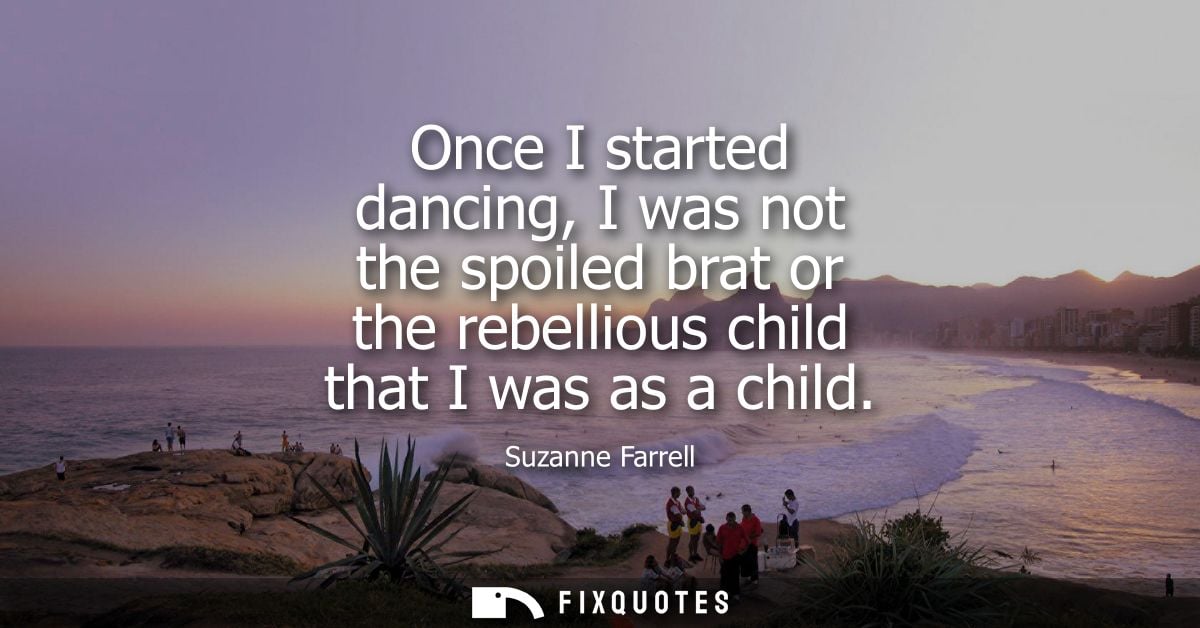
"Once I started dancing, I was not the spoiled brat or the rebellious child that I was as a child"
About this Quote
Her phrasing is bluntly self-incriminating - “spoiled brat,” “rebellious child” - which reads less like confession than like reclaiming the narrative. She names the stereotypes before anyone else can. Then she counters them with a third identity: dancer. The subtext is that discipline can be a kind of reinvention, not in the cheesy “art saved me” way, but in a concrete, bodily way. Ballet is structure, hierarchy, pain, repetition. You don’t get to be merely “rebellious” in the studio; you have to translate raw temperament into technique.
Context sharpens the intent. Farrell emerged in a world where ballet demanded not just talent but compliance: the body must obey, the ego must negotiate with choreography, the artist must submit to rehearsal. Her sentence hints at why dance can function like social camouflage and self-clarification at once. Onstage, you’re allowed intensity without being “difficult.” You can be forceful, exacting, even defiant - as long as it reads as artistry.
Quote Details
| Topic | Reinvention |
|---|---|
| Source | Help us find the source |
| Cite |
Citation Formats
APA Style (7th ed.)
Farrell, Suzanne. (2026, January 17). Once I started dancing, I was not the spoiled brat or the rebellious child that I was as a child. FixQuotes. https://fixquotes.com/quotes/once-i-started-dancing-i-was-not-the-spoiled-brat-82201/
Chicago Style
Farrell, Suzanne. "Once I started dancing, I was not the spoiled brat or the rebellious child that I was as a child." FixQuotes. January 17, 2026. https://fixquotes.com/quotes/once-i-started-dancing-i-was-not-the-spoiled-brat-82201/.
MLA Style (9th ed.)
"Once I started dancing, I was not the spoiled brat or the rebellious child that I was as a child." FixQuotes, 17 Jan. 2026, https://fixquotes.com/quotes/once-i-started-dancing-i-was-not-the-spoiled-brat-82201/. Accessed 5 Mar. 2026.