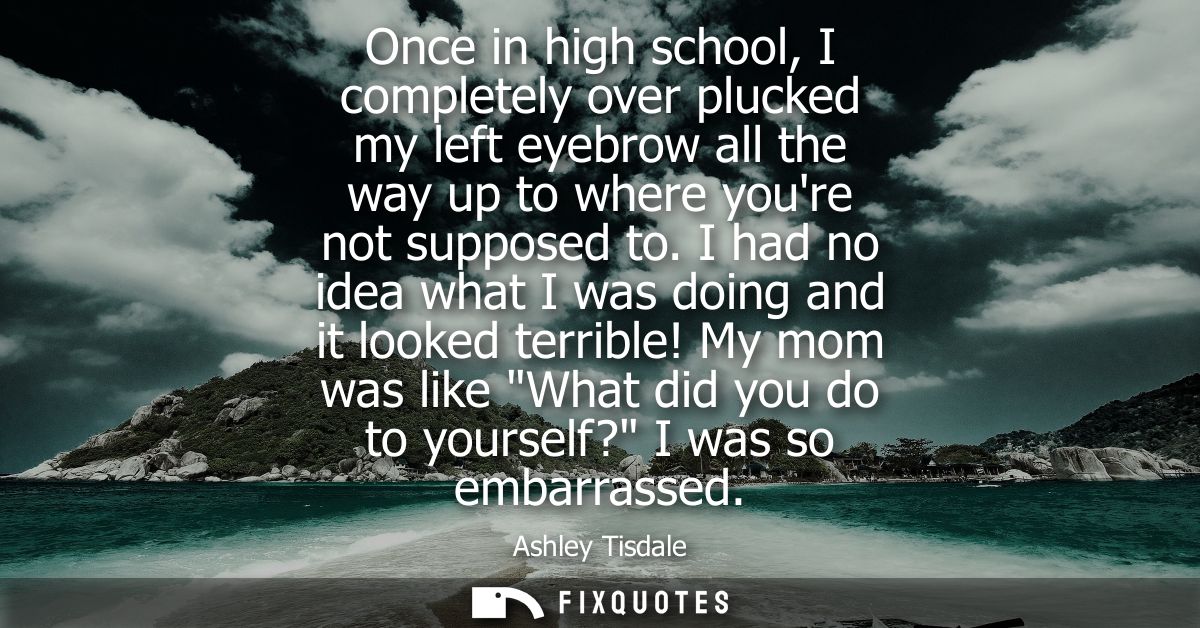
"Once in high school, I completely over plucked my left eyebrow all the way up to where you're not supposed to. I had no idea what I was doing and it looked terrible! My mom was like, "What did you do to yourself?" I was so embarrassed""
About this Quote
Her mom's blunt line - "What did you do to yourself?" - is doing more than parental scolding. It's a miniature culture critique, framing beauty labor as self-inflicted harm. The subtext is that girls are expected to curate their faces early, with limited tools and maximum scrutiny, then get punished for the inevitable missteps. Tisdale doesn't position herself as a victim of the industry; she positions herself as a kid trying to keep up. That matters coming from an actress whose public image was shaped in the 2000s, an era of thin brows, flash photography, and tabloid-grade policing of minor flaws.
The embarrassment is the emotional punchline, but also the point: shame is the enforcement mechanism that keeps beauty norms working. By narrating a small humiliation, she normalizes imperfection without turning it into a brand. It's not empowerment rhetoric; it's recognition, which is often more convincing.
Quote Details
| Topic | Funny |
|---|---|
| Source | Help us find the source |
| Cite |
Citation Formats
APA Style (7th ed.)
Tisdale, Ashley. (2026, February 17). Once in high school, I completely over plucked my left eyebrow all the way up to where you're not supposed to. I had no idea what I was doing and it looked terrible! My mom was like, "What did you do to yourself?" I was so embarrassed". FixQuotes. https://fixquotes.com/quotes/once-in-high-school-i-completely-over-plucked-my-123171/
Chicago Style
Tisdale, Ashley. "Once in high school, I completely over plucked my left eyebrow all the way up to where you're not supposed to. I had no idea what I was doing and it looked terrible! My mom was like, "What did you do to yourself?" I was so embarrassed"." FixQuotes. February 17, 2026. https://fixquotes.com/quotes/once-in-high-school-i-completely-over-plucked-my-123171/.
MLA Style (9th ed.)
"Once in high school, I completely over plucked my left eyebrow all the way up to where you're not supposed to. I had no idea what I was doing and it looked terrible! My mom was like, "What did you do to yourself?" I was so embarrassed"." FixQuotes, 17 Feb. 2026, https://fixquotes.com/quotes/once-in-high-school-i-completely-over-plucked-my-123171/. Accessed 31 Mar. 2026.