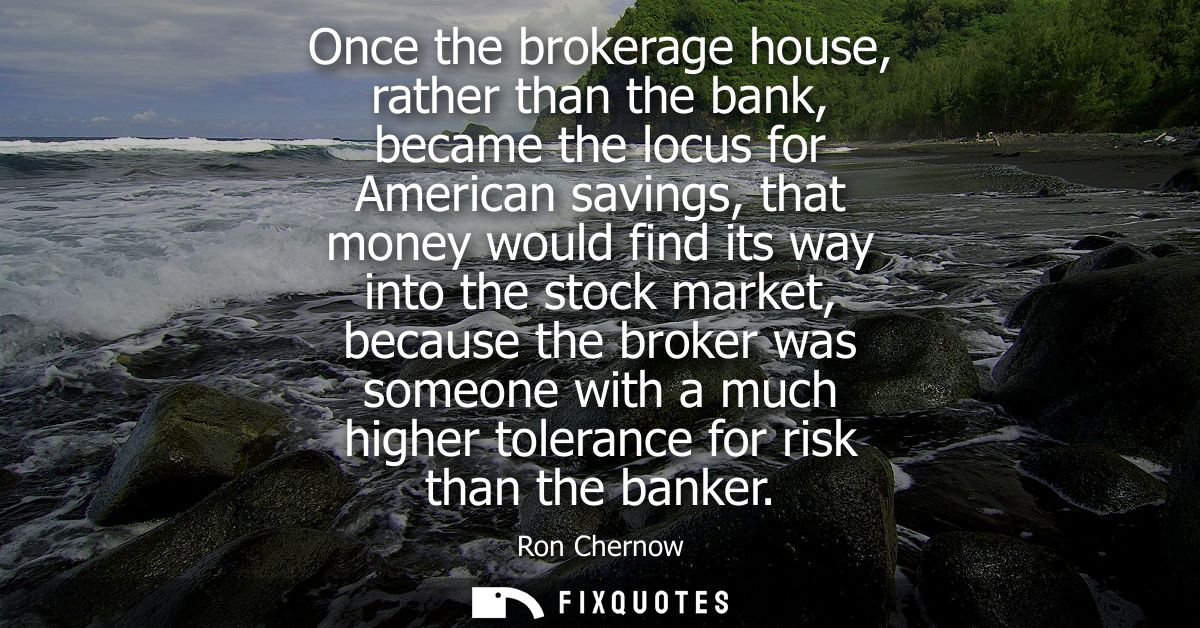
"Once the brokerage house, rather than the bank, became the locus for American savings, that money would find its way into the stock market, because the broker was someone with a much higher tolerance for risk than the banker"
About this Quote
The subtext is that “tolerance for risk” isn’t an individual virtue Americans suddenly discovered; it’s a cultivated posture, encouraged by whichever intermediary holds the public’s money. Put your savings in a bank and the system nudges you toward stability. Put them in the hands of a broker and the system nudges you toward exposure. Chernow’s phrasing makes this feel almost inevitable: once the locus changes, the destination follows. That’s a critique of structural power disguised as plain economic logic.
Contextually, this reads like a historian’s explanation for the financialization of everyday life: retirement accounts tied to markets, household wealth riding equities, booms and panics becoming kitchen-table events. It also carries a warning. When the cultural center of gravity moves from safeguarding deposits to selling possibility, risk stops being exceptional. It becomes the baseline, and the public learns to experience volatility as normal civic weather.
Quote Details
| Topic | Investment |
|---|---|
| Source | Help us find the source |
| Cite |
Citation Formats
APA Style (7th ed.)
Chernow, Ron. (2026, January 16). Once the brokerage house, rather than the bank, became the locus for American savings, that money would find its way into the stock market, because the broker was someone with a much higher tolerance for risk than the banker. FixQuotes. https://fixquotes.com/quotes/once-the-brokerage-house-rather-than-the-bank-102737/
Chicago Style
Chernow, Ron. "Once the brokerage house, rather than the bank, became the locus for American savings, that money would find its way into the stock market, because the broker was someone with a much higher tolerance for risk than the banker." FixQuotes. January 16, 2026. https://fixquotes.com/quotes/once-the-brokerage-house-rather-than-the-bank-102737/.
MLA Style (9th ed.)
"Once the brokerage house, rather than the bank, became the locus for American savings, that money would find its way into the stock market, because the broker was someone with a much higher tolerance for risk than the banker." FixQuotes, 16 Jan. 2026, https://fixquotes.com/quotes/once-the-brokerage-house-rather-than-the-bank-102737/. Accessed 5 Apr. 2026.