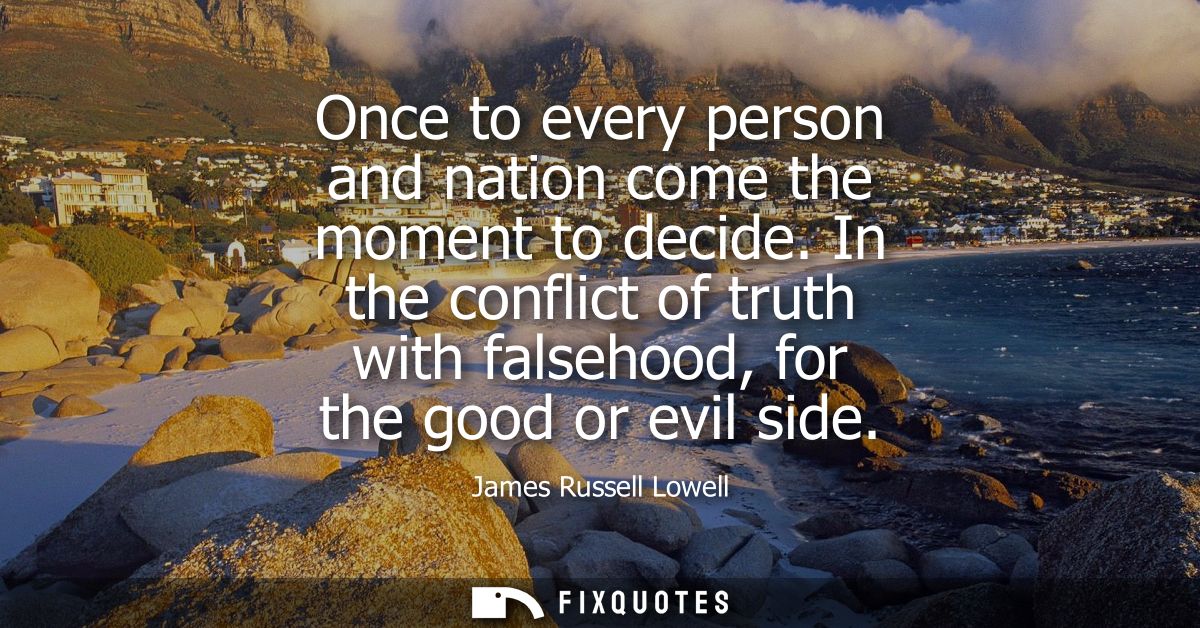
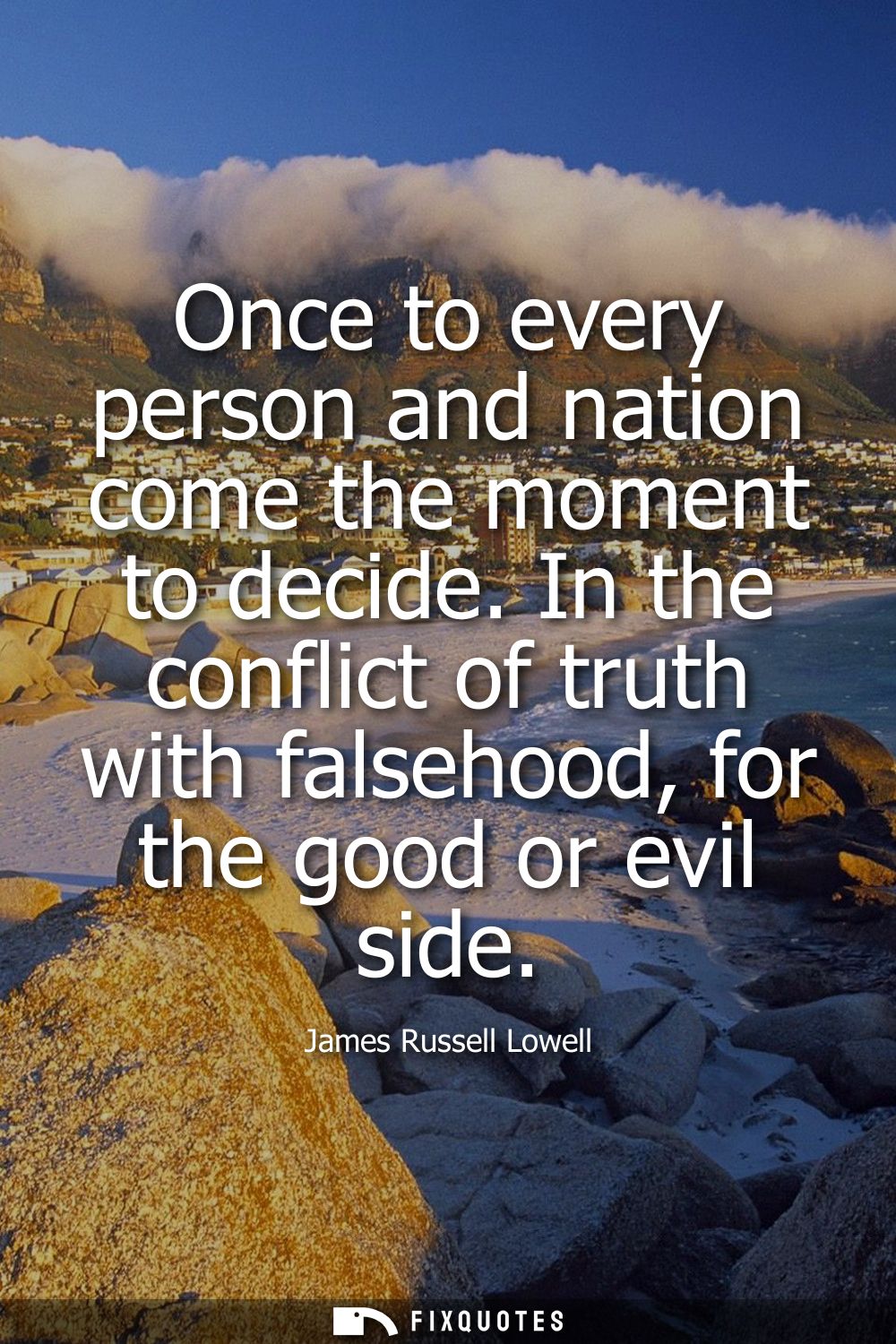
"Once to every person and nation come the moment to decide. In the conflict of truth with falsehood, for the good or evil side"
About this Quote
The line’s pressure comes from its stark binaries: “truth with falsehood,” “good or evil.” That’s not naivete; it’s strategy. Lowell is writing abolitionist-era moral rhetoric, when moderation often functioned as a respectable costume for delay. By refusing the comforting language of “both sides” or “tragic dilemmas,” he tries to make neutrality feel like an active choice for the wrong camp. The subtext is accusatory: if you’re waiting for perfect information, you’re already voting with your feet.
As a poet, Lowell is also leveraging cadence as persuasion. The sentence moves like a civic hymn, designed for recitation, for rallies, for classrooms - a portable piece of conscience. Its authority is less about providing an argument than about imposing a frame: reality is a “conflict,” and you are already enlisted.
There’s a risk baked in, too. Absolutist language can be hijacked by anyone claiming “truth.” Lowell’s intent is to mobilize moral clarity; the uncomfortable legacy is that clarity always invites counterfeits.
Quote Details
| Topic | Truth |
|---|---|
| Source | James Russell Lowell, "The Present Crisis" (1845), stanza beginning "Once to every man and nation..." (original poem containing the quoted lines). |
| Cite |
Citation Formats
APA Style (7th ed.)
Lowell, James Russell. (2026, January 17). Once to every person and nation come the moment to decide. In the conflict of truth with falsehood, for the good or evil side. FixQuotes. https://fixquotes.com/quotes/once-to-every-person-and-nation-come-the-moment-34051/
Chicago Style
Lowell, James Russell. "Once to every person and nation come the moment to decide. In the conflict of truth with falsehood, for the good or evil side." FixQuotes. January 17, 2026. https://fixquotes.com/quotes/once-to-every-person-and-nation-come-the-moment-34051/.
MLA Style (9th ed.)
"Once to every person and nation come the moment to decide. In the conflict of truth with falsehood, for the good or evil side." FixQuotes, 17 Jan. 2026, https://fixquotes.com/quotes/once-to-every-person-and-nation-come-the-moment-34051/. Accessed 12 Feb. 2026.