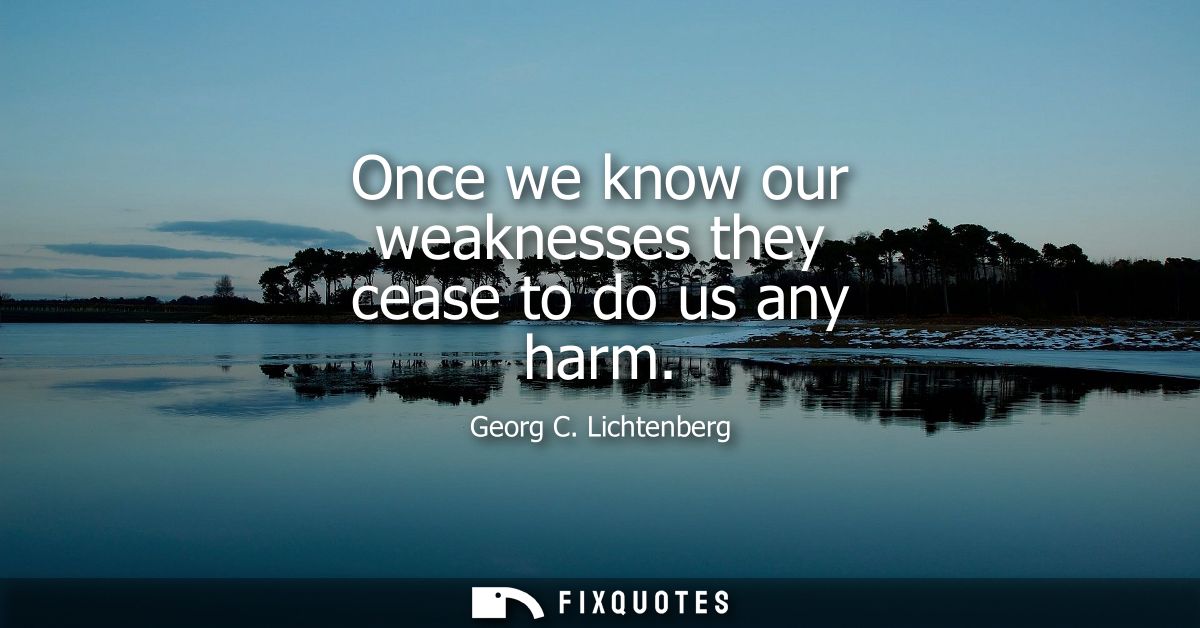
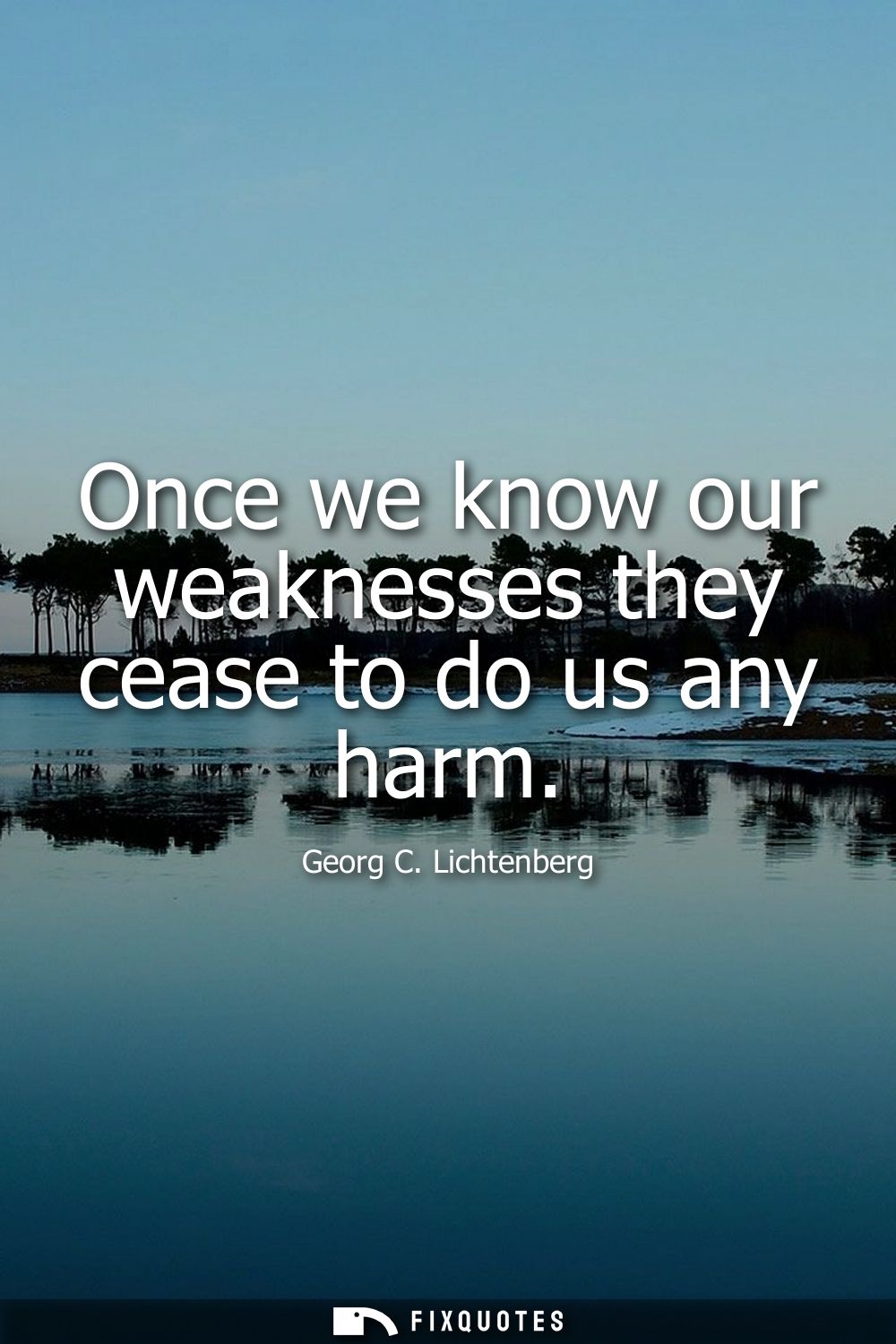
"Once we know our weaknesses, they cease to do us any harm"
About this Quote
Self-knowledge is framed here not as a noble mirror but as a safety mechanism: name the weakness and it loses its fangs. Lichtenberg, a scientist with a satirist's bite, compresses an entire Enlightenment program into one clean, almost clinical proposition. The sentence works because it treats the psyche like a system you can debug. The harm doesn’t disappear because the flaw vanishes; it disappears because the flaw stops operating in the dark.
The subtext is quietly ruthless about human vanity. We’re not undone by weakness itself so much as by the stories we tell to avoid seeing it: rationalizations, inflated self-images, denial disguised as principle. Once a weakness is illuminated, it can’t as easily masquerade as destiny or virtue. Pride becomes insecurity with a label. Impulsiveness becomes a pattern you can predict. In that shift, the weakness is demoted from puppet master to data point.
Context matters: late-18th-century Europe is busy replacing moral certainty with empirical habits of mind. Lichtenberg, famous for his notebooks and aphorisms, distrusts grand systems but loves precise observation - especially of the self. His line carries that experimental ethos: observe, identify, reduce error.
Of course, the claim is also slyly optimistic, and that’s where the irony flickers. Knowing you’re vain doesn’t automatically make you humble; it just makes you harder to fool. The harm “ceases” not because you’ve achieved virtue, but because you’ve gained leverage. In a culture that still sells transformation as revelation, Lichtenberg offers something sharper: awareness as containment.
The subtext is quietly ruthless about human vanity. We’re not undone by weakness itself so much as by the stories we tell to avoid seeing it: rationalizations, inflated self-images, denial disguised as principle. Once a weakness is illuminated, it can’t as easily masquerade as destiny or virtue. Pride becomes insecurity with a label. Impulsiveness becomes a pattern you can predict. In that shift, the weakness is demoted from puppet master to data point.
Context matters: late-18th-century Europe is busy replacing moral certainty with empirical habits of mind. Lichtenberg, famous for his notebooks and aphorisms, distrusts grand systems but loves precise observation - especially of the self. His line carries that experimental ethos: observe, identify, reduce error.
Of course, the claim is also slyly optimistic, and that’s where the irony flickers. Knowing you’re vain doesn’t automatically make you humble; it just makes you harder to fool. The harm “ceases” not because you’ve achieved virtue, but because you’ve gained leverage. In a culture that still sells transformation as revelation, Lichtenberg offers something sharper: awareness as containment.
Quote Details
| Topic | Self-Improvement |
|---|---|
| Source | Help us find the source |
| Cite |
Citation Formats
APA Style (7th ed.)
Lichtenberg, Georg C. (2026, February 19). Once we know our weaknesses, they cease to do us any harm. FixQuotes. https://fixquotes.com/quotes/once-we-know-our-weaknesses-they-cease-to-do-us-35026/
Chicago Style
Lichtenberg, Georg C. "Once we know our weaknesses, they cease to do us any harm." FixQuotes. February 19, 2026. https://fixquotes.com/quotes/once-we-know-our-weaknesses-they-cease-to-do-us-35026/.
MLA Style (9th ed.)
"Once we know our weaknesses, they cease to do us any harm." FixQuotes, 19 Feb. 2026, https://fixquotes.com/quotes/once-we-know-our-weaknesses-they-cease-to-do-us-35026/. Accessed 1 Apr. 2026.
More Quotes by Georg
Add to List