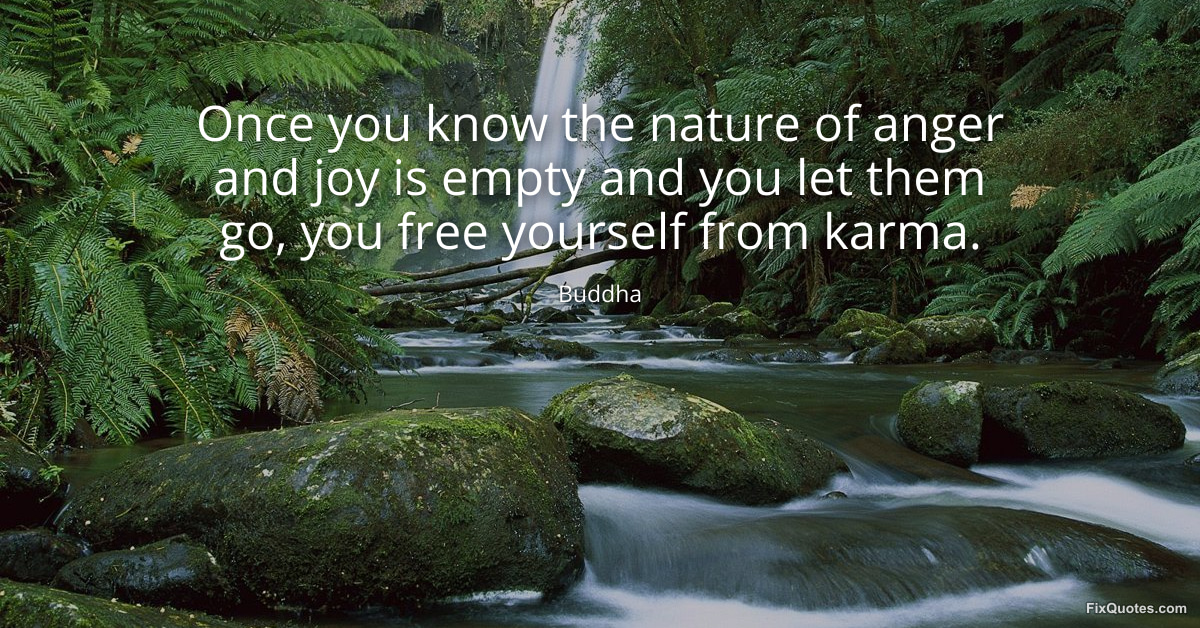
"Once you know the nature of anger and joy is empty and you let them go, you free yourself from karma"
About this Quote
That is where the second half lands with real force. Karma here is not a cosmic bookkeeping system so much as the chain reaction of attachment, craving, aversion, and repeated action. If you cling to joy, you generate longing and fear of loss. If you cling to anger, you generate retaliation, resentment, and suffering. Letting them go interrupts that machinery. The freedom being described is psychological and ethical at once.
The historical context matters. Early Buddhist teaching emerged against religious cultures deeply invested in ritual, status, and metaphysical certainty. Buddha shifts the focus inward, toward disciplined attention to the mind. The line carries the authority of a leader, but its rhetoric is almost clinical: observe experience clearly, stop mistaking passing states for truth, and the cycle loosens.
Its subtext is unsentimental and demanding. You are not imprisoned by feeling itself, but by your insistence on possessing it, obeying it, or calling it "me". That remains a startlingly modern diagnosis.
Quote Details
| Topic | Meditation |
|---|---|
| Source | Help us find the source |
| Cite |
Citation Formats
APA Style (7th ed.)
Buddha. (2026, March 10). Once you know the nature of anger and joy is empty and you let them go, you free yourself from karma. FixQuotes. https://fixquotes.com/quotes/once-you-know-the-nature-of-anger-and-joy-is-185987/
Chicago Style
Buddha. "Once you know the nature of anger and joy is empty and you let them go, you free yourself from karma." FixQuotes. March 10, 2026. https://fixquotes.com/quotes/once-you-know-the-nature-of-anger-and-joy-is-185987/.
MLA Style (9th ed.)
"Once you know the nature of anger and joy is empty and you let them go, you free yourself from karma." FixQuotes, 10 Mar. 2026, https://fixquotes.com/quotes/once-you-know-the-nature-of-anger-and-joy-is-185987/. Accessed 5 Apr. 2026.