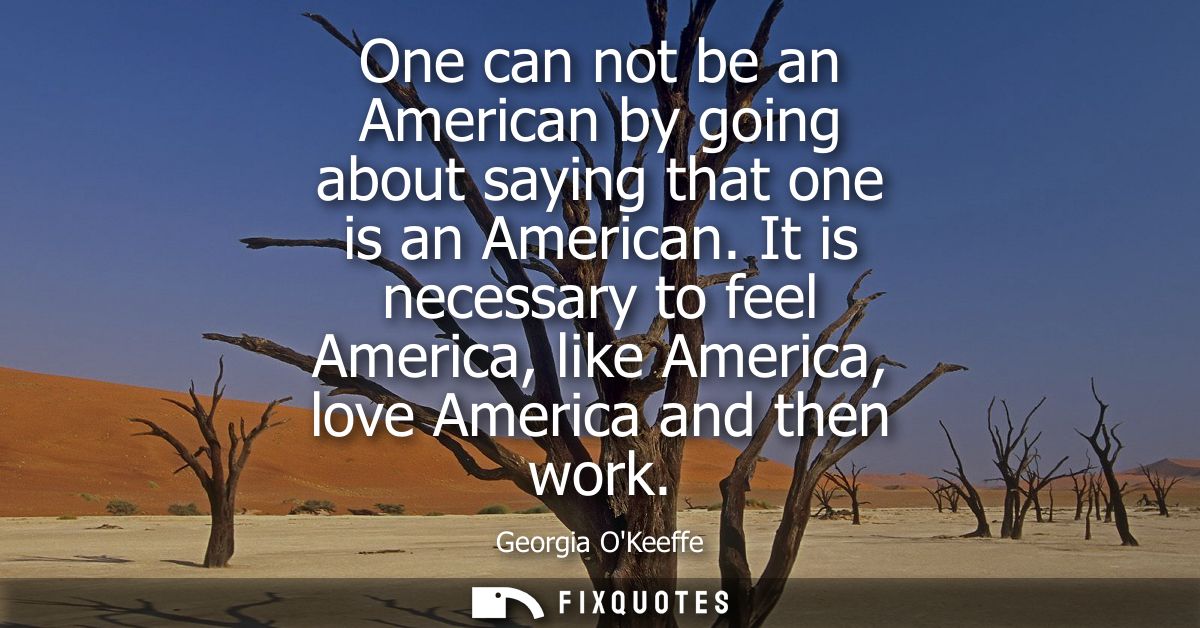
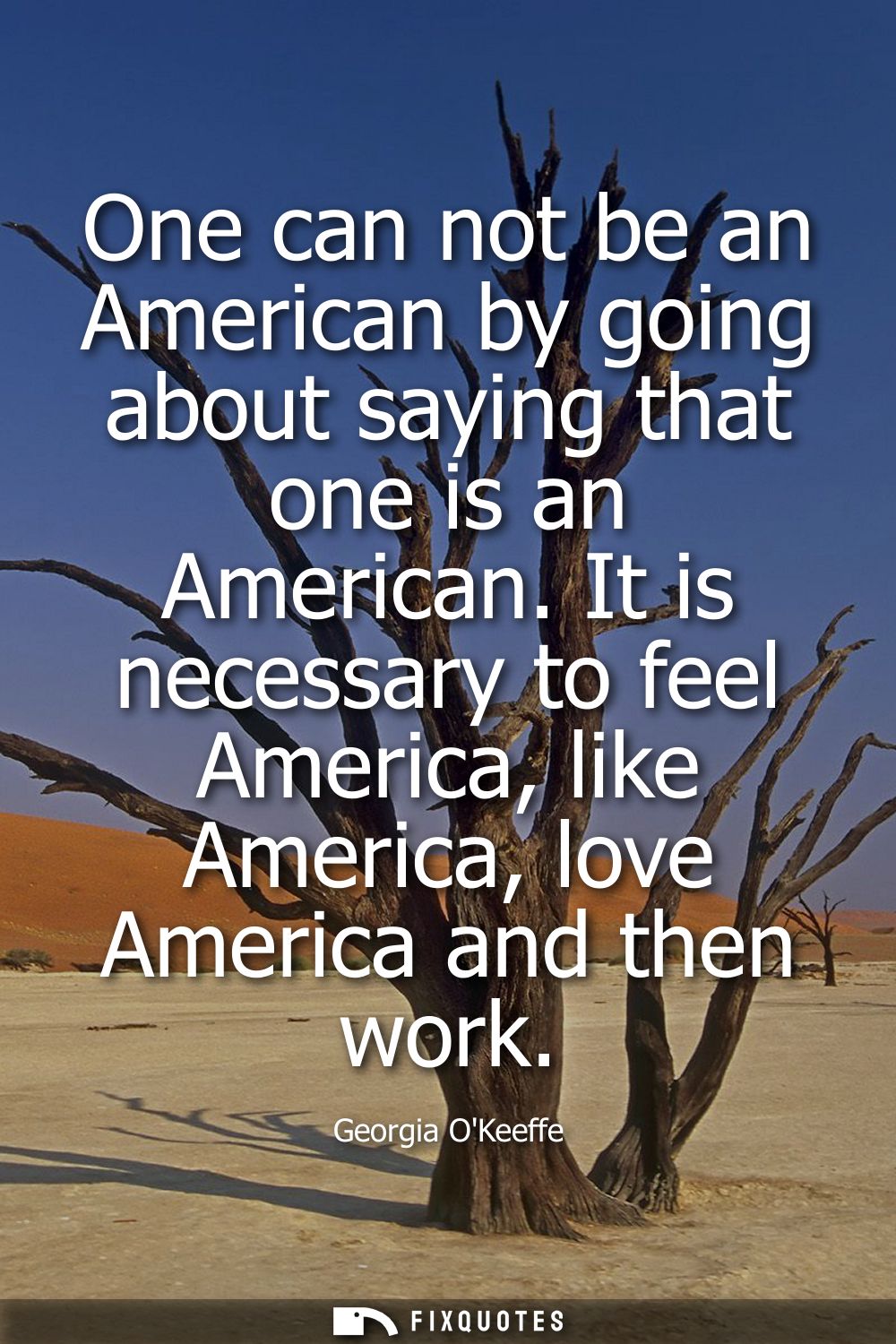
"One can not be an American by going about saying that one is an American. It is necessary to feel America, like America, love America, and then work"
About this Quote
The verbs do the real work. “Feel,” “like,” “love,” then “work” sketches a progression from interior attachment to outward responsibility. It’s not sentimental nationalism; it’s a demand for embodied belonging. The subtext is that America is not a static inheritance but a practice, something you have to participate in and, crucially, build. That final “then work” lands like a moral check on the romance of the landscape. O'Keeffe’s New Mexico paintings can look like pure rapture, but her life was also logistics, discipline, and choice: leaving New York’s art machinery, making a home in an austere place, committing to a vision.
Context matters: she lived through two world wars, the Great Depression, and the rise of mass advertising, eras when “Americanism” was routinely weaponized as purity test. Her line refuses both cynicism and chest-thumping. It suggests a quieter civic criterion: not what you claim, but what you commit to - emotionally, aesthetically, and practically. Being American, in her framing, is less a passport than a daily labor of attention and responsibility.
Quote Details
| Topic | Pride |
|---|---|
| Source | Help us find the source |
| Cite |
Citation Formats
APA Style (7th ed.)
O'Keeffe, Georgia. (2026, February 17). One can not be an American by going about saying that one is an American. It is necessary to feel America, like America, love America, and then work. FixQuotes. https://fixquotes.com/quotes/one-can-not-be-an-american-by-going-about-saying-16236/
Chicago Style
O'Keeffe, Georgia. "One can not be an American by going about saying that one is an American. It is necessary to feel America, like America, love America, and then work." FixQuotes. February 17, 2026. https://fixquotes.com/quotes/one-can-not-be-an-american-by-going-about-saying-16236/.
MLA Style (9th ed.)
"One can not be an American by going about saying that one is an American. It is necessary to feel America, like America, love America, and then work." FixQuotes, 17 Feb. 2026, https://fixquotes.com/quotes/one-can-not-be-an-american-by-going-about-saying-16236/. Accessed 30 Mar. 2026.