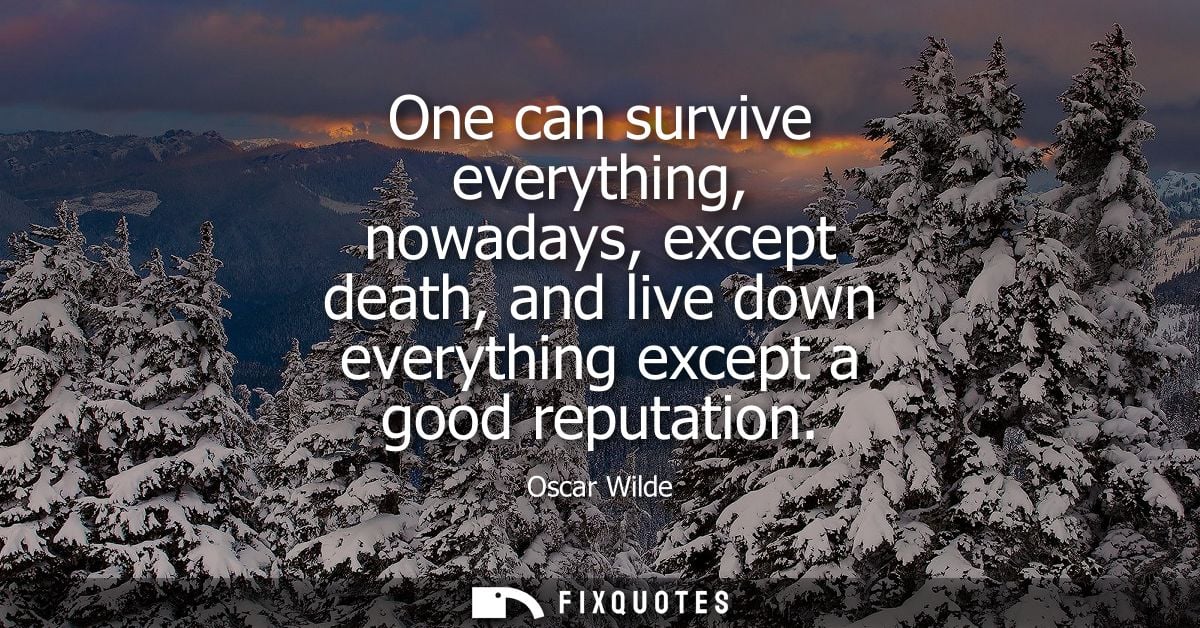
"One can survive everything, nowadays, except death, and live down everything except a good reputation"
About this Quote
That inversion is the subtextual engine. A “good reputation” sounds like a prize, but Wilde frames it as a trap: once you’re labeled respectable, you’re expected to perform respectability forever. Reputation becomes a social contract written by other people, policed by gossip, and enforced through exclusion. Bad behavior can be narrated away as a phase; virtue becomes a brand you’re not allowed to revise. Wilde, who understood the theater of manners better than almost anyone, is pointing out that society forgives sins more easily than it forgives sincerity.
The “nowadays” matters. It’s Wilde placing modernity in the dock: the late-19th-century world of newspapers, salons, and public spectacle where identity is constantly adjudicated. He’s also writing with an artist’s self-defense. For a dramatist who trafficked in paradox, a spotless reputation would be aesthetic suffocation. Coming from a man later punished brutally for his private life, the line reads less like idle epigram and more like a smirking premonition: society can tolerate transgression as entertainment, but it cannot tolerate anyone refusing its script.
Quote Details
| Topic | Mortality |
|---|---|
| Source | Help us find the source |
| Cite |
Citation Formats
APA Style (7th ed.)
Wilde, Oscar. (2026, January 16). One can survive everything, nowadays, except death, and live down everything except a good reputation. FixQuotes. https://fixquotes.com/quotes/one-can-survive-everything-nowadays-except-death-83357/
Chicago Style
Wilde, Oscar. "One can survive everything, nowadays, except death, and live down everything except a good reputation." FixQuotes. January 16, 2026. https://fixquotes.com/quotes/one-can-survive-everything-nowadays-except-death-83357/.
MLA Style (9th ed.)
"One can survive everything, nowadays, except death, and live down everything except a good reputation." FixQuotes, 16 Jan. 2026, https://fixquotes.com/quotes/one-can-survive-everything-nowadays-except-death-83357/. Accessed 4 Mar. 2026.