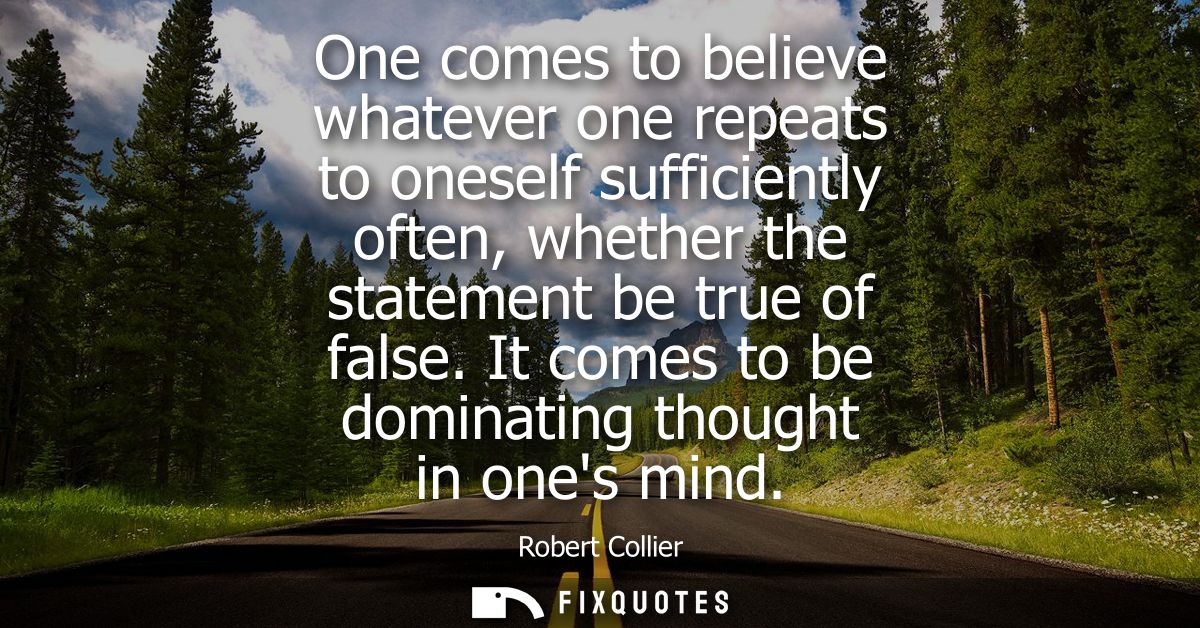
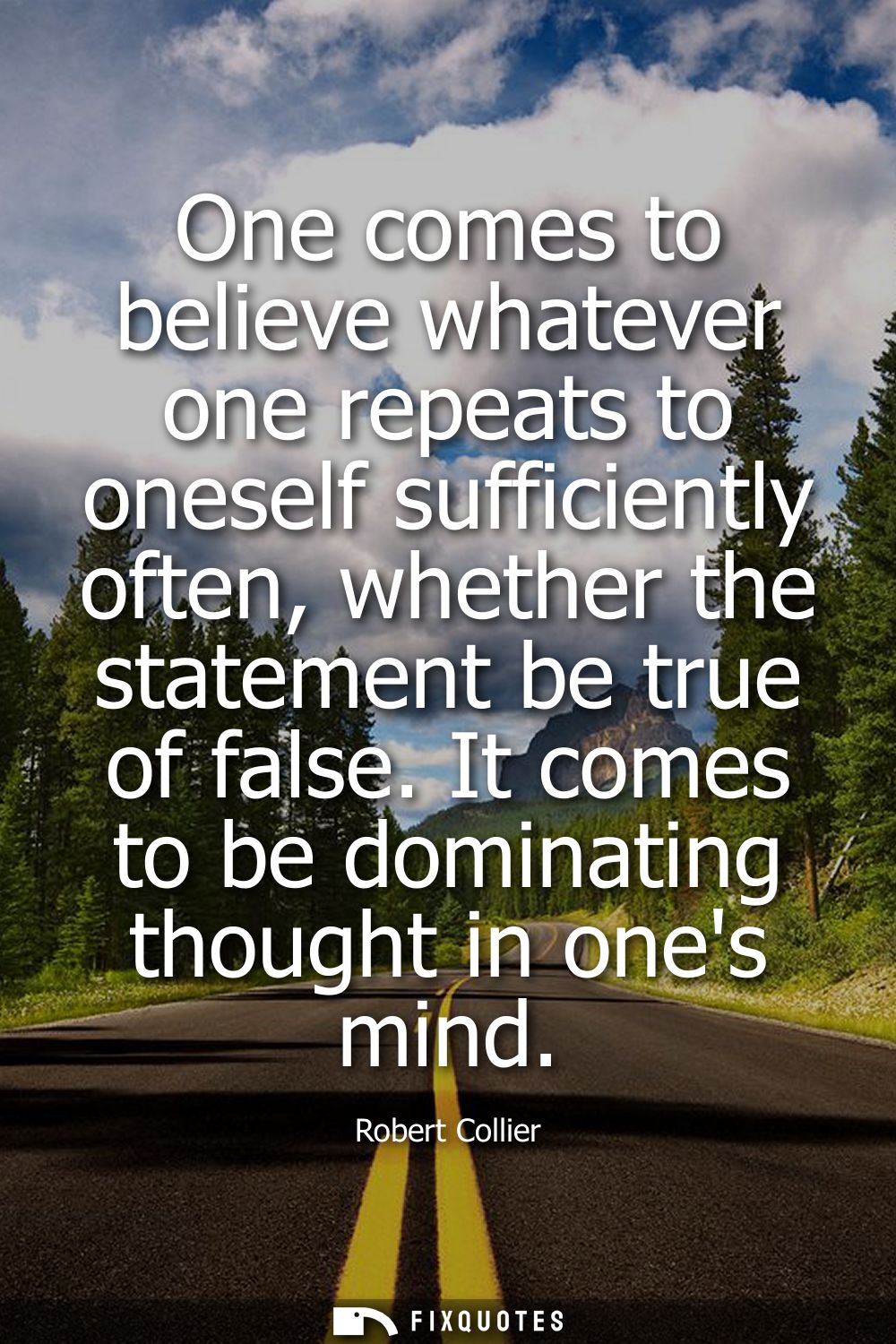
"One comes to believe whatever one repeats to oneself sufficiently often, whether the statement be true of false. It comes to be dominating thought in one's mind"
About this Quote
The intent is practical, almost instructional. Repeat a thought until it stops feeling like a visitor and starts acting like the landlord. Collier’s phrasing is blunt about the danger too. “Whether the statement be true or false” isn’t a throwaway caveat; it’s the point. He’s warning that the same mechanism that builds confidence also manufactures delusion. The subtext is unsettlingly modern: your inner monologue is an algorithm, and frequency beats accuracy.
“Dominating thought” suggests a hostile takeover rather than a gentle persuasion. Repetition doesn’t merely persuade; it crowds out competitors. That’s the psychological realism here: attention is finite, and whatever you loop gains priority, emotional charge, and eventually identity. You don’t just think the thought; you become the person who thinks it.
Culturally, the quote sits at the crossroads of advertising, mass media, and self-improvement, when slogans and affirmations were becoming everyday tools. Read now, it feels like a precursor to everything from brand messaging to doomscrolling: what you feed yourself, you will start to believe. The unsettling implication is that “truth” is often just the most repeated sentence in the room - including the room inside your head.
Quote Details
| Topic | Habits |
|---|---|
| Source | Help us find the source |
| Cite |
Citation Formats
APA Style (7th ed.)
Collier, Robert. (2026, January 15). One comes to believe whatever one repeats to oneself sufficiently often, whether the statement be true of false. It comes to be dominating thought in one's mind. FixQuotes. https://fixquotes.com/quotes/one-comes-to-believe-whatever-one-repeats-to-8883/
Chicago Style
Collier, Robert. "One comes to believe whatever one repeats to oneself sufficiently often, whether the statement be true of false. It comes to be dominating thought in one's mind." FixQuotes. January 15, 2026. https://fixquotes.com/quotes/one-comes-to-believe-whatever-one-repeats-to-8883/.
MLA Style (9th ed.)
"One comes to believe whatever one repeats to oneself sufficiently often, whether the statement be true of false. It comes to be dominating thought in one's mind." FixQuotes, 15 Jan. 2026, https://fixquotes.com/quotes/one-comes-to-believe-whatever-one-repeats-to-8883/. Accessed 27 Mar. 2026.