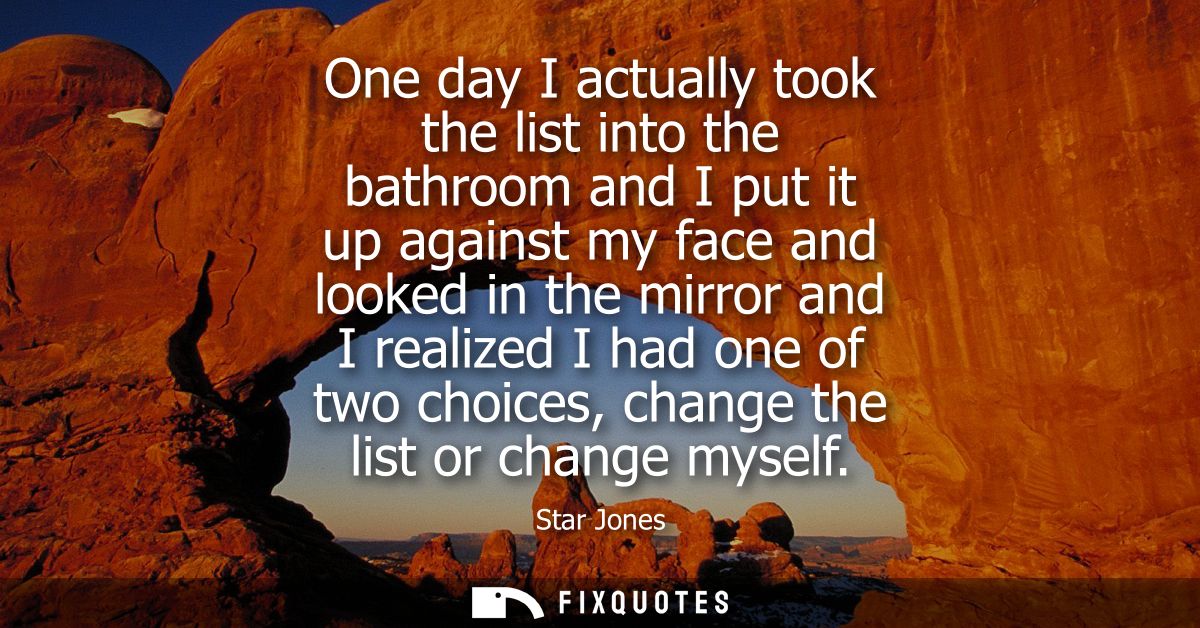
"One day I actually took the list into the bathroom and I put it up against my face and looked in the mirror and I realized I had one of two choices, change the list or change myself"
About this Quote
The line’s power comes from its blunt binary: change the list or change myself. That structure mimics the kind of tough-love clarity that daytime TV made legible in the late 1990s and early 2000s, when personal transformation was packaged as both empowerment and entertainment. Jones, as an entertainer and highly visible media personality, is speaking from inside a culture that inventories women constantly: bodies, careers, relationships, “brand.” A “list” is how that culture pretends to be rational about desire and self-worth. It’s also how it smuggles in shame.
Subtextually, the quote is about agency under pressure. “Change myself” can sound like growth, but it also hints at conformity - reshaping the self to satisfy an external rubric. “Change the list” is the radical option: revising the criteria, loosening perfectionism, refusing the idea that life is a checklist audition. The moment works because it doesn’t resolve the tension. It admits the choice is real, and that either path costs something.
Quote Details
| Topic | Reinvention |
|---|---|
| Source | Help us find the source |
| Cite |
Citation Formats
APA Style (7th ed.)
Jones, Star. (2026, January 16). One day I actually took the list into the bathroom and I put it up against my face and looked in the mirror and I realized I had one of two choices, change the list or change myself. FixQuotes. https://fixquotes.com/quotes/one-day-i-actually-took-the-list-into-the-102235/
Chicago Style
Jones, Star. "One day I actually took the list into the bathroom and I put it up against my face and looked in the mirror and I realized I had one of two choices, change the list or change myself." FixQuotes. January 16, 2026. https://fixquotes.com/quotes/one-day-i-actually-took-the-list-into-the-102235/.
MLA Style (9th ed.)
"One day I actually took the list into the bathroom and I put it up against my face and looked in the mirror and I realized I had one of two choices, change the list or change myself." FixQuotes, 16 Jan. 2026, https://fixquotes.com/quotes/one-day-i-actually-took-the-list-into-the-102235/. Accessed 31 Mar. 2026.