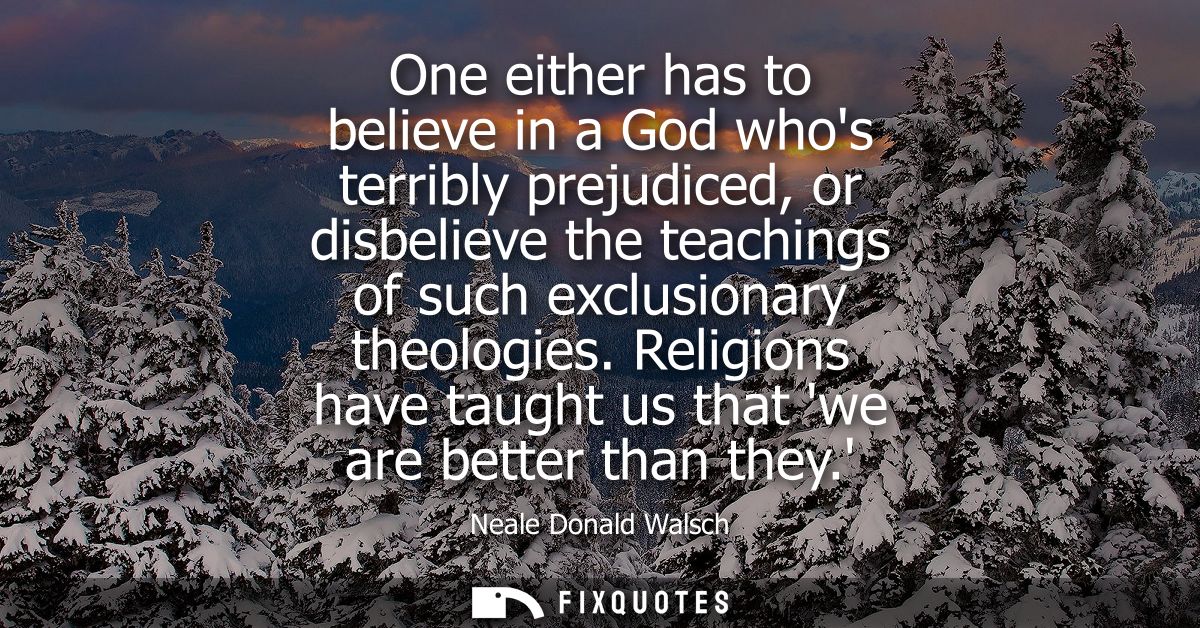
"One either has to believe in a God who's terribly prejudiced, or disbelieve the teachings of such exclusionary theologies. Religions have taught us that 'We are better than they.'"
About this Quote
The subtext isn’t just interfaith tolerance; it’s a diagnosis of how group identity works. “We are better than they” is less doctrine than social technology, a simple algorithm for cohesion: draw a border, attach cosmic consequences, and suddenly belonging feels like righteousness. Walsch’s phrasing “terribly prejudiced” is deliberately blunt, almost conversational, because he’s not arguing like a theologian. He’s arguing like someone who’s watched religion function as a badge, not a practice.
Context matters here. Walsch’s wider work (notably the 1990s Conversations with God books) rides a spiritual-but-skeptical wave that distrusts institutions while still craving transcendence. This quote channels post-Cold War, post-culture-war fatigue: a sense that the fiercest certainties are often just fear dressed up as faith. By framing exclusion as “teachings,” he also points a finger at human intermediaries - clergy, texts, traditions - without fully discarding the possibility of God. It’s a strategic separation: salvage the sacred, indict the gatekeepers.
Quote Details
| Topic | God |
|---|---|
| Source | Help us find the source |
| Cite |
Citation Formats
APA Style (7th ed.)
Walsch, Neale Donald. (2026, February 18). One either has to believe in a God who's terribly prejudiced, or disbelieve the teachings of such exclusionary theologies. Religions have taught us that 'We are better than they.'. FixQuotes. https://fixquotes.com/quotes/one-either-has-to-believe-in-a-god-whos-terribly-71641/
Chicago Style
Walsch, Neale Donald. "One either has to believe in a God who's terribly prejudiced, or disbelieve the teachings of such exclusionary theologies. Religions have taught us that 'We are better than they.'." FixQuotes. February 18, 2026. https://fixquotes.com/quotes/one-either-has-to-believe-in-a-god-whos-terribly-71641/.
MLA Style (9th ed.)
"One either has to believe in a God who's terribly prejudiced, or disbelieve the teachings of such exclusionary theologies. Religions have taught us that 'We are better than they.'." FixQuotes, 18 Feb. 2026, https://fixquotes.com/quotes/one-either-has-to-believe-in-a-god-whos-terribly-71641/. Accessed 5 Apr. 2026.