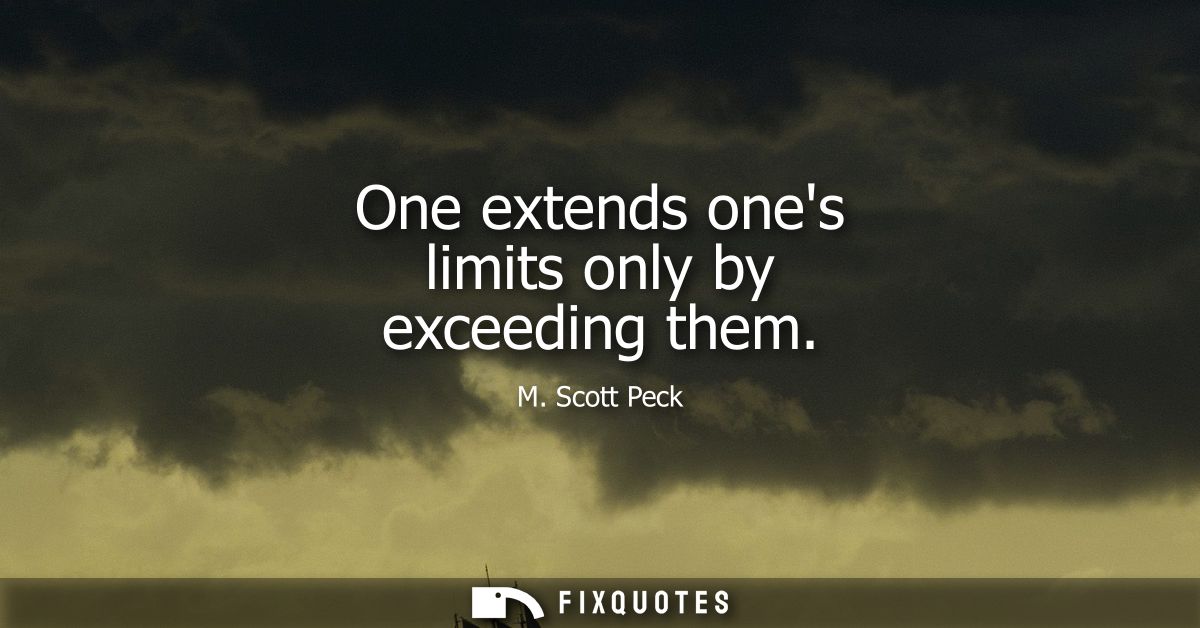
"One extends one's limits only by exceeding them"
About this Quote
A neat paradox in a lab coat: Peck smuggles a dare into the language of self-help. "One extends one's limits only by exceeding them" reads like a logical loop, but it lands as a moral claim about growth. The sentence refuses the comforting idea that you can expand gently, by education or insight alone. Peck’s intent is behavioral and disciplinary: change is not an internal realization that magically rearranges your habits; it is the costly act of doing what your current self-definition says you can’t.
The subtext is a rebuke to the modern obsession with "knowing yourself" as an end point. Peck, writing from a clinical and spiritual-leaning psychological tradition, treats the self less as a fixed identity to be honored and more as a set of boundaries to be negotiated. Limits are not simply constraints imposed by the world; they’re also protective stories we tell to avoid pain, risk, or responsibility. Exceeding them implies discomfort, and the phrasing makes that discomfort non-negotiable. "Only" is the pressure point: no hacks, no shortcuts, no vibe-based transformation.
Context matters here. Peck’s work (especially The Road Less Traveled) sits at the late-20th-century crossroads of psychotherapy and popular moral instruction. He championed "discipline" as a path out of suffering, which gives this line its quiet severity. It’s not motivational fluff; it’s a clinician’s blunt description of exposure therapy in everyday clothes: you prove a new capacity by surviving the thing you’ve been avoiding. Growth, in Peck’s frame, isn’t discovery. It’s trespassing.
The subtext is a rebuke to the modern obsession with "knowing yourself" as an end point. Peck, writing from a clinical and spiritual-leaning psychological tradition, treats the self less as a fixed identity to be honored and more as a set of boundaries to be negotiated. Limits are not simply constraints imposed by the world; they’re also protective stories we tell to avoid pain, risk, or responsibility. Exceeding them implies discomfort, and the phrasing makes that discomfort non-negotiable. "Only" is the pressure point: no hacks, no shortcuts, no vibe-based transformation.
Context matters here. Peck’s work (especially The Road Less Traveled) sits at the late-20th-century crossroads of psychotherapy and popular moral instruction. He championed "discipline" as a path out of suffering, which gives this line its quiet severity. It’s not motivational fluff; it’s a clinician’s blunt description of exposure therapy in everyday clothes: you prove a new capacity by surviving the thing you’ve been avoiding. Growth, in Peck’s frame, isn’t discovery. It’s trespassing.
Quote Details
| Topic | Motivational |
|---|
More Quotes by Scott Peck
Add to List