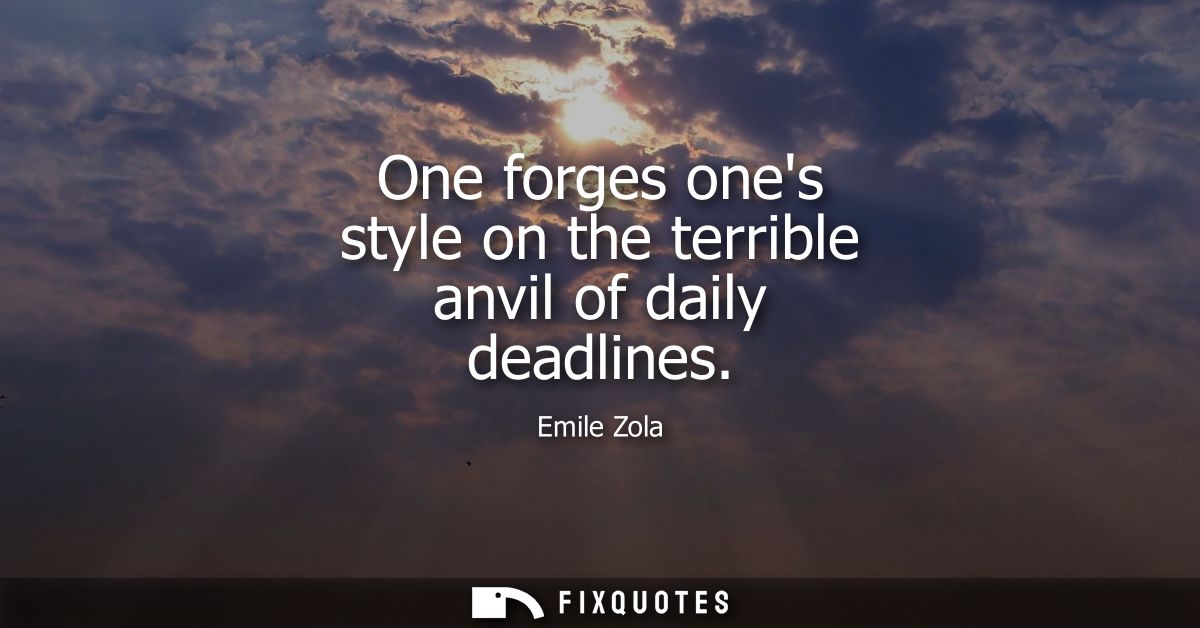
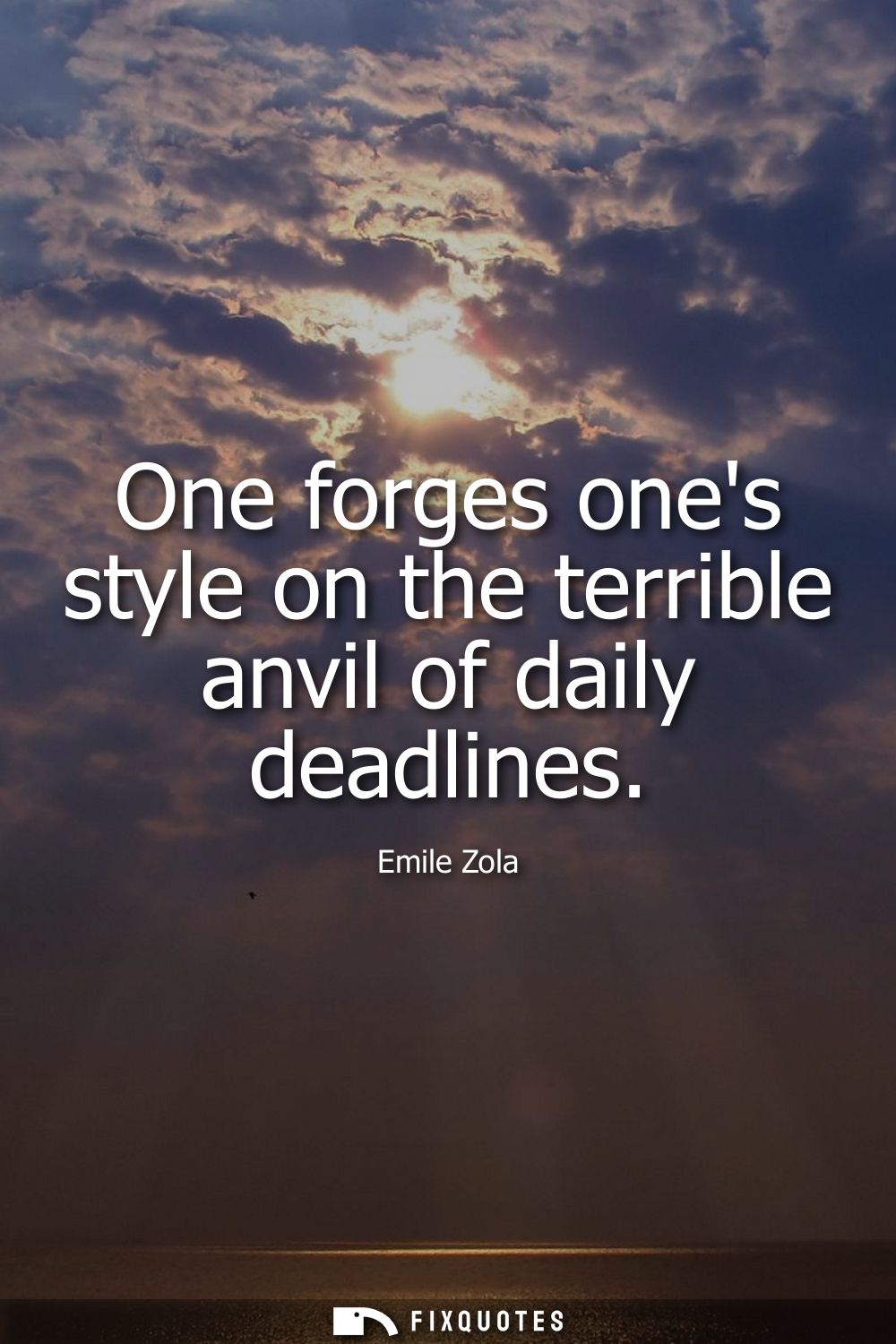
"One forges one's style on the terrible anvil of daily deadlines"
About this Quote
Style, Zola insists, is not a perfume dabbed on at the end; it is hammered into shape under pressure. The “terrible anvil” image drags literary craft out of the salon and into the workshop, where deadlines function like blows from a smith’s hammer: repetitive, unforgiving, and cumulative. The verb “forges” matters. It implies heat, resistance, and deformation - that your raw impulses and fine theories don’t survive contact with the day’s demand to produce sentences that work.
Zola’s intent is partly anti-romantic. He’s puncturing the fantasy of inspiration as a rare lightning strike and replacing it with something closer to industrial discipline. That fits his Naturalist project: art as labor, the writer as observer and technician, accountable to reality and routine. The line also carries a quiet ethics. Deadlines are “terrible” because they humiliate the ego; they force decisions. You can’t indulge infinite revision or hide behind taste. You learn what you actually do when time won’t let you do everything.
The subtext is a kind of professional solidarity with working writers - journalists, feuilletonists, serial novelists - who must ship on schedule. In Zola’s 19th-century media ecosystem, publication rhythms and editorial timetables weren’t peripheral; they shaped literature’s very texture. The context makes the metaphor sharper: modernity’s clock doesn’t merely constrain art, it manufactures it. Under daily pressure, style stops being a personality trait and becomes a survival skill.
Zola’s intent is partly anti-romantic. He’s puncturing the fantasy of inspiration as a rare lightning strike and replacing it with something closer to industrial discipline. That fits his Naturalist project: art as labor, the writer as observer and technician, accountable to reality and routine. The line also carries a quiet ethics. Deadlines are “terrible” because they humiliate the ego; they force decisions. You can’t indulge infinite revision or hide behind taste. You learn what you actually do when time won’t let you do everything.
The subtext is a kind of professional solidarity with working writers - journalists, feuilletonists, serial novelists - who must ship on schedule. In Zola’s 19th-century media ecosystem, publication rhythms and editorial timetables weren’t peripheral; they shaped literature’s very texture. The context makes the metaphor sharper: modernity’s clock doesn’t merely constrain art, it manufactures it. Under daily pressure, style stops being a personality trait and becomes a survival skill.
Quote Details
| Topic | Writing |
|---|---|
| Source | Help us find the source |
| Cite | Cite this Quote |
Citation Formats
APA Style (7th ed.)
Zola, Emile. (n.d.). One forges one's style on the terrible anvil of daily deadlines. FixQuotes. https://fixquotes.com/quotes/one-forges-ones-style-on-the-terrible-anvil-of-4211/
Chicago Style
Zola, Emile. "One forges one's style on the terrible anvil of daily deadlines." FixQuotes. Accessed February 2, 2026. https://fixquotes.com/quotes/one-forges-ones-style-on-the-terrible-anvil-of-4211/.
MLA Style (9th ed.)
"One forges one's style on the terrible anvil of daily deadlines." FixQuotes, https://fixquotes.com/quotes/one-forges-ones-style-on-the-terrible-anvil-of-4211/. Accessed 2 Feb. 2026.
More Quotes by Emile
Add to List