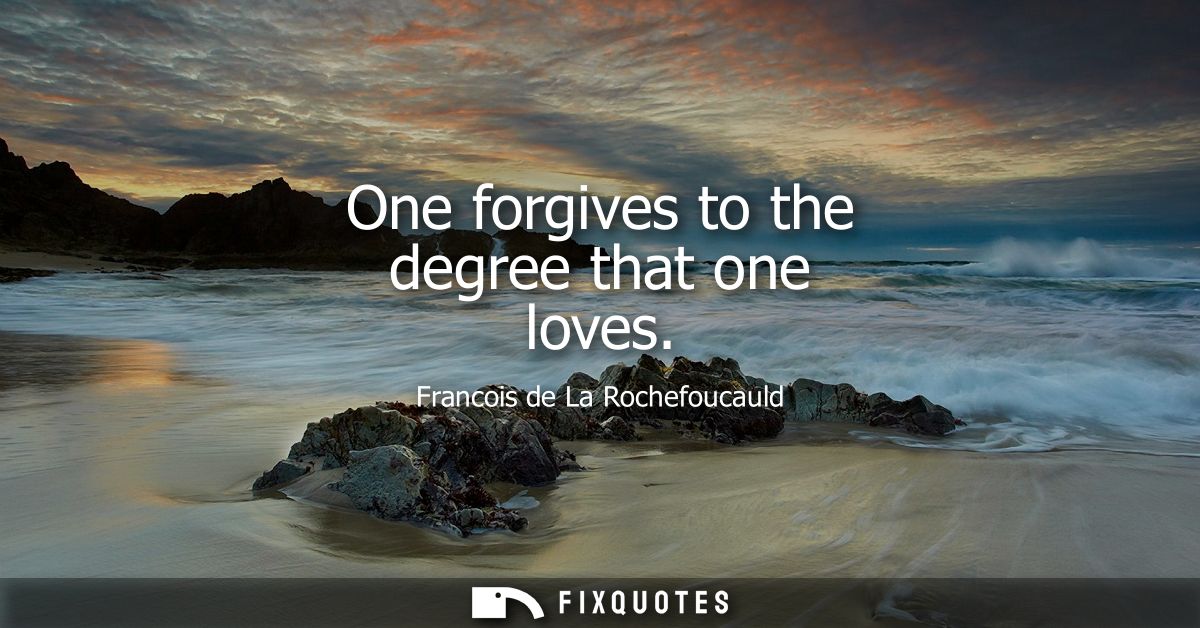
"One forgives to the degree that one loves"
About this Quote
Forgiveness, La Rochefoucauld implies, isn’t a moral achievement so much as a measurement: a gauge of attachment. The line has the clean, aristocratic chill he perfected in his maxims, where virtue is rarely pure and sentiment is rarely innocent. By tying forgiveness to love, he quietly demotes it from a lofty Christian ideal to a private economy of desire. We don’t forgive because it’s right; we forgive because we can’t bear the cost of losing someone, or the version of ourselves that loving them sustains.
The subtext is almost clinical. “To the degree” suggests calibration, not revelation. Forgiveness becomes incremental and conditional, meted out in proportion to investment. That phrasing also smuggles in a darker corollary: where love is thin, forgiveness will be stingy, and where love is absent, indignation can pose as principle. The maxim flatters no one. It tells the aggrieved that their “standards” may just be emotional distance; it tells the forgiving that their generosity may be dependency, nostalgia, or self-interest dressed up as grace.
Context matters: La Rochefoucauld wrote from the volatile ecosystem of 17th-century French court life, where alliances were intimate, betrayals routine, and reputations currency. In that world, forgiveness isn’t a halo; it’s a negotiation tactic, a way to keep the social fabric from tearing while still keeping score. The line works because it’s both romantic and unsentimental: it acknowledges love’s power, then immediately limits it, turning what sounds like tenderness into a quietly ruthless diagnostic of the heart.
The subtext is almost clinical. “To the degree” suggests calibration, not revelation. Forgiveness becomes incremental and conditional, meted out in proportion to investment. That phrasing also smuggles in a darker corollary: where love is thin, forgiveness will be stingy, and where love is absent, indignation can pose as principle. The maxim flatters no one. It tells the aggrieved that their “standards” may just be emotional distance; it tells the forgiving that their generosity may be dependency, nostalgia, or self-interest dressed up as grace.
Context matters: La Rochefoucauld wrote from the volatile ecosystem of 17th-century French court life, where alliances were intimate, betrayals routine, and reputations currency. In that world, forgiveness isn’t a halo; it’s a negotiation tactic, a way to keep the social fabric from tearing while still keeping score. The line works because it’s both romantic and unsentimental: it acknowledges love’s power, then immediately limits it, turning what sounds like tenderness into a quietly ruthless diagnostic of the heart.
Quote Details
| Topic | Forgiveness |
|---|---|
| Source | La Rochefoucauld, Francois de. Maximes (Maxims), 1665. Often quoted from the Maxims in French as "On pardonne à proportion qu'on aime" ("One forgives to the degree that one loves"). |
More Quotes by Francois
Add to List