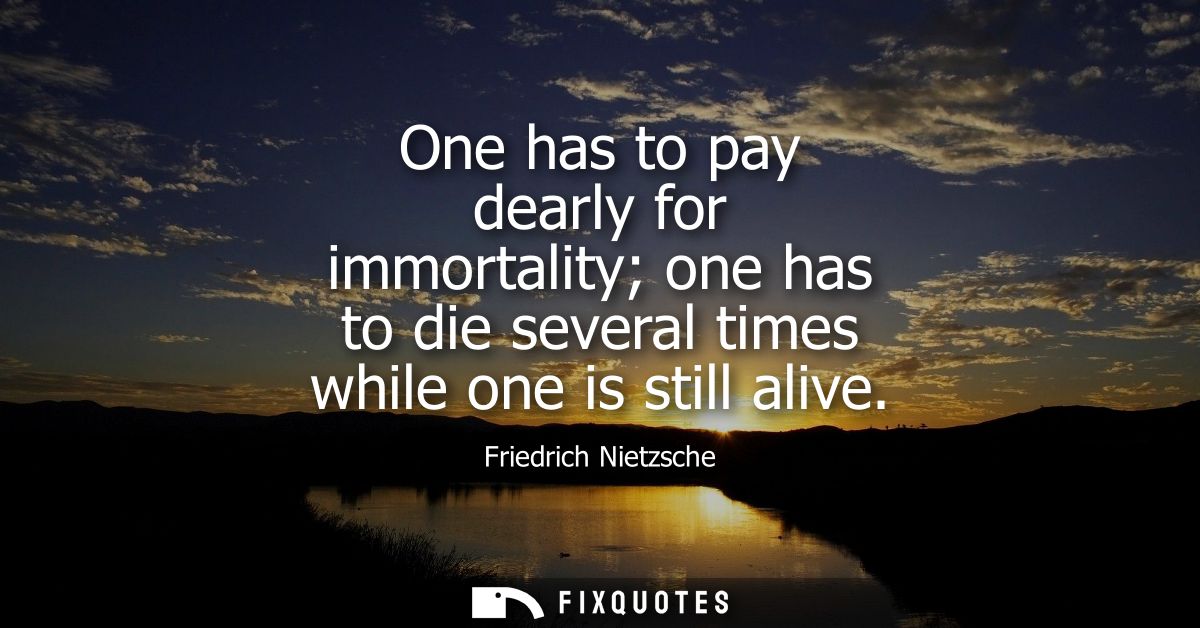
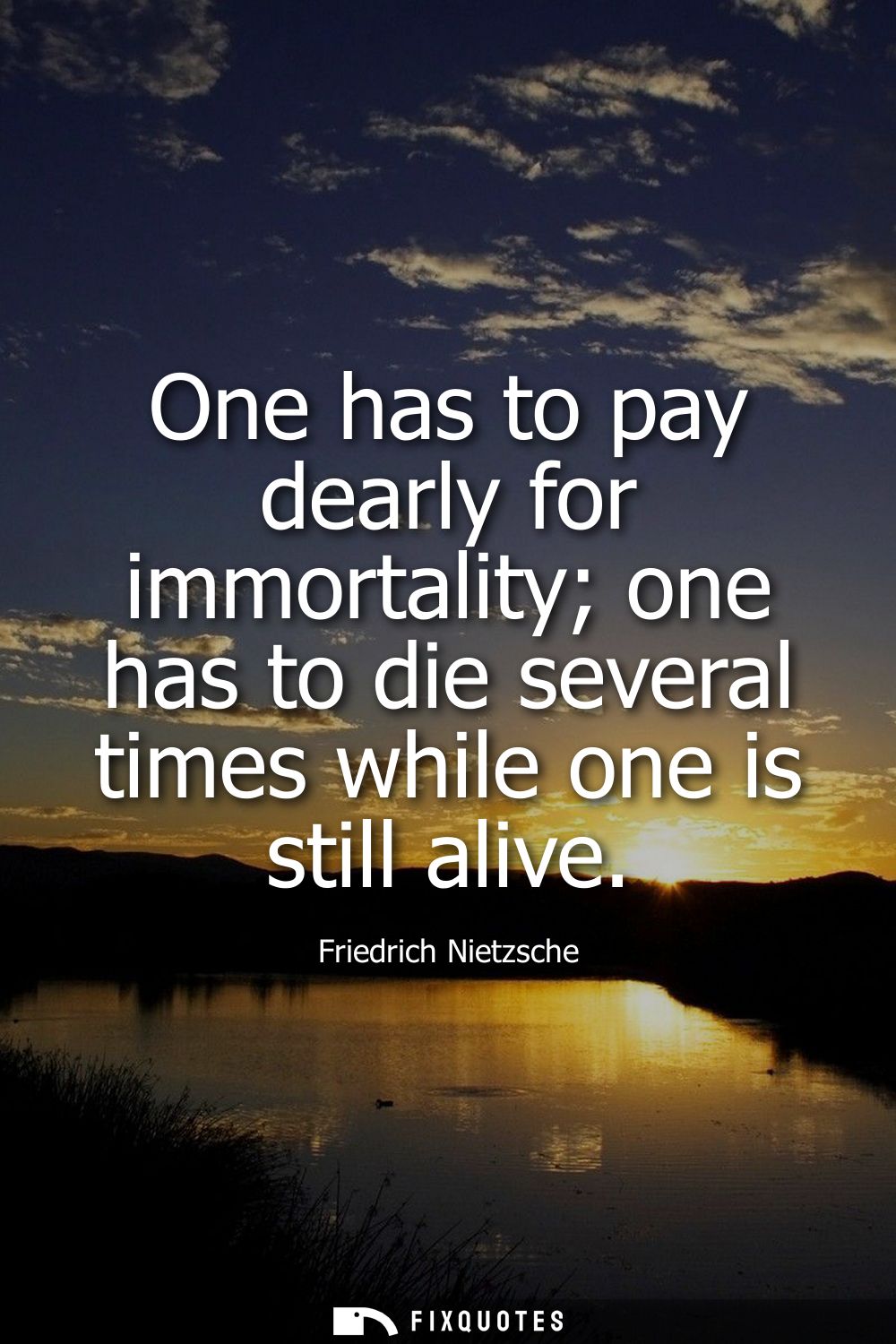
"One has to pay dearly for immortality; one has to die several times while one is still alive"
About this Quote
The subtext is his broader campaign against comfort. “Pay dearly” signals that lasting creation or influence requires ruthless self-editing: abandoning beloved beliefs, shedding identities that once secured status, letting old moral reflexes die. Those are the “several times” you die while breathing. It’s an attack on the fantasy of seamless growth, the TED-talk version of self-improvement. Nietzsche’s transformation is violent, not curated.
Context matters. He’s writing in a Europe where God is losing his job and the old metaphysical guarantees are collapsing. In that vacuum, “immortality” becomes a secular desire: legacy, cultural afterlife, becoming unignorable. Nietzsche knows how easily that desire curdles into vanity or ressentiment, so he sets a price that filters out the merely ambitious. Only those willing to suffer internal extinctions can “transvalue” the inherited moral order and produce something genuinely new.
There’s also autobiography humming underneath: the philosopher as exile, repeatedly cutting himself loose from academic respectability, friendships, even intellectual allegiances. Nietzsche isn’t romanticizing pain for its own sake; he’s insisting that any permanence worth having is forged through discontinuity. To endure, you must first learn how to disappear on purpose.
Quote Details
| Topic | Mortality |
|---|---|
| Source | Unverified source: Ecce Homo (Friedrich Nietzsche, 1888)
Evidence: A man pays dearly for being immortal: to this end he must die many times over during his life. (Chapter: "Thus Spake Zarathustra", section 5). This wording appears in the English translation hosted by Project Gutenberg, in Ecce Homo under the discussion of "Thus Spake Zarathustra" (section 5). Yo... Other candidates (1) Friedrich Nietzsche (Friedrich Nietzsche) compilation88.9% lebzeiten one must pay dearly for immortality one has to die several times while one is still alive 5 and nothing |
| Cite |
Citation Formats
APA Style (7th ed.)
Nietzsche, Friedrich. (2026, February 12). One has to pay dearly for immortality; one has to die several times while one is still alive. FixQuotes. https://fixquotes.com/quotes/one-has-to-pay-dearly-for-immortality-one-has-to-280/
Chicago Style
Nietzsche, Friedrich. "One has to pay dearly for immortality; one has to die several times while one is still alive." FixQuotes. February 12, 2026. https://fixquotes.com/quotes/one-has-to-pay-dearly-for-immortality-one-has-to-280/.
MLA Style (9th ed.)
"One has to pay dearly for immortality; one has to die several times while one is still alive." FixQuotes, 12 Feb. 2026, https://fixquotes.com/quotes/one-has-to-pay-dearly-for-immortality-one-has-to-280/. Accessed 31 Mar. 2026.