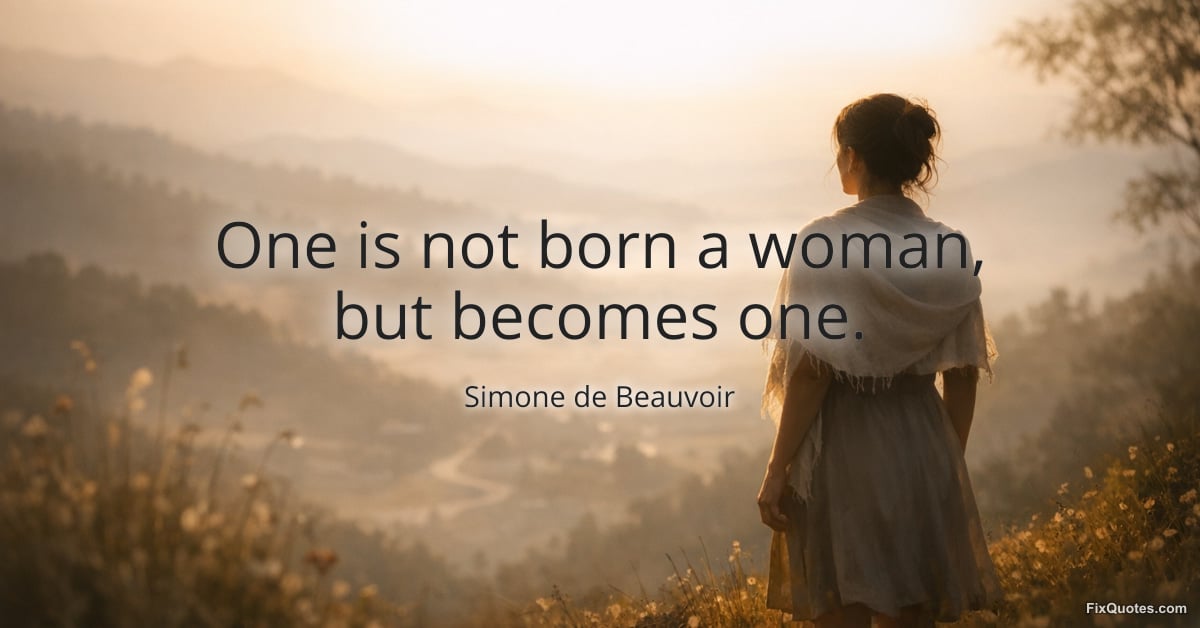
"One is not born a woman, but becomes one"
About this Quote
De Beauvoir’s line lands like a quiet demolition charge: it takes what’s treated as “natural” and reveals it as a project, imposed and policed over time. The phrasing matters. “Born” evokes biology, inevitability, a sealed fate. “Becomes” flips the frame to process - social training, repetition, reward and punishment - the slow manufacture of “woman” as a role. It’s not merely a claim about identity; it’s a diagnosis of power. If femininity is made, then someone is doing the making, and someone benefits from the final product.
Written in the aftermath of World War II and published in 1949 in The Second Sex, the sentence arrives when Europe is renegotiating citizenship, labor, and family life. Women had stepped into wartime work and public responsibility, only to be nudged back toward domestic “normalcy.” De Beauvoir’s target is that rollback masquerading as tradition: the idea that womanhood is destiny rather than design.
The subtext is existentialist and unsparing. For de Beauvoir, a person isn’t born with a ready-made essence; we are pushed into meanings by institutions, myths, and expectations. “Woman,” then, is not just a demographic category but a social position constructed as “the Other” - defined relative to man, kept in a state of managed dependence. The line endures because it doesn’t ask for sympathy; it demands a new accounting. If gender is something one becomes, it can also be unlearned, resisted, remade.
Written in the aftermath of World War II and published in 1949 in The Second Sex, the sentence arrives when Europe is renegotiating citizenship, labor, and family life. Women had stepped into wartime work and public responsibility, only to be nudged back toward domestic “normalcy.” De Beauvoir’s target is that rollback masquerading as tradition: the idea that womanhood is destiny rather than design.
The subtext is existentialist and unsparing. For de Beauvoir, a person isn’t born with a ready-made essence; we are pushed into meanings by institutions, myths, and expectations. “Woman,” then, is not just a demographic category but a social position constructed as “the Other” - defined relative to man, kept in a state of managed dependence. The line endures because it doesn’t ask for sympathy; it demands a new accounting. If gender is something one becomes, it can also be unlearned, resisted, remade.
Quote Details
| Topic | Equality |
|---|---|
| Source | Verified source: Le Deuxième Sexe (tome II : L’expérience vécue) (Simone de Beauvoir, 1949)
Evidence: On ne naît pas femme, on le devient. (Tome II, Première partie « Formation », Chapitre I « Enfance » (often paginated as p. 13 in the 1976 Folio essais reprint; page varies by edition)). This sentence is Beauvoir’s original French wording and is widely identified as the opening line of Tome II (L’expérience vécue), in the section on girls’ formation/childhood (“Formation” → “Enfance”). The commonly-circulated English version “One is not born a woman, but becomes one” is a shortened/modernized rendering; a well-known earlier English translation is “One is not born, but rather becomes, a woman.” (H. M. Parshley, 1953). The earliest publication of the idea in Beauvoir’s own work is the 1949 French publication of Le Deuxième Sexe (Gallimard). Other candidates (1) Contemporary Literary And Cultural Theory: From Structura... (Nayar, 2010) compilation95.0% ... Simone de Beauvoir . SIMONE DE BEAUVOIR AND EXISTENTIAL FEMINISM De Beauvoir's status as a feminist has always be... |
| Cite |
Citation Formats
APA Style (7th ed.)
Beauvoir, Simone de. (2026, March 19). One is not born a woman, but becomes one. FixQuotes. https://fixquotes.com/quotes/one-is-not-born-a-woman-but-becomes-one-22530/
Chicago Style
Beauvoir, Simone de. "One is not born a woman, but becomes one." FixQuotes. March 19, 2026. https://fixquotes.com/quotes/one-is-not-born-a-woman-but-becomes-one-22530/.
MLA Style (9th ed.)
"One is not born a woman, but becomes one." FixQuotes, 19 Mar. 2026, https://fixquotes.com/quotes/one-is-not-born-a-woman-but-becomes-one-22530/. Accessed 3 Apr. 2026.
More Quotes by Simone
Add to List