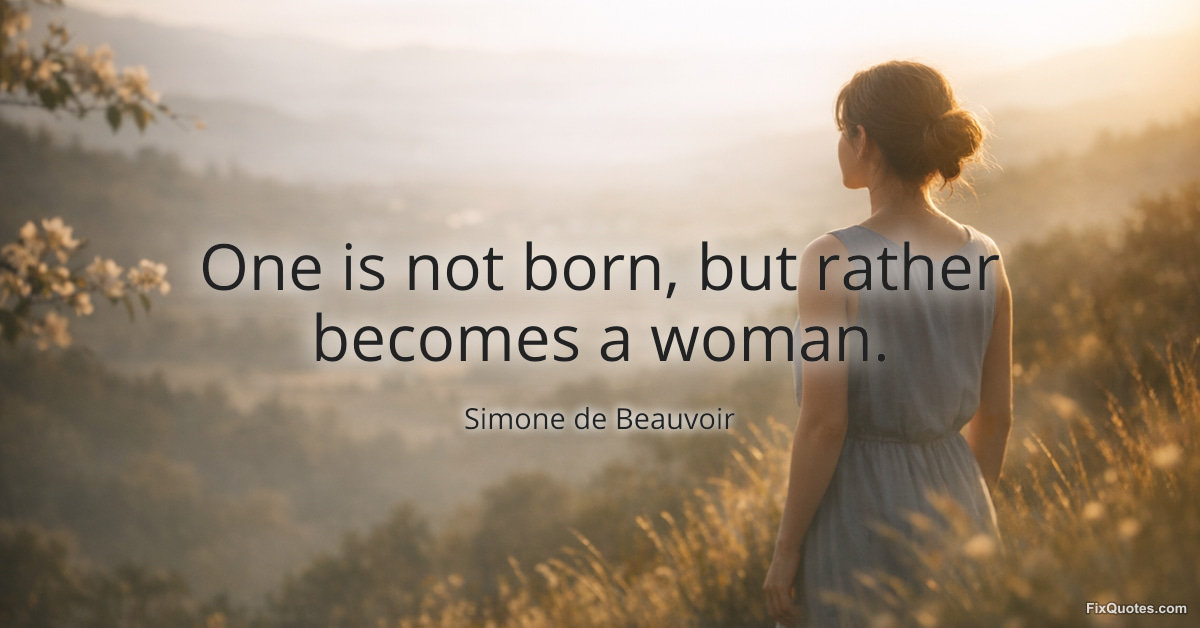
"One is not born, but rather becomes a woman"
About this Quote
A single sentence that detonates the comforting myth of “nature” and leaves behind the machinery of culture. When Simone de Beauvoir writes, “One is not born, but rather becomes, a woman,” she’s not offering a motivational aphorism; she’s filing a philosophical indictment. The line turns “woman” from a biological fact into a social project, something manufactured through training, punishment, reward, and repetition. Its power is grammatical as much as political: “becomes” implies process, time, coercion, and contingency. If you can become it, it can be unmade.
The specific intent in The Second Sex (1949) is to sever femininity from destiny. Postwar France was busy reinstalling traditional gender roles under the glow of reconstruction: men as citizens and workers, women as wives, mothers, symbols of stability. Beauvoir, working in the wake of existentialism, rejects the idea that essence precedes existence. “Woman” is not an essence waiting in the body; it’s a status conferred by a world organized around male normativity.
The subtext cuts sharper: patriarchy doesn’t merely exclude women from full subjecthood; it scripts them into “the Other,” a category defined in relation to men rather than on its own terms. The sentence also anticipates later debates about gender as performance, without reducing life to costume. Becoming is not playacting; it’s socialization with consequences, from economic dependency to sexual expectation to the internal policing of desire.
That’s why it still lands. It doesn’t ask for sympathy. It demands we notice the factory.
The specific intent in The Second Sex (1949) is to sever femininity from destiny. Postwar France was busy reinstalling traditional gender roles under the glow of reconstruction: men as citizens and workers, women as wives, mothers, symbols of stability. Beauvoir, working in the wake of existentialism, rejects the idea that essence precedes existence. “Woman” is not an essence waiting in the body; it’s a status conferred by a world organized around male normativity.
The subtext cuts sharper: patriarchy doesn’t merely exclude women from full subjecthood; it scripts them into “the Other,” a category defined in relation to men rather than on its own terms. The sentence also anticipates later debates about gender as performance, without reducing life to costume. Becoming is not playacting; it’s socialization with consequences, from economic dependency to sexual expectation to the internal policing of desire.
That’s why it still lands. It doesn’t ask for sympathy. It demands we notice the factory.
Quote Details
| Topic | Equality |
|---|---|
| Source | Verified source: Le Deuxième Sexe (tome II : L’expérience vécue) (Simone de Beauvoir, 1949)
Evidence: On ne naît pas femme : on le devient. (Tome II, 1re partie « Formation », chap. I « Enfance » (opening sentence; page varies by edition)). Primary/original formulation is in Simone de Beauvoir’s 1949 book Le Deuxième Sexe, specifically at the start of Volume/Tome II (L’expérience vécue), in the section on formation/childhood. The common English version (“One is not born, but rather becomes, a woman”) is from H. M. Parshley’s 1953 English translation (first English publication), while a later unabridged translation (Borde & Malovany-Chevallier, 2010) renders it without the article (“becomes, woman”), which is widely debated. I could not, in open web sources available here, verify a scan of the 1949 Gallimard first edition page number; page numbers differ substantially across printings and reissues, so you should confirm against the exact French edition you’re citing (tome/part/chapter is the stable locator). Other candidates (1) Simone de Beauvoir's The Second Sex (Ruth Evans, 1998) compilation95.0% New Interdisciplinary Essays Ruth Evans. thanks to existentialism , and to Simone de Beauvoir's ' one is not born , b... |
| Cite |
Citation Formats
APA Style (7th ed.)
Beauvoir, Simone de. (2026, March 19). One is not born, but rather becomes a woman. FixQuotes. https://fixquotes.com/quotes/one-is-not-born-but-rather-becomes-a-woman-22531/
Chicago Style
Beauvoir, Simone de. "One is not born, but rather becomes a woman." FixQuotes. March 19, 2026. https://fixquotes.com/quotes/one-is-not-born-but-rather-becomes-a-woman-22531/.
MLA Style (9th ed.)
"One is not born, but rather becomes a woman." FixQuotes, 19 Mar. 2026, https://fixquotes.com/quotes/one-is-not-born-but-rather-becomes-a-woman-22531/. Accessed 21 Mar. 2026.
More Quotes by Simone
Add to List