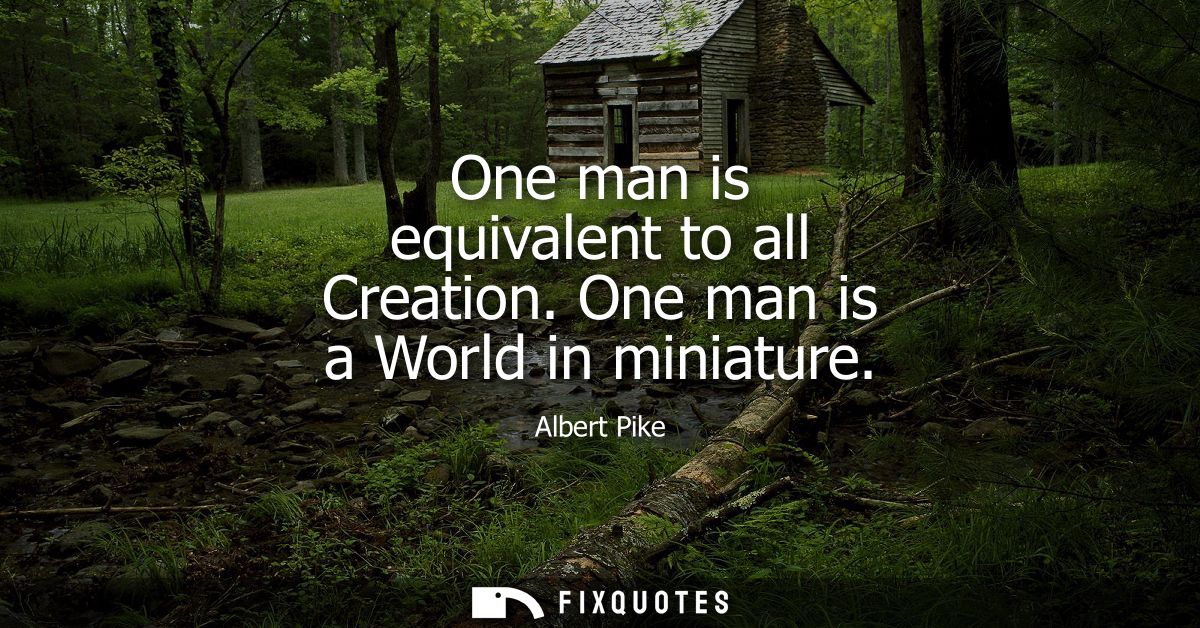
"One man is equivalent to all Creation. One man is a World in miniature"
About this Quote
The specific intent is to elevate moral agency. If one person contains, in miniature, the whole, then private choices are never merely private. Pike doesn’t need to invoke God, government, or society directly; the claim makes the individual a site where the cosmic and the civic converge. It’s a way to justify seriousness, discipline, initiation, and hierarchy of knowledge without saying those words.
The subtext is also unmistakably 19th-century: faith in systems, in legibility, in the idea that reality is structured enough to be “equivalent” across scales. That confidence can feel grand or dangerous. If one man stands in for Creation, it’s easy to slide into the notion that the right kind of man - educated, initiated, “virtuous” - deserves disproportionate authority.
Context matters: Pike was a lawyer, a profession trained to make sweeping principles feel actionable. This is a brief for human significance written in the language of totalizing claims.
Quote Details
| Topic | Wisdom |
|---|---|
| Source | Help us find the source |
| Cite |
Citation Formats
APA Style (7th ed.)
Pike, Albert. (2026, January 15). One man is equivalent to all Creation. One man is a World in miniature. FixQuotes. https://fixquotes.com/quotes/one-man-is-equivalent-to-all-creation-one-man-is-74414/
Chicago Style
Pike, Albert. "One man is equivalent to all Creation. One man is a World in miniature." FixQuotes. January 15, 2026. https://fixquotes.com/quotes/one-man-is-equivalent-to-all-creation-one-man-is-74414/.
MLA Style (9th ed.)
"One man is equivalent to all Creation. One man is a World in miniature." FixQuotes, 15 Jan. 2026, https://fixquotes.com/quotes/one-man-is-equivalent-to-all-creation-one-man-is-74414/. Accessed 27 Mar. 2026.