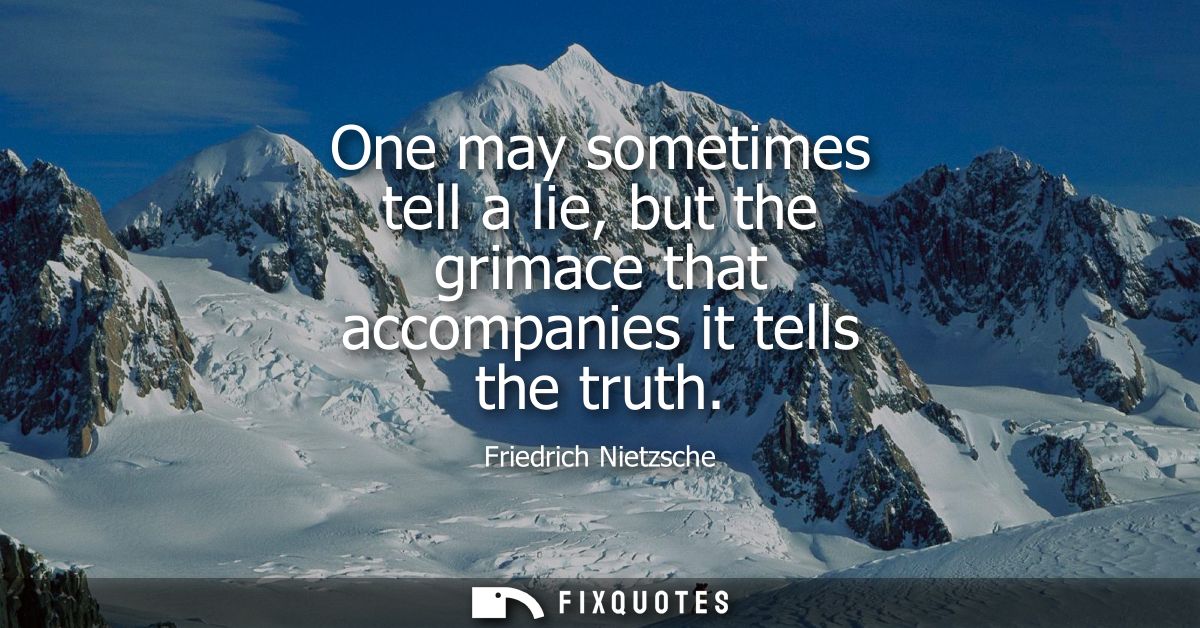
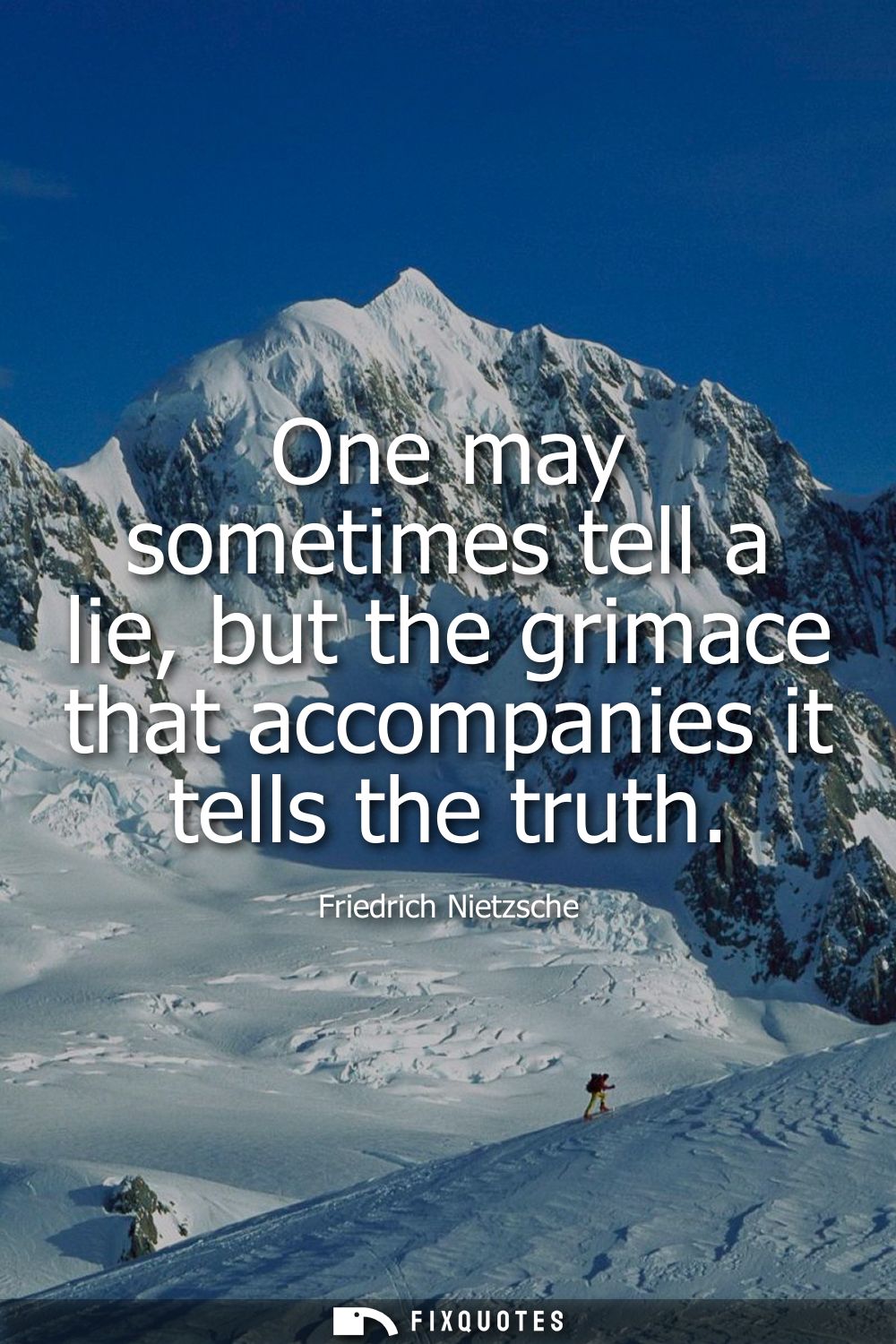
"One may sometimes tell a lie, but the grimace that accompanies it tells the truth"
About this Quote
The intent isn’t to defend some Hallmark idea of honesty. It’s to undercut the Enlightenment fantasy that humans are primarily rational, transparent selves who merely choose between truth and falsehood. Nietzsche’s target is the prestige of conscious narration. A lie is a strategy; the grimace is a symptom. He’s implying that what we call “truth” often arrives not as a proposition but as an affective signal: discomfort, strain, self-disgust, a flash of fear at being caught. That’s also why the line hits: it weaponizes embarrassment as epistemology.
The subtext is darker. Grimaces don’t only accompany deception; they can accompany obedience, moralizing, self-denial - all the little violences people perform on themselves to fit a code. In Nietzsche’s world, the face becomes a battleground between will and constraint. The body, less polite than the intellect, registers the cost.
Context matters: late-19th-century Europe is drenched in bourgeois propriety, Christian moral inheritance, and a growing faith in scientific objectivity. Nietzsche replies with suspicion. If we want the truth, he suggests, watch where the performance breaks - not just in speech, but in the muscles that can’t help reacting.
Quote Details
| Topic | Truth |
|---|---|
| Source | Unverified source: Beyond Good and Evil (Friedrich Nietzsche, 1886)
Evidence: Man lügt wohl mit dem Munde; aber mit dem Maule, das man dabei macht, sagt man doch noch die Wahrheit. (Aphorism 166 (part of the 'Maxims and Interludes' section)). This is the primary-source original German in Nietzsche’s Jenseits von Gut und Böse (Beyond Good and Evil), aphorism 166. The common... Other candidates (1) Humorous Wit (Djamel Ouis, 2020) compilation95.0% ... Friedrich Nietzsche One may sometimes tell a lie , but the grimace that accompanies it tells the truth . Friedric... |
| Cite |
Citation Formats
APA Style (7th ed.)
Nietzsche, Friedrich. (2026, February 18). One may sometimes tell a lie, but the grimace that accompanies it tells the truth. FixQuotes. https://fixquotes.com/quotes/one-may-sometimes-tell-a-lie-but-the-grimace-that-281/
Chicago Style
Nietzsche, Friedrich. "One may sometimes tell a lie, but the grimace that accompanies it tells the truth." FixQuotes. February 18, 2026. https://fixquotes.com/quotes/one-may-sometimes-tell-a-lie-but-the-grimace-that-281/.
MLA Style (9th ed.)
"One may sometimes tell a lie, but the grimace that accompanies it tells the truth." FixQuotes, 18 Feb. 2026, https://fixquotes.com/quotes/one-may-sometimes-tell-a-lie-but-the-grimace-that-281/. Accessed 7 Mar. 2026.