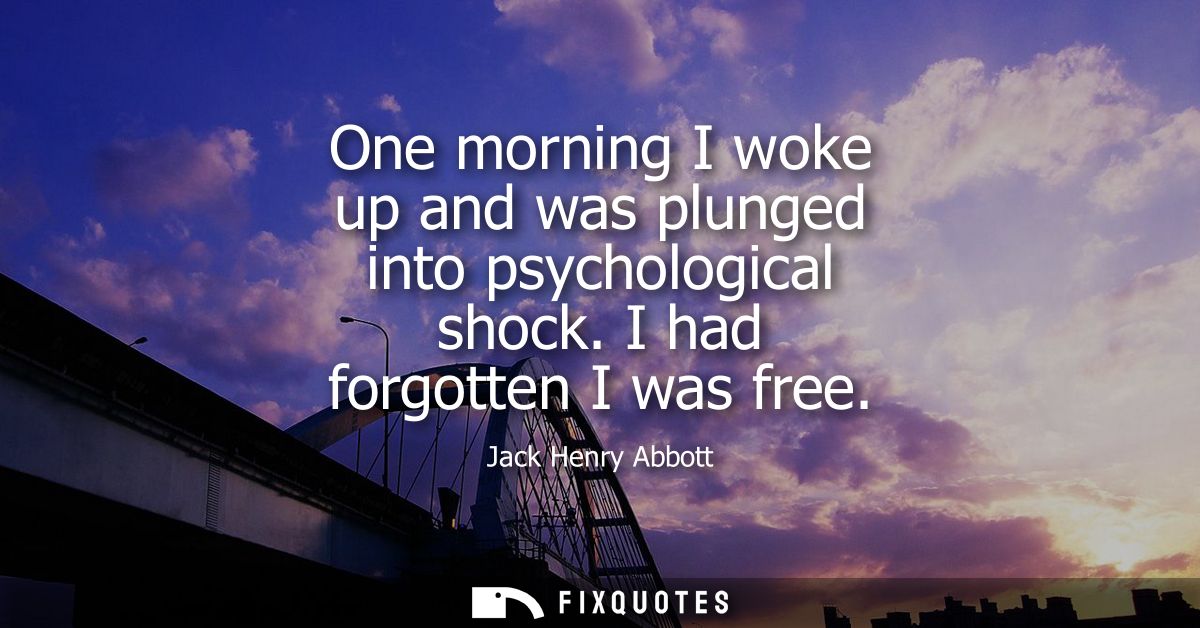
"One morning I woke up and was plunged into psychological shock. I had forgotten I was free"
About this Quote
Abbott’s specific intent is less confession than indictment. He’s describing what institutions do when they train a person’s nervous system around surveillance, routine, and threat. The most revealing phrase is “I had forgotten”: not “I didn’t know,” but “I used to know and it got erased.” Prison becomes a memory machine that overwrites ordinary autonomy. The subtext is that freedom is not a switch the state flips; it’s a skill, a social grammar, even a bodily rhythm. Take it away long enough and the return can be destabilizing, even terrifying.
Context matters because Abbott was not an inspirational case study in “rehabilitation.” He was a notorious, articulate prisoner whose letters drew literary attention and political romanticizing, and who later committed murder after release. That biography makes the quote feel like both warning and self-diagnosis: a glimpse of disorientation that can curdle into danger. It also punctures the clean story we like: that the punishment ends at the gate. Here, the gate is where the punishment mutates.
Quote Details
| Topic | Freedom |
|---|---|
| Source | Help us find the source |
| Cite |
Citation Formats
APA Style (7th ed.)
Abbott, Jack Henry. (2026, January 17). One morning I woke up and was plunged into psychological shock. I had forgotten I was free. FixQuotes. https://fixquotes.com/quotes/one-morning-i-woke-up-and-was-plunged-into-49123/
Chicago Style
Abbott, Jack Henry. "One morning I woke up and was plunged into psychological shock. I had forgotten I was free." FixQuotes. January 17, 2026. https://fixquotes.com/quotes/one-morning-i-woke-up-and-was-plunged-into-49123/.
MLA Style (9th ed.)
"One morning I woke up and was plunged into psychological shock. I had forgotten I was free." FixQuotes, 17 Jan. 2026, https://fixquotes.com/quotes/one-morning-i-woke-up-and-was-plunged-into-49123/. Accessed 13 Feb. 2026.