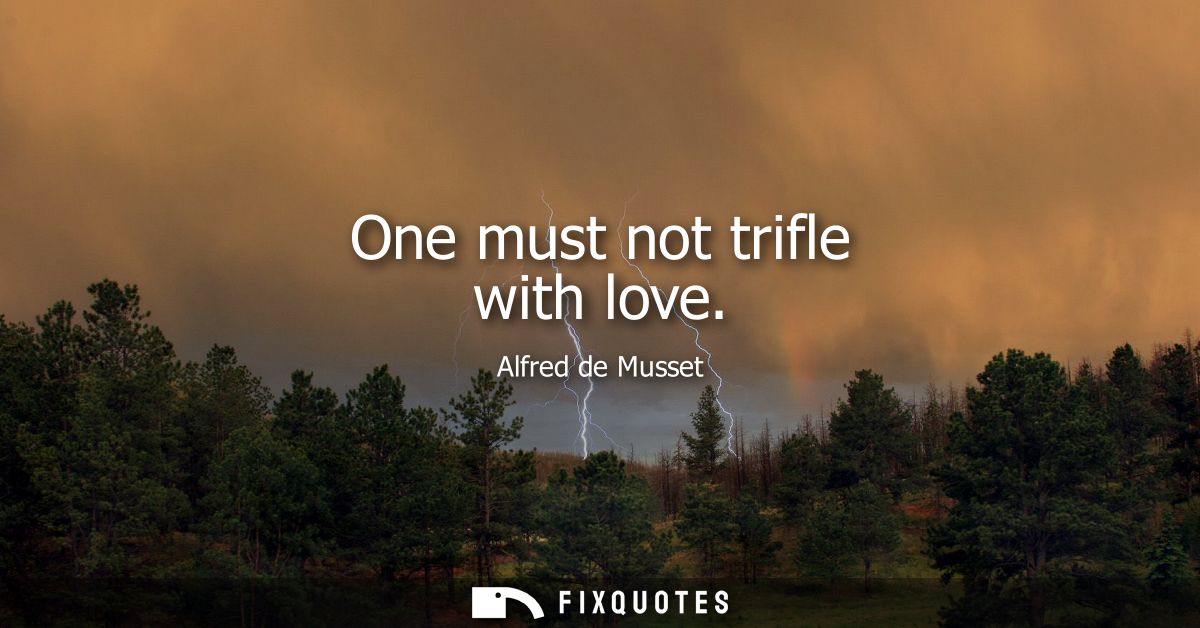
"One must not trifle with love"
About this Quote
A warning that sounds almost polite, then lands like a slap. "One must not trifle with love" is Musset in miniature: romantic idealism with a hangover, tenderness laced with consequence. The verb is the tell. To trifle is to treat something as a pastime, a flirtation, a game you can exit without paying the bill. Musset insists the bill always comes due.
The line carries the moral temperature of early 19th-century France, when love was being rebranded by the Romantics as a secular religion: private feeling elevated to destiny. But Musset isn’t preaching purity; he’s diagnosing damage. In his world, the most dangerous cruelty isn’t open malice but casualness: the half-promises, the performative jealousy, the testing of someone’s devotion for sport. The sentence reads like etiquette and functions like threat.
Subtext: love is not a soft space outside power. It is power. The moment you enter it, you’re handling someone else’s sense of self, their future, their dignity. Trifling becomes a kind of violence precisely because it masquerades as harmless. Musset, famously entangled in messy, public heartbreak (his affair with George Sand made emotional chaos into cultural spectacle), knew how easily passion curdles into theater.
The quote also has a sly self-indictment. "One must not" is impersonal, almost judicial, as if the speaker is trying to legislate against his own impulses. It’s less a romantic slogan than a hard-won rule from someone who’s already broken it.
The line carries the moral temperature of early 19th-century France, when love was being rebranded by the Romantics as a secular religion: private feeling elevated to destiny. But Musset isn’t preaching purity; he’s diagnosing damage. In his world, the most dangerous cruelty isn’t open malice but casualness: the half-promises, the performative jealousy, the testing of someone’s devotion for sport. The sentence reads like etiquette and functions like threat.
Subtext: love is not a soft space outside power. It is power. The moment you enter it, you’re handling someone else’s sense of self, their future, their dignity. Trifling becomes a kind of violence precisely because it masquerades as harmless. Musset, famously entangled in messy, public heartbreak (his affair with George Sand made emotional chaos into cultural spectacle), knew how easily passion curdles into theater.
The quote also has a sly self-indictment. "One must not" is impersonal, almost judicial, as if the speaker is trying to legislate against his own impulses. It’s less a romantic slogan than a hard-won rule from someone who’s already broken it.
Quote Details
| Topic | Love |
|---|---|
| Source | Verified source: On ne badine pas avec l’amour (Alfred de Musset, 1834)
Evidence: On ne badine pas avec l'amour. This is the original French wording (and also the title) of Alfred de Musset’s three-act prose play. The Bibliothèque nationale de France (BnF) authority record states the work date as 1834 and specifies: first edition/publication in the periodical "Revue des deux mondes" on 1 July 1834, with first stage performance much later on 18 November 1861 at the Comédie-Française. The English sentence “One must not trifle with love” is a common translation of the French title, not a separately identifiable first-printed English line. I could not access the Gallica scan of the 1834 periodical in this session (403), so I can’t supply the exact page number from the 1 July 1834 issue. Other candidates (1) Humorous Wit (Djamel Ouis, 2020) compilation95.0% ... One must not trifle with love. Alfred de Musset Love is a foolishness committed by two people. Napoleon Bonaparte... |
| Cite |
Citation Formats
APA Style (7th ed.)
Musset, Alfred de. (2026, February 24). One must not trifle with love. FixQuotes. https://fixquotes.com/quotes/one-must-not-trifle-with-love-57291/
Chicago Style
Musset, Alfred de. "One must not trifle with love." FixQuotes. February 24, 2026. https://fixquotes.com/quotes/one-must-not-trifle-with-love-57291/.
MLA Style (9th ed.)
"One must not trifle with love." FixQuotes, 24 Feb. 2026, https://fixquotes.com/quotes/one-must-not-trifle-with-love-57291/. Accessed 29 Mar. 2026.
More Quotes by Alfred
Add to List