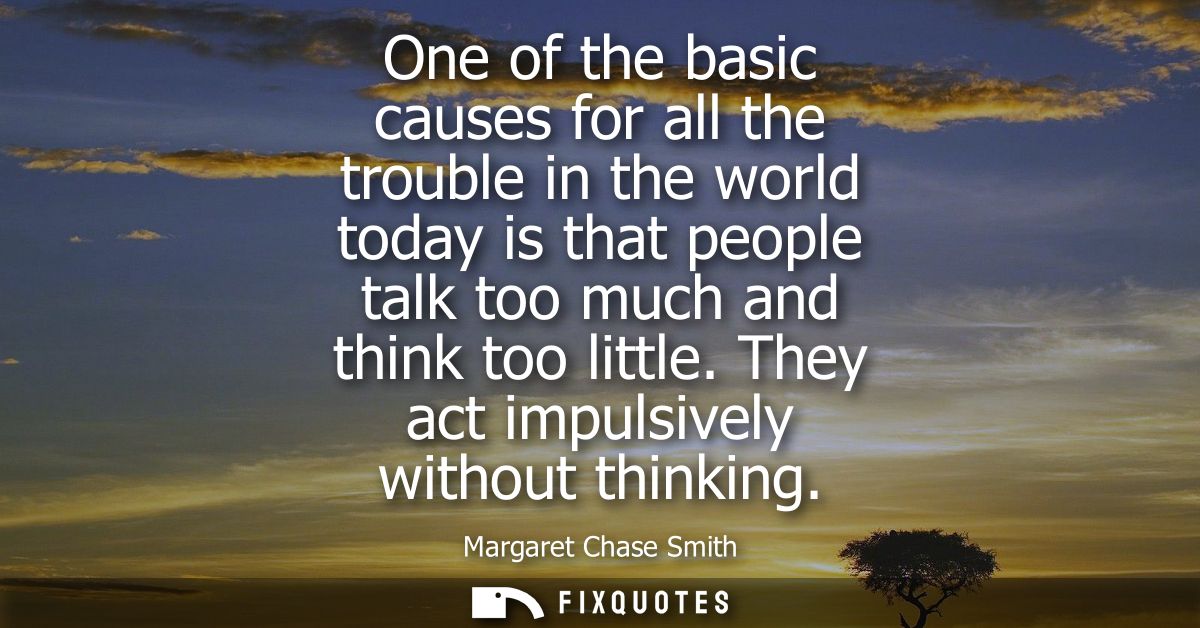
"One of the basic causes for all the trouble in the world today is that people talk too much and think too little. They act impulsively without thinking"
About this Quote
The subtext is a rebuke to the politics of impulse: the crowd that demands instant certainty, the lawmaker who chases headlines, the institution that confuses reaction with leadership. “Talk too much” isn’t just gossip; it’s the constant churn of accusations, slogans, and loyalty tests that make thinking feel like hesitation. “Think too little” is her real indictment: not a lack of intelligence, but a refusal to weigh consequences, check facts, or tolerate complexity. In that frame, “acting impulsively” becomes a civic hazard, not a personality quirk.
Context matters: Smith lived through world war, the dawn of mass broadcast media, and the Cold War’s paranoia engine. Her era discovered how fast fear can travel and how easily it can be weaponized. The quote works because it’s blunt and portable, a pocket-sized ethic for self-government: rights require restraint, speech requires responsibility, and leadership begins where reflex ends.
Quote Details
| Topic | Reason & Logic |
|---|---|
| Source | Help us find the source |
| Cite |
Citation Formats
APA Style (7th ed.)
Smith, Margaret Chase. (2026, January 15). One of the basic causes for all the trouble in the world today is that people talk too much and think too little. They act impulsively without thinking. FixQuotes. https://fixquotes.com/quotes/one-of-the-basic-causes-for-all-the-trouble-in-169027/
Chicago Style
Smith, Margaret Chase. "One of the basic causes for all the trouble in the world today is that people talk too much and think too little. They act impulsively without thinking." FixQuotes. January 15, 2026. https://fixquotes.com/quotes/one-of-the-basic-causes-for-all-the-trouble-in-169027/.
MLA Style (9th ed.)
"One of the basic causes for all the trouble in the world today is that people talk too much and think too little. They act impulsively without thinking." FixQuotes, 15 Jan. 2026, https://fixquotes.com/quotes/one-of-the-basic-causes-for-all-the-trouble-in-169027/. Accessed 30 Mar. 2026.