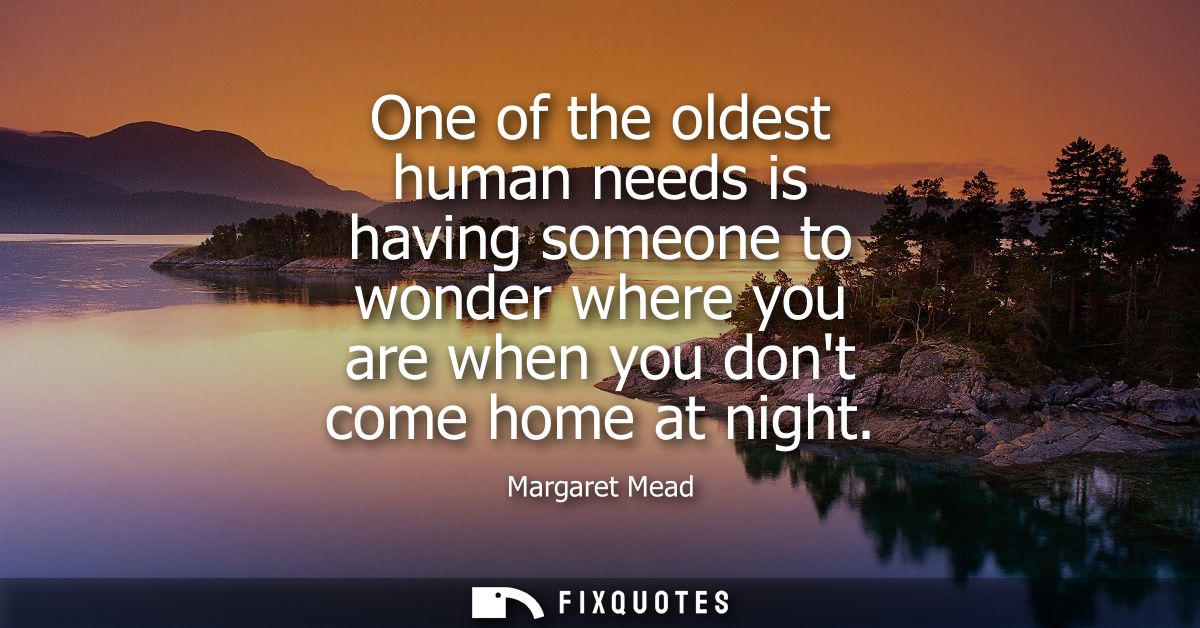
"One of the oldest human needs is having someone to wonder where you are when you don't come home at night"
About this Quote
The line’s subtext is quietly accusatory toward modern fantasies of self-sufficiency. “Wonder where you are” isn’t surveillance; it’s the humane version of accountability, the thin line between freedom and vanishing. Mead, an anthropologist, understood that cultures don’t just produce art and rituals; they produce systems of attention. In many small-scale societies she studied, social ties are not abstract emotions but practical networks: who checks on whom, who searches, who mourns, who remembers. To “not come home” is to risk becoming a story, or becoming nothing.
Context matters here: Mead wrote in a century that marketed autonomy while reorganizing life around mobility, urban anonymity, and fragmented households. Her sentence reads like a rebuttal to that drift. It’s also a compact ethic: the minimum promise a community owes its members is not constant closeness, but meaningful notice. The need she names is small enough to be achievable, and profound enough to be civilization.
Quote Details
| Topic | Love |
|---|---|
| Source | Help us find the source |
| Cite |
Citation Formats
APA Style (7th ed.)
Mead, Margaret. (2026, January 14). One of the oldest human needs is having someone to wonder where you are when you don't come home at night. FixQuotes. https://fixquotes.com/quotes/one-of-the-oldest-human-needs-is-having-someone-9081/
Chicago Style
Mead, Margaret. "One of the oldest human needs is having someone to wonder where you are when you don't come home at night." FixQuotes. January 14, 2026. https://fixquotes.com/quotes/one-of-the-oldest-human-needs-is-having-someone-9081/.
MLA Style (9th ed.)
"One of the oldest human needs is having someone to wonder where you are when you don't come home at night." FixQuotes, 14 Jan. 2026, https://fixquotes.com/quotes/one-of-the-oldest-human-needs-is-having-someone-9081/. Accessed 1 Apr. 2026.