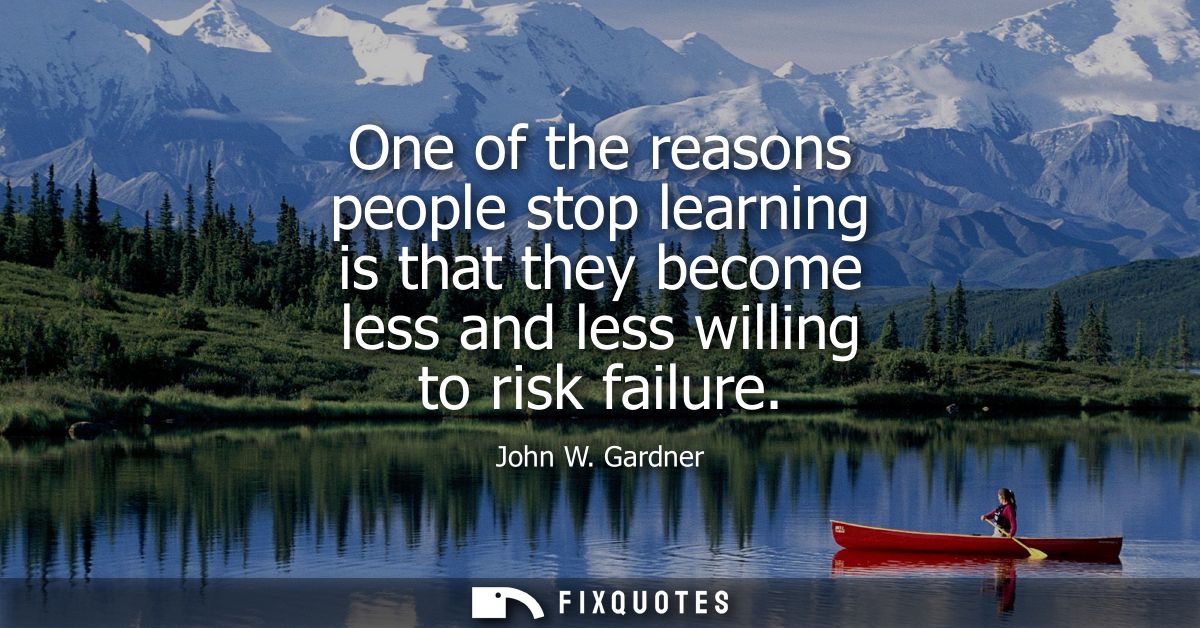
"One of the reasons people stop learning is that they become less and less willing to risk failure"
About this Quote
The subtext is about status. In childhood, failure is expected, even narratively useful. In adulthood, failure threatens the story you’re selling: competent worker, reliable parent, seasoned professional, “the kind of person who knows.” The more identity gets welded to expertise, the more costly it becomes to look like a beginner. Gardner’s phrasing “less and less willing” matters here; he’s describing a gradual tightening, not a sudden collapse. You don’t wake up uncurious. You just stop volunteering for situations where you might be publicly wrong.
Context sharpens the intent. Gardner spent his career arguing that personal renewal and civic renewal are inseparable: a society can’t adapt if its citizens and leaders are allergic to humiliation. Read against mid-century American confidence and bureaucratic consolidation, the quote reads like a warning label for institutional life: organizations reward error-avoidance, then wonder why innovation stalls.
It works because it redefines failure as a psychological toll booth for learning. The question isn’t whether you’re smart enough to grow, but whether you can afford to look dumb long enough to do it.
Quote Details
| Topic | Learning from Mistakes |
|---|---|
| Source | Help us find the source |
| Cite |
Citation Formats
APA Style (7th ed.)
Gardner, John W. (2026, January 18). One of the reasons people stop learning is that they become less and less willing to risk failure. FixQuotes. https://fixquotes.com/quotes/one-of-the-reasons-people-stop-learning-is-that-5204/
Chicago Style
Gardner, John W. "One of the reasons people stop learning is that they become less and less willing to risk failure." FixQuotes. January 18, 2026. https://fixquotes.com/quotes/one-of-the-reasons-people-stop-learning-is-that-5204/.
MLA Style (9th ed.)
"One of the reasons people stop learning is that they become less and less willing to risk failure." FixQuotes, 18 Jan. 2026, https://fixquotes.com/quotes/one-of-the-reasons-people-stop-learning-is-that-5204/. Accessed 30 Mar. 2026.