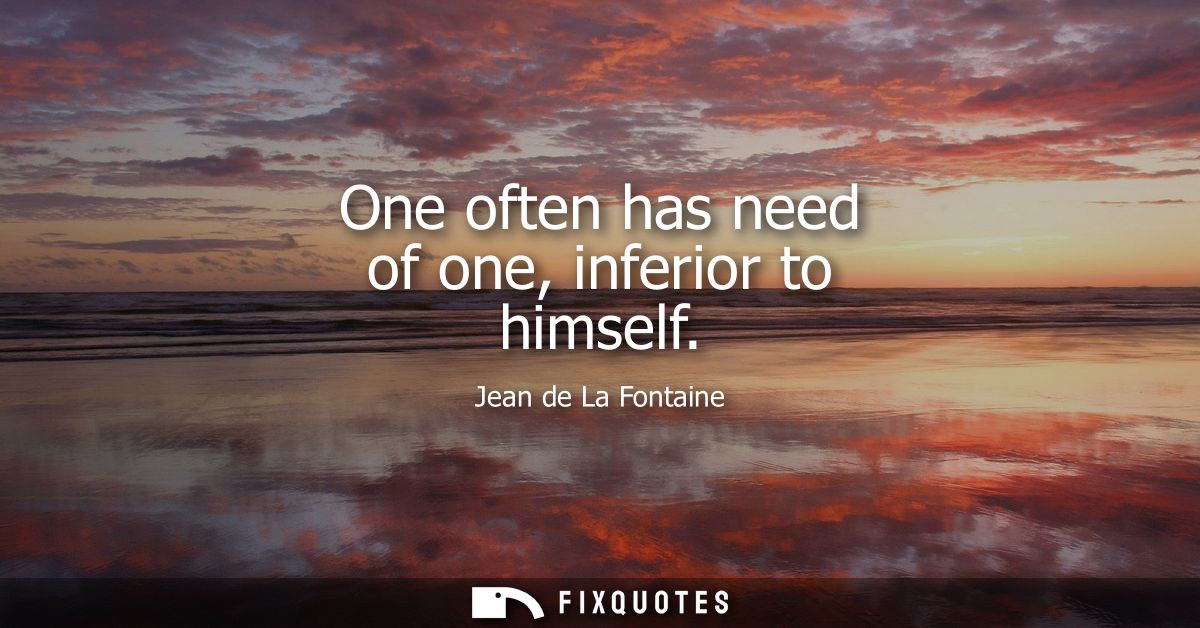
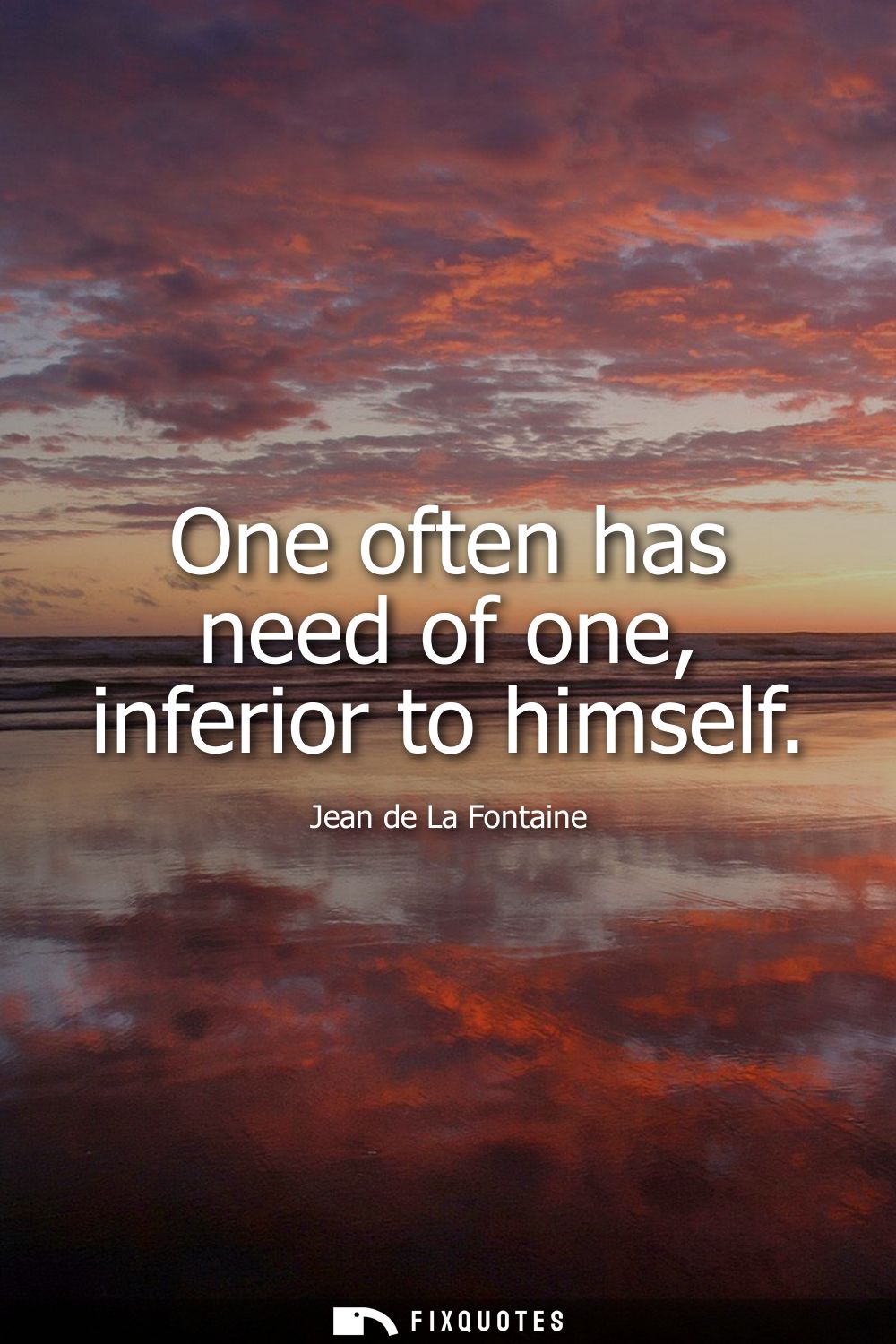
"One often has need of one, inferior to himself"
About this Quote
Dependency is the quiet punchline in La Fontaine's line: even the proudest self-image gets humbled by logistics. "One often has need of one, inferior to himself" isn’t a plea for charity; it’s a coolly observed social mechanism. The sentence is built like a maxim, but its real work is corrosive: it pries open hierarchy and shows the hidden seams where power relies on what it claims to surpass.
La Fontaine, writing in the orbit of Louis XIV’s court, knew a culture obsessed with rank, polish, and the performance of superiority. His fables regularly let animals and archetypes act out what polite society can’t admit. Here, the subtext is that superiority is not self-sufficiency. The "inferior" person is cast not as noble underdog but as functional necessity: the servant who makes grandeur possible, the minor official who actually knows the procedure, the artisan who repairs the wheel, the flatterer who oils the social machine. If you need them, your superiority becomes conditional.
The phrasing also exposes how "inferior" is less a fact than a label that protects status. La Fontaine doesn’t deny inequality; he sidesteps moralizing and goes straight for leverage. The line reminds the reader that reliance travels downward as often as orders travel up. In a world where dignity is guarded like property, admitting need is embarrassing. La Fontaine turns that embarrassment into insight: the hierarchy is real, but it’s never complete.
La Fontaine, writing in the orbit of Louis XIV’s court, knew a culture obsessed with rank, polish, and the performance of superiority. His fables regularly let animals and archetypes act out what polite society can’t admit. Here, the subtext is that superiority is not self-sufficiency. The "inferior" person is cast not as noble underdog but as functional necessity: the servant who makes grandeur possible, the minor official who actually knows the procedure, the artisan who repairs the wheel, the flatterer who oils the social machine. If you need them, your superiority becomes conditional.
The phrasing also exposes how "inferior" is less a fact than a label that protects status. La Fontaine doesn’t deny inequality; he sidesteps moralizing and goes straight for leverage. The line reminds the reader that reliance travels downward as often as orders travel up. In a world where dignity is guarded like property, admitting need is embarrassing. La Fontaine turns that embarrassment into insight: the hierarchy is real, but it’s never complete.
Quote Details
| Topic | Wisdom |
|---|---|
| Source | Jean de La Fontaine — Fable "Le Lion et le Rat" (Fables). Contains the original French line "On a souvent besoin d'un plus petit que soi", often rendered in English as the supplied quotation. |
| Cite |
Citation Formats
APA Style (7th ed.)
Fontaine, Jean de La. (2026, January 17). One often has need of one, inferior to himself. FixQuotes. https://fixquotes.com/quotes/one-often-has-need-of-one-inferior-to-himself-56884/
Chicago Style
Fontaine, Jean de La. "One often has need of one, inferior to himself." FixQuotes. January 17, 2026. https://fixquotes.com/quotes/one-often-has-need-of-one-inferior-to-himself-56884/.
MLA Style (9th ed.)
"One often has need of one, inferior to himself." FixQuotes, 17 Jan. 2026, https://fixquotes.com/quotes/one-often-has-need-of-one-inferior-to-himself-56884/. Accessed 3 Apr. 2026.
More Quotes by Jean
Add to List