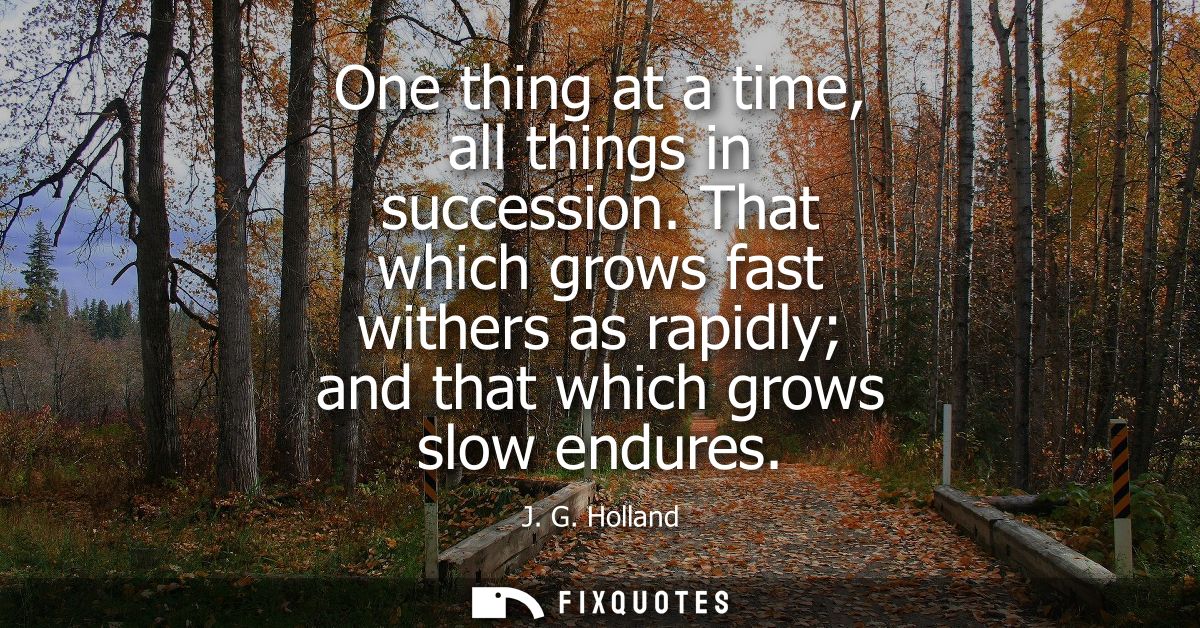
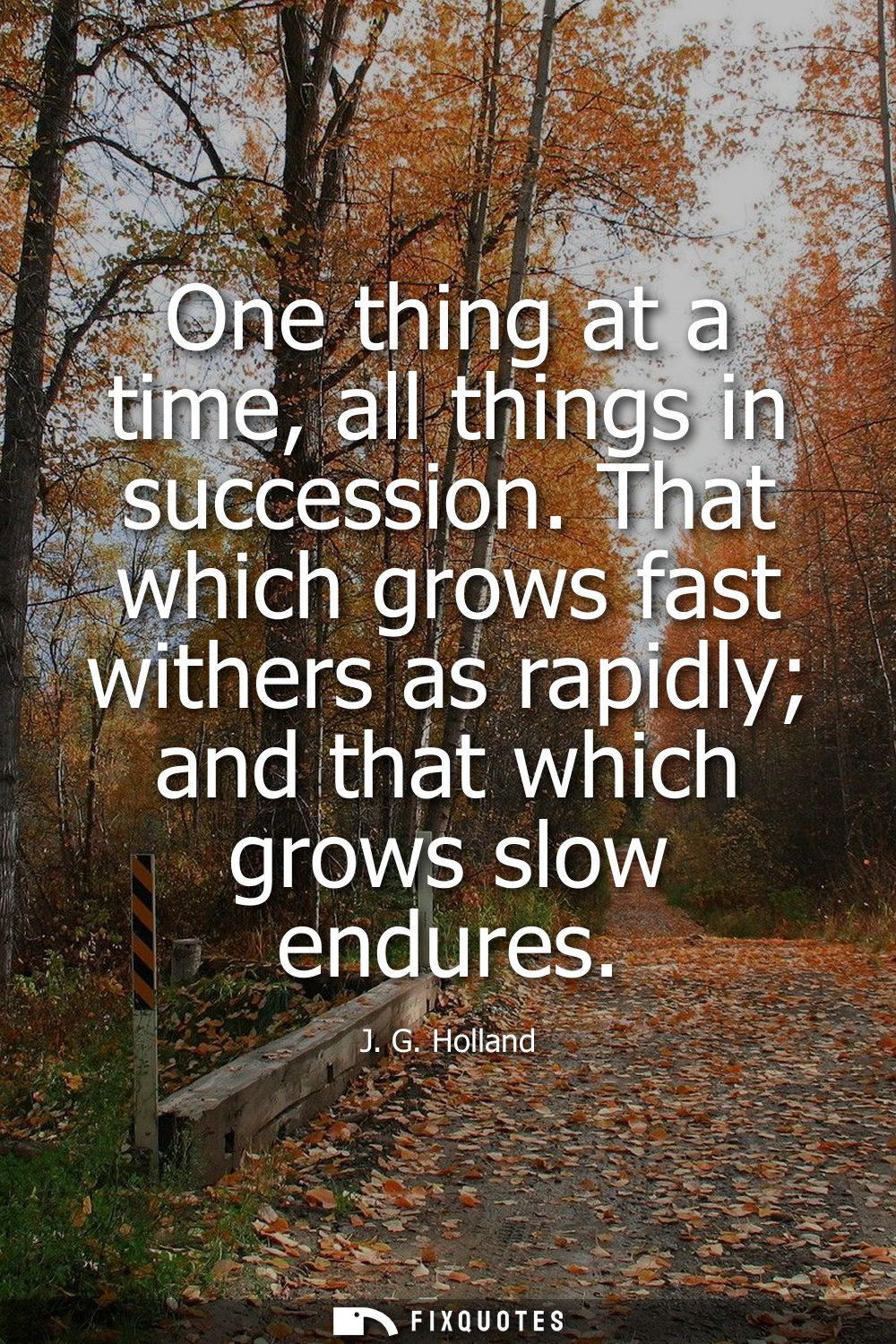
"One thing at a time, all things in succession. That which grows fast withers as rapidly; and that which grows slow endures"
About this Quote
The real bite is in the horticultural metaphor. “That which grows fast withers as rapidly” turns quick wins into a kind of botanical scam: lush on the surface, structurally flimsy underneath. Holland is quietly warning against the seduction of shortcuts, whether in character, craft, money, or public reputation. The slow-growing plant “endures” not because it’s prettier, but because it has roots. Endurance is presented as an engineering fact, not a moral prize.
Context matters here. Holland is writing in a 19th-century America intoxicated by expansion, industry, and the myth of the self-made climb. His sentence reads like a corrective to a culture that’s already learning what boom-and-bust feels like, economically and spiritually. For a novelist, “succession” also signals narrative sense: lives, like stories, become coherent when events earn each other. The subtext is almost stern: if you want something that lasts, build it slowly enough that it can survive you.
Quote Details
| Topic | Perseverance |
|---|---|
| Source | Help us find the source |
| Cite |
Citation Formats
APA Style (7th ed.)
Holland, J. G. (2026, January 16). One thing at a time, all things in succession. That which grows fast withers as rapidly; and that which grows slow endures. FixQuotes. https://fixquotes.com/quotes/one-thing-at-a-time-all-things-in-succession-that-132981/
Chicago Style
Holland, J. G. "One thing at a time, all things in succession. That which grows fast withers as rapidly; and that which grows slow endures." FixQuotes. January 16, 2026. https://fixquotes.com/quotes/one-thing-at-a-time-all-things-in-succession-that-132981/.
MLA Style (9th ed.)
"One thing at a time, all things in succession. That which grows fast withers as rapidly; and that which grows slow endures." FixQuotes, 16 Jan. 2026, https://fixquotes.com/quotes/one-thing-at-a-time-all-things-in-succession-that-132981/. Accessed 15 Mar. 2026.