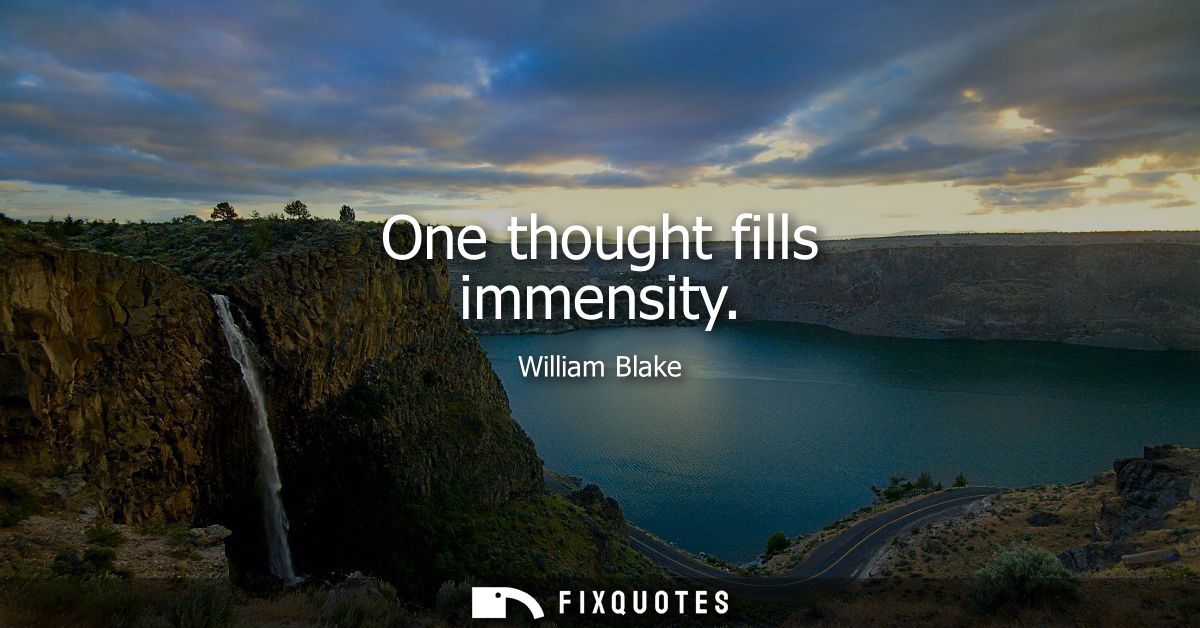
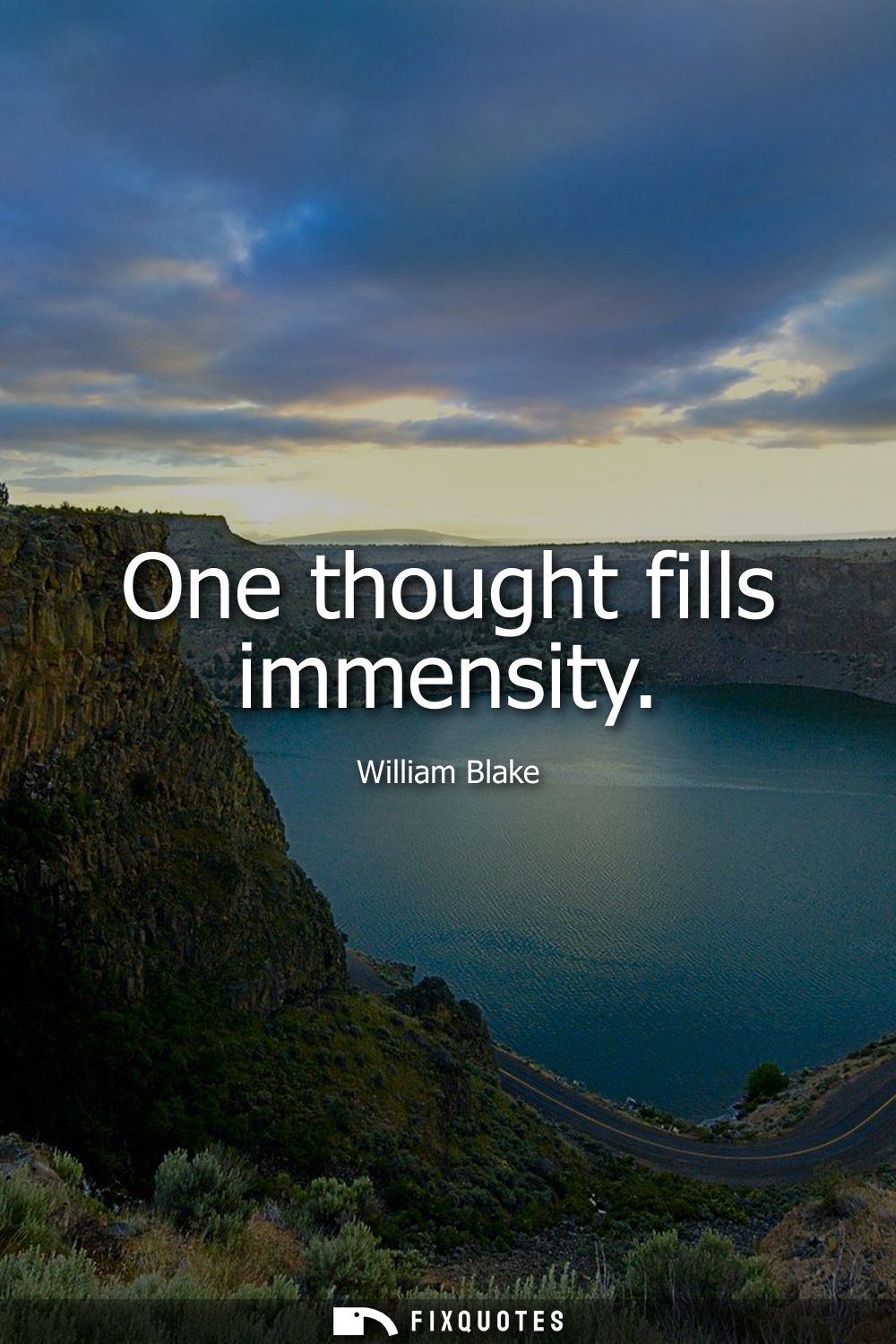
"One thought fills immensity"
About this Quote
A single line that behaves like a cosmology: not a metaphor about being “deep,” but a dare about scale. Blake’s “One thought fills immensity” compresses his entire project into six words, insisting that the mind isn’t a private room; it’s an engine that generates worlds. The phrasing is blunt, almost mathematical. “One” is doing the heavy lifting: not many thoughts accumulating into meaning, but one charged perception that suddenly makes the universe feel crowded.
The subtext is Blake’s war on Enlightenment-era “single vision,” the kind of rationalism that measures reality while missing it. He isn’t praising abstract contemplation; he’s elevating imaginative attention as a force that reorganizes what counts as real. In Blake’s universe, thought isn’t a shadow of experience but a creative act with physical consequence. Immensity, usually reserved for God, nature, or empire, becomes something consciousness can occupy. That’s both exhilarating and slightly menacing: if thought can fill immensity, it can also colonize it, turning the infinite into a mirror.
Context matters. Blake wrote against an England remade by industrial capitalism, mechanization, and bureaucratic religion - systems that shrank human life into units and rules. His answer wasn’t polite spirituality; it was visionary defiance. The line works because it refuses moderation. It takes the reader’s inner life seriously enough to make it cosmic, then leaves you with an uncomfortable implication: if your thought can fill immensity, you’re responsible for the kind of world it builds.
The subtext is Blake’s war on Enlightenment-era “single vision,” the kind of rationalism that measures reality while missing it. He isn’t praising abstract contemplation; he’s elevating imaginative attention as a force that reorganizes what counts as real. In Blake’s universe, thought isn’t a shadow of experience but a creative act with physical consequence. Immensity, usually reserved for God, nature, or empire, becomes something consciousness can occupy. That’s both exhilarating and slightly menacing: if thought can fill immensity, it can also colonize it, turning the infinite into a mirror.
Context matters. Blake wrote against an England remade by industrial capitalism, mechanization, and bureaucratic religion - systems that shrank human life into units and rules. His answer wasn’t polite spirituality; it was visionary defiance. The line works because it refuses moderation. It takes the reader’s inner life seriously enough to make it cosmic, then leaves you with an uncomfortable implication: if your thought can fill immensity, you’re responsible for the kind of world it builds.
Quote Details
| Topic | Poetry |
|---|---|
| Source | Help us find the source |
| Cite |
Citation Formats
APA Style (7th ed.)
Blake, William. (2026, January 18). One thought fills immensity. FixQuotes. https://fixquotes.com/quotes/one-thought-fills-immensity-16027/
Chicago Style
Blake, William. "One thought fills immensity." FixQuotes. January 18, 2026. https://fixquotes.com/quotes/one-thought-fills-immensity-16027/.
MLA Style (9th ed.)
"One thought fills immensity." FixQuotes, 18 Jan. 2026, https://fixquotes.com/quotes/one-thought-fills-immensity-16027/. Accessed 12 Feb. 2026.
More Quotes by William
Add to List