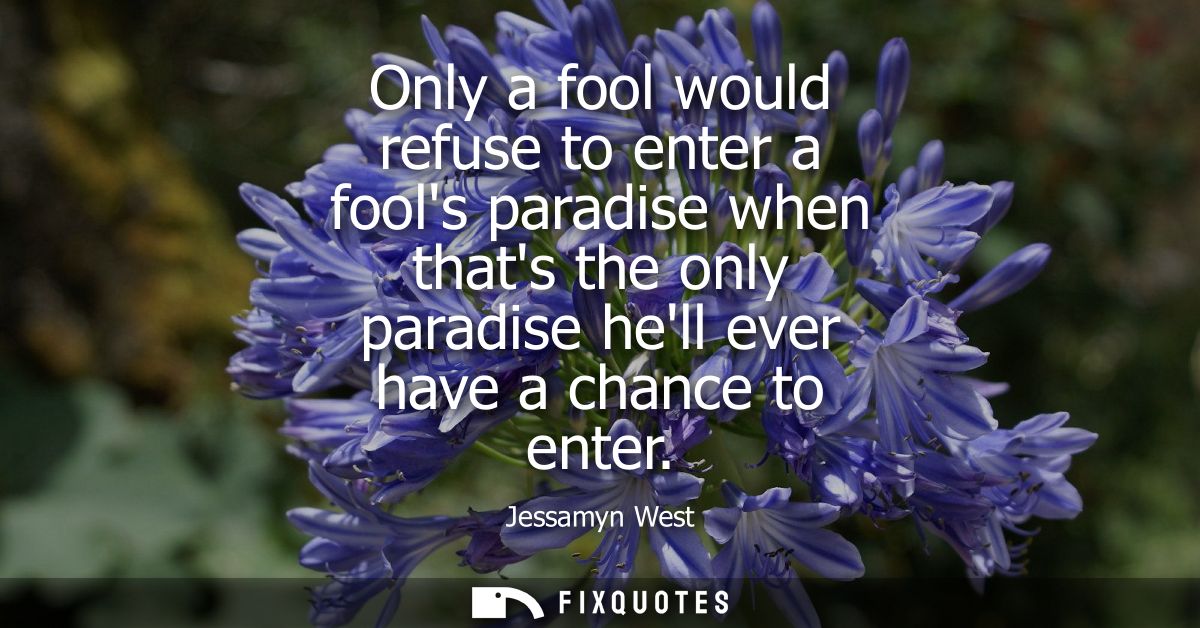
"Only a fool would refuse to enter a fool's paradise when that's the only paradise he'll ever have a chance to enter"
About this Quote
West’s line is a dare dressed up as pragmatism: if you’re offered a counterfeit heaven, she suggests, it may be the only heaven you’ll ever touch. The hook is the double use of “fool,” a word that usually ends the conversation. Here it becomes a trap door. Refusing “a fool’s paradise” is framed as the real foolishness, because purity tests are a luxury reserved for people who believe a better option is guaranteed.
The intent isn’t to celebrate delusion so much as to interrogate our hunger for certainty. “Only paradise he’ll ever have a chance to enter” carries the fatalism of someone who has watched good people negotiate with reality: soldiers, wives, workers, believers. West came of age through war and depression, decades when the promise of stable meaning looked thin. In that setting, the “paradise” might be romantic optimism, patriotic myth, religion, the American Dream, even the comforting story we tell ourselves about who we are. She isn’t saying those stories are true; she’s saying they function.
The subtext is brutally compassionate. West recognizes that humans live on partial illusions the way we live on partial information. The sentence also needles the reader: are you the kind of person who prides yourself on refusing the fake, even if the refusal leaves you with nothing? Or do you accept a flawed consolation and call it wisdom? The quote works because it weaponizes irony against moral vanity, then leaves you with an unsettling question: how much of your “clarity” is just a different kind of escape?
The intent isn’t to celebrate delusion so much as to interrogate our hunger for certainty. “Only paradise he’ll ever have a chance to enter” carries the fatalism of someone who has watched good people negotiate with reality: soldiers, wives, workers, believers. West came of age through war and depression, decades when the promise of stable meaning looked thin. In that setting, the “paradise” might be romantic optimism, patriotic myth, religion, the American Dream, even the comforting story we tell ourselves about who we are. She isn’t saying those stories are true; she’s saying they function.
The subtext is brutally compassionate. West recognizes that humans live on partial illusions the way we live on partial information. The sentence also needles the reader: are you the kind of person who prides yourself on refusing the fake, even if the refusal leaves you with nothing? Or do you accept a flawed consolation and call it wisdom? The quote works because it weaponizes irony against moral vanity, then leaves you with an unsettling question: how much of your “clarity” is just a different kind of escape?
Quote Details
| Topic | Wisdom |
|---|
More Quotes by Jessamyn
Add to List